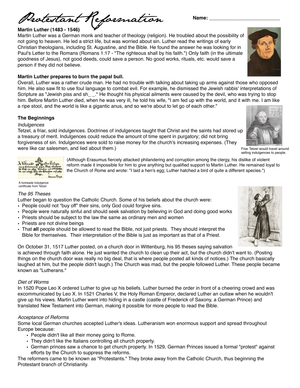
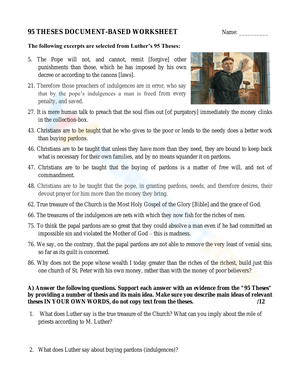
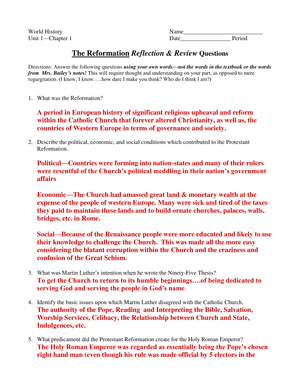
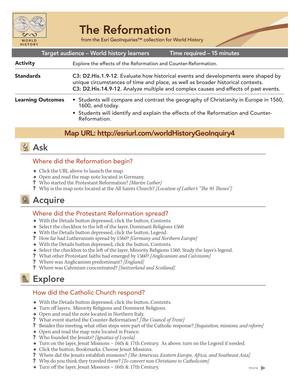
Teaching the Reformation means helping students see two things at once: how the Catholic Church and European society reacted to Martin Luther, and how those reactions reshaped the map and daily religious life. These responses and effects of the Protestant Reformation worksheets give you ready-to-use activities for that exact analytical jump, built for grades 6-10 world history.
What These Reformation Worksheets Cover
Each page is designed to work as a standalone station or as part of a full unit. You can assign the timeline as bell work, run the Council of Trent analysis as a small-group task, and save the cause-and-effect organizer for a summative check. The goal is analytical writing backed by specific evidence, not vocabulary recall.
Every prompt is written answer-first, so students state a claim in the first sentence and then support it. That structure mirrors how document-based questions are scored and gives you a fast way to spot who can defend a position versus who is still summarizing.
- Compare and contrast: Protestant reforms set against Catholic Counter-Reformation responses.
- Timeline building: from the 95 Theses in 1517 through the Council of Trent to the Thirty Years' War.
- Cause and effect: linking religious division to political and social change.
The Catholic Church's Counter-Reformation Response
When students ask what the Church actually did, the worksheets keep the answer concrete. The Counter-Reformation, usually dated from the Council of Trent in 1545 and running to roughly 1700, was the Catholic Church's organized answer to Protestant criticism. It combined doctrine, discipline, and new religious orders rather than a single decree.
One analysis page asks students to sort Church actions into three buckets: reaffirming doctrine, ending abuses, and expanding education and missions. That sorting task makes the response feel like a strategy students can evaluate, not a list to copy. It also sets up the comparison with Luther's original complaints about the sale of indulgences.
The worksheets also flag a common student misconception: that the Counter-Reformation was purely reactive. In practice, reform of the clergy and a push into new schools had roots before 1545, and a short margin note prompts students to notice that the Church was reforming and responding at the same time.
Inside the Council of Trent
The centerpiece primary-source activity focuses on the Council of Trent, which met intermittently between 1545 and 1563 in Trent, in northern Italy. Students work with paraphrased decisions and explain what each one rejected or reaffirmed, then argue how it answered a specific Protestant position.
According to World History Encyclopedia, the Council of Trent met across three sessions between 1545 and 1563 and reaffirmed all seven sacraments, rejecting Martin Luther's argument for only two. The council also condemned justification by faith alone and ordered new seminaries to train priests, directly answering Protestant charges of clerical corruption.
From there, students connect each ruling to a practical outcome: seminaries meant better-trained clergy, the end of indulgence abuses removed Luther's original spark, and the reaffirmed sacraments hardened the doctrinal line between the two camps.
Discussion and Writing Prompts
The set closes with prompts that turn analysis into argument. One asks students whether the Reformation or the Counter-Reformation did more to shape modern Europe, requiring evidence from both sides of the unit. Another asks them to take the position of a village priest in 1560 explaining the Council of Trent to a skeptical congregation.
These prompts work as exit tickets, homework, or a graded paragraph. Because each one names a specific year or event, students cannot answer in generalities, and you get writing you can assess for historical reasoning rather than opinion.
Classroom Implementation
Sequence matters with this topic. Start with the timeline so students have a shared chronology, then move to the Council of Trent analysis once they can place 1545 in context. Save the cause-and-effect organizer for after both, when students have enough content to trace consequences honestly.
- Bell work: the timeline builder, revisited across three days as new events are added.
- Small groups: the Council of Trent decisions, one ruling per group, shared out loud.
- Formative check: the cause-and-effect organizer with the religious, political, and social labels.
- Enrichment: a short writing prompt on how division reshaped European identity.
For intervention groups, shorten the primary-source language and give a word bank. For enrichment, ask students to add a counterargument that a Catholic reformer might have made in 1563. Both moves keep the same organizer while adjusting the reading load.
Frequently Asked Questions
1. What was the Catholic Church's main response to the Reformation?
The Counter-Reformation was the main response. Through the Council of Trent, the Church reaffirmed its doctrine, ended abuses like the sale of indulgences, trained clergy in new seminaries, and expanded education and missions through orders such as the Jesuits.
2. What did the Council of Trent actually decide?
Meeting between 1545 and 1563, the council reaffirmed seven sacraments, rejected justification by faith alone, condemned indulgence abuses, and required seminaries for priest training. Each decision answered a specific Protestant criticism, which the worksheets ask students to identify.
3. How did the Reformation affect everyday religious life?
Communities often became officially Catholic or Protestant, which changed worship, schooling, and local authority. The worksheets have students trace those social effects at the town level, not only the level of kings and councils.
4. What long-term political effects did the Reformation have?
Religious division hardened into political blocs and helped drive conflicts like the Thirty Years' War from 1618 to 1648. Students use the cause-and-effect organizer to connect the 1517 dispute to that later war.
5. What grade level and standards fit these worksheets?
They fit grades 6-10 world history units on the Reformation and Counter-Reformation. Because they center on causation, comparison, and primary-source reasoning, they align with the world history skills your course already targets for this era.