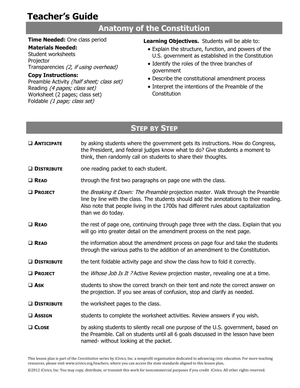
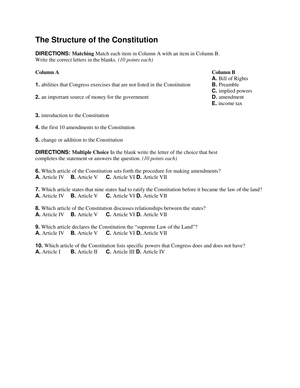
Anatomy of the Constitution Worksheets: A Teacher's Guide to Every Part
What "Anatomy of the Constitution" Worksheets Actually Teach
When you search for anatomy of the Constitution worksheets, you're usually after one thing: a printable that helps students take apart a dense founding document and see how its pieces fit together. These worksheets treat the Constitution like a labeled diagram. Students identify the Preamble, walk through the seven articles, and sort the 27 amendments into categories they can actually explain. For US social studies and civics teachers, that structure turns an intimidating text into a set of manageable parts students can point to and describe.
The goal isn't memorization for its own sake. A strong anatomy worksheet asks students to connect each section to a function: who makes laws, who enforces them, who interprets them, and how the whole thing can change over time. That functional lens is what separates a labeling exercise from real civic understanding. When you plan the activity around what each part does, students leave with a mental map they can reuse in every later lesson on government.
The Three Building Blocks: Preamble, Articles, and Amendments
Every anatomy-of-the-Constitution activity comes back to three parts. The Preamble is the 52-word introduction that opens with "We the People" and states the document's goals. The seven articles form the operating manual for the federal government. The 27 amendments record every formal change since ratification. When students can name and describe these three layers, they have the scaffolding they need for the deeper analysis that follows.
A good labeling worksheet moves students from surface identification to meaning. Instead of just marking where Article I begins, students explain that Article I creates Congress, Article II establishes the presidency, and Article III sets up the Supreme Court. Pairing the diagram with short primary-source excerpts keeps the reading grounded in the actual text, so students aren't just memorizing a chart someone else built for them.
Here's a detail that reshapes how students read the document: Article I, which lays out the legislative branch, is by far the longest section of the original Constitution. That length is a design choice, not an accident. The framers gave Congress the most detailed instructions because they expected the lawmaking branch to be the most active and the most in need of limits. Point students to the sheer proportion of text devoted to Congress and they start reading structure as argument—the document tells you what the framers worried about by how much space they spend on it.
Mapping Separation of Powers with Article-by-Article Organizers
The clearest payoff of anatomy worksheets is separation of powers. Articles I, II, and III map directly onto the legislative, executive, and judicial branches, so a three-column graphic organizer lets students record each branch's powers side by side. Add a fourth row for checks and balances and students can trace how each branch limits the others, from the veto to judicial review to the power of the purse.
This is where worksheets earn their place in a unit. A labeling page front-loads vocabulary, and the organizer that follows pushes students to compare and evaluate. By the end, students should be able to answer a scenario question—such as which branch would handle a given action—without flipping back to their notes. That transfer from recall to application is the real evidence that the anatomy lesson stuck.
Teaching the Amendment Process and the Bill of Rights
Article V is the part students often overlook, yet it explains how the Constitution stays a living document. It sets the process for adding amendments, requiring approval at both the national and state levels. That high bar is why only 27 amendments have passed in more than two centuries. An anatomy worksheet that includes Article V gives you a natural mini-lesson on how change happens by design rather than by accident, and it sets up the Bill of Rights as the first and most sweeping round of edits.
According to the National Constitution Center, the U.S. Constitution has been amended only 27 times since 1787. The first 10 amendments—the Bill of Rights—were ratified together in 1791, and fewer than two dozen changes have followed in the 230-plus years since, underscoring how deliberately difficult the amendment process is by design.
Pairing Worksheets with Founding-Document Primary Sources
A labeling worksheet does more when it sits next to the real text. The National Archives keeps the original Constitution on public display and publishes clean transcriptions of the founding documents, so you can hand students a short excerpt of the Preamble or Article I and have them match the language to the parts they just labeled. Reading even one paragraph of the actual document changes the tone of the lesson from worksheet completion to primary-source analysis.
Keep the excerpts short and purposeful. Ask students to underline a power, circle a limit, or paraphrase a clause in one sentence. When the worksheet and the source work together, students practice the same close-reading moves that document-based questions and state civics assessments expect from them.
Classroom Implementation
Anatomy worksheets slot into more than one moment in a civics unit. Use a blank labeling page as a pre-assessment on day one to see what students already recognize. Bring the same diagram back at the end as a review, and the gap between the two versions becomes visible evidence of learning. For small-group intervention, a partially completed organizer gives struggling readers a scaffold without doing the thinking for them.
Constitution Day, observed every September 17, is the obvious hook. That date marks the signing of the Constitution in 1787, and a focused anatomy activity fits a single class period. Pair the worksheet with excerpts from the National Archives founding documents so students work from the real text, not a paraphrase. For enrichment, ask early finishers to draft a one-sentence summary of each article in their own words, then trade papers and check a partner's summaries against the diagram.
Differentiating for Middle School and High School
The same anatomy framework flexes across grade bands. In middle school, keep the focus on identification and plain-language function: name the branch, state its job, give one example. Word banks, sentence starters, and matching formats lower the reading load while keeping the content honest. Most middle schoolers can handle the three-branch structure once the vocabulary is anchored.
In high school government classes, push students past labeling into analysis. Ask them to evaluate why the framers ordered the articles as they did, or to argue which check on power matters most. The worksheet becomes a launch point for writing and debate rather than the finished product. Same document, same anatomy, different cognitive demand—and one printable that serves both rooms with a change in the questions you attach.
Frequently Asked Questions
1. What are the main parts of the Constitution students should identify?
Students should be able to name three parts: the Preamble, the seven articles, and the 27 amendments. Within the articles, they should recognize that Article I creates Congress, Article II the presidency, and Article III the Supreme Court. That three-part frame is the backbone of any anatomy-of-the-Constitution worksheet.
2. How can teachers use these worksheets for Constitution Day?
Constitution Day falls on September 17, the anniversary of the 1787 signing. A single-period anatomy activity works well: students label the document's parts, then discuss one article in depth. Pairing the page with National Archives primary sources keeps the lesson tied to the actual text rather than a summary.
3. What grade levels are anatomy-of-the-Constitution worksheets best for?
These worksheets fit middle and high school social studies and civics classes most naturally. Middle school students benefit from labeling and matching formats, while high school government students can use the same structure for analysis, argument, and comparison of the three branches of government.
4. How do these worksheets support standards-based civics instruction?
By tying each section of the Constitution to a government function, the worksheets build the structural knowledge civics standards expect: separation of powers, checks and balances, and the amendment process. They give you a concrete artifact to assess understanding before moving into case studies or document-based questions.
Clear All