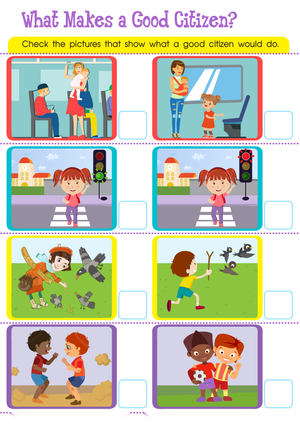
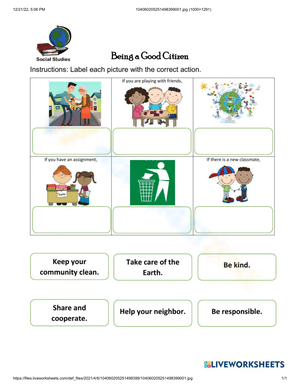
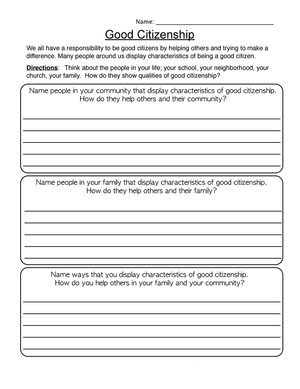
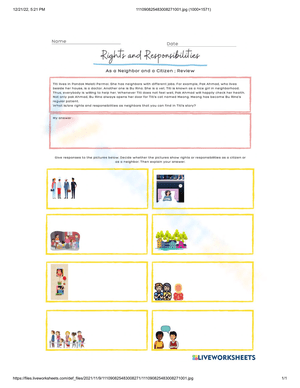
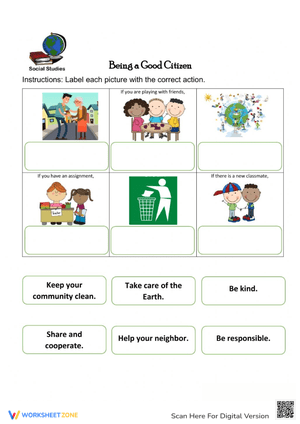
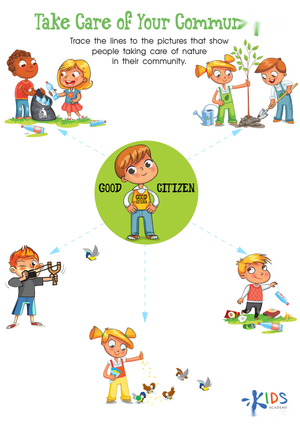
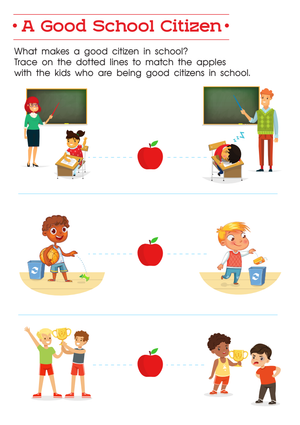
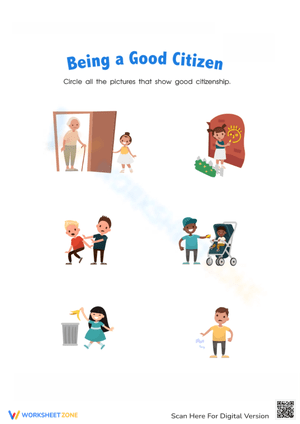
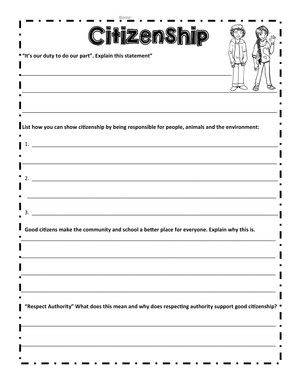
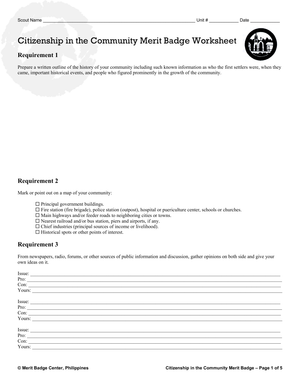
Teachers searching for citizen in the community worksheets are usually planning a unit that goes beyond a single lesson on community helpers. These worksheets ask young learners to name what a citizen actually does: follow shared rules, help neighbors, vote in classroom decisions, and take care of shared spaces like the playground or library. Rather than opening with a broad claim about worksheets being useful, it helps to start from the classroom problem they solve. Many primary teachers have strong read-alouds and posters about community helpers but few structured ways to check whether students can transfer that vocabulary into their own words on paper.
Citizen in the community worksheets fill that gap. They give students a low-stakes way to practice civic vocabulary such as citizen, community, responsibility, rule, and cooperation before those words show up again in later grades tied to formal government structures. For a curriculum lead building a K-5 social studies scope and sequence, that early repetition matters more than any single activity.
Aligning Community Citizenship Worksheets to Social Studies Standards
Most states structure their social studies standards around the College, Career, and Civic Life Framework for Social Studies State Standards, which organizes instruction around four dimensions: developing questions, applying disciplinary concepts, evaluating sources, and communicating conclusions or taking informed action.
That framework calls for introducing rights, responsibilities, and civic participation concepts starting in the primary grades, not waiting until middle school. On the 2022 NAEP Civics Assessment, only about one-fifth of eighth graders scored at or above proficient, the first decline ever recorded on that assessment, and nearly one-third could not describe the structure or function of government. Those results are a strong argument for building civic vocabulary early rather than trying to catch students up in a single middle school course.
The College, Career, and Civic Life Framework for Social Studies State Standards calls for introducing rights, responsibilities, and civic participation concepts starting in the primary grades. That guidance gives K-2 teachers a clear rationale for community citizenship instruction well before formal civics coursework begins in middle school.
Classroom Implementation
Citizen in the community worksheets work best as part of a routine rather than a one-time handout. A few practical ways to build them into a school week:
- Use a short worksheet as a morning meeting warm-up tied to a classroom rule that came up the day before.
- Pair a community-helpers worksheet with a guest speaker visit or a walking tour of the school building.
- Assign a rights-and-responsibilities sorting worksheet before a class vote, so students practice applying the vocabulary to a real decision.
- Send a simplified version home so families can reinforce vocabulary like citizen and community in everyday conversation.
For a character education or social-emotional learning block, these worksheets also double as a bridge activity, since being a good citizen and being a good classmate rely on many of the same behaviors: listening, sharing, and following through on commitments to the group.
Frequently Asked Questions
1. What grade level are citizen in the community worksheets appropriate for?
They work across K-5. In K-2, they focus on concrete community roles and rule-following; in grades 3-5, they extend into distinguishing rights from responsibilities and reasoning about civic participation.
2. How do these worksheets align with social studies standards?
Most states organize social studies instruction around the College, Career, and Civic Life Framework for Social Studies State Standards, which calls for introducing rights, responsibilities, and civic participation as early as the primary grades.
3. What civic vocabulary should these worksheets introduce?
Core terms include citizen, community, responsibility, rule, cooperation, and, by grades 3-5, right. Keeping this vocabulary consistent across grade levels helps students build on prior learning instead of relearning terms each year.
4. How can teachers use these worksheets alongside classroom community-building routines?
Many teachers pair a worksheet with a morning meeting discussion, a class vote, or a character education block, since the same behaviors that make a good classroom community, like listening and sharing, overlap directly with citizenship concepts.
5. Do these worksheets support English language learners and struggling readers?
Yes. Picture-supported vocabulary, sentence starters, and matching tasks let students engage with civic concepts without a heavy reading load, and partner discussion before writing gives extra rehearsal time for producing civic language independently.