Why the Dred Scott Decision Belongs in Your US History Unit
Few Supreme Court cases give students a clearer window into the tensions that pulled the country toward civil war than Dred Scott v. Sandford. When you're planning a unit on slavery, sectionalism, or the road to 1861, this 1857 decision links constitutional questions to the lived experience of one enslaved family. The right worksheets turn a dense legal opinion into something students can actually work through, whether you teach eighth-grade US history or an eleventh-grade survey. This guide walks through the facts you need, the classroom angles that hold up to close reading, and practical ways to build worksheet activities that move students from recall into analysis. You'll also find ideas for differentiating across grades 6-12 and tying the case to the Reconstruction amendments your standards already cover.
Case Background: The Scotts' Fight for Freedom
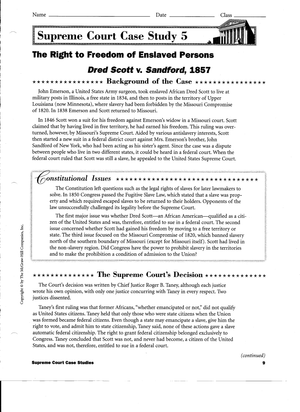
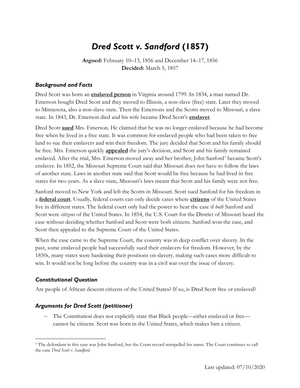
Dred Scott and his wife Harriet were enslaved people who sued for their freedom in 1846 in the St. Louis Circuit Court. Their argument rested on where they had lived. Scott's enslaver had taken him into Illinois, a free state, and into the Wisconsin Territory, where the Missouri Compromise banned slavery. The Scotts claimed that living on free soil had made them legally free, and that their freedom did not disappear when they returned to Missouri. The legal fight stretched on for more than a decade before it reached the nation's highest court. For middle and high school students, this "once free, always free" logic is a concrete entry point, and a worksheet that maps each move on a timeline helps learners see why residence sat at the heart of the case.
The 1857 Ruling and Chief Justice Taney's Reasoning
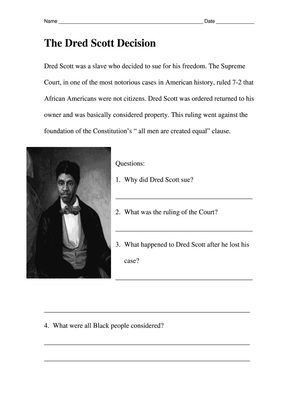
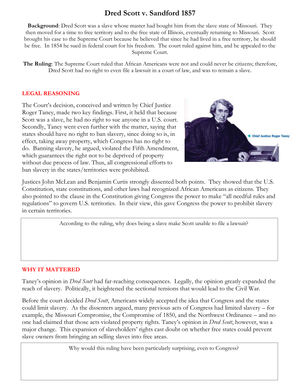
On March 6, 1857, the Supreme Court ruled 7-2 against Scott. Chief Justice Roger B. Taney wrote the majority opinion, and its reasoning reached far beyond one family's status. The Court held that Black Americans, whether enslaved or free, were not and could never be citizens of the United States, and therefore had no standing to sue in federal court. Taney went further, striking down the Missouri Compromise of 1820 as unconstitutional and declaring that Congress had no power to ban slavery in federal territories. A short citation capsule works well on a worksheet as a quotable anchor for student analysis.
According to the National Archives, in Dred Scott v. Sandford (1857) the Supreme Court ruled 7-2 that people of African descent were not U.S. citizens and could not sue in federal court, and it declared the Missouri Compromise of 1820 unconstitutional. The decision is widely counted among the worst in the Court's history.
Connecting the Decision to the Missouri Compromise and the Civil War
The Dred Scott ruling did not calm the national argument over slavery; it poured fuel on it. By declaring the Missouri Compromise unconstitutional, the Court erased a political settlement that had held since 1820 and signaled that Congress could not stop slavery from expanding into western territories. Northern opponents of slavery were outraged, Southern defenders felt vindicated, and the political middle ground shrank. Placing the case on a cause-and-effect worksheet alongside other flashpoints of the 1850s helps students trace how a single decision sharpened sectional lines. For classes ready to go deeper, a document-based question that layers the ruling against the era's political debates gives strong readers room to build an argument. Ask students to explain, in their own words, why so many in free states viewed the ruling as a direct threat, and you'll surface exactly the kind of reasoning the case is meant to build.
How the 13th and 14th Amendments Overturned the Ruling
One of the most useful classroom connections is showing students that the Constitution itself answered Dred Scott. The 13th Amendment, ratified in 1865, abolished slavery and destroyed the legal status at the center of the case. The 14th Amendment, ratified in 1868, guaranteed birthright citizenship, directly reversing Taney's claim that Black Americans could never be citizens. A compare-and-contrast worksheet that sets the Court's 1857 language beside the text of these amendments makes the reversal vivid. You can even ask students to rewrite Taney's citizenship holding as the 14th Amendment corrected it, which turns a reading task into a short writing exercise. Students can see that constitutional change, not a new Court decision, was what it took to undo Dred Scott, a point that anchors Reconstruction and Constitution units alike.
Using These Worksheets In Real Classes
Worksheets carry the most weight when they ask students to do the thinking, not just fill blanks. Build a set of activities that move from facts to analysis across a class period or two, and adjust the reading load to fit your grade level.
- Primary source analysis: Have students read a short, excerpted passage from the majority opinion, mark the claims about citizenship, and restate each one in plain language.
- Timeline sequencing: Give a scrambled list of events from 1846 to 1868 and ask students to order them, from the Scotts' first lawsuit to the 14th Amendment.
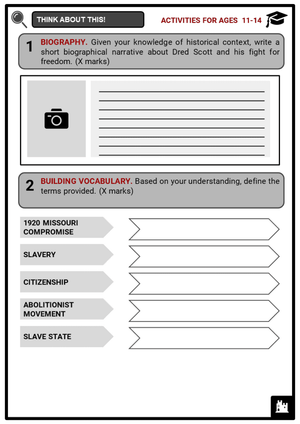
- Vocabulary and comprehension checks: Build quick-recall items for terms like standing, citizenship, federal territory, and unconstitutional.
- Socratic discussion prompts: Use open questions about citizenship and civil rights to move students from comprehension into debate.
For grades 6-8, keep excerpts short and define legal terms on the page; for grades 9-12, assign longer passages and evidence-based responses that ask students to evaluate the Court's reasoning.
Here's a distinction that trips up even strong students: the Supreme Court never overturned Dred Scott. The decision was undone by constitutional amendment rather than by a later ruling. Building a worksheet item around that fact, asking students to explain why an amendment was required to reverse the Court, pushes them past memorizing dates and into understanding how the branches of government actually check one another.
Frequently Asked Questions
1. What grade levels are Dred Scott v. Sandford worksheets appropriate for?
These worksheets fit grades 6-12, with adjustments for reading level. Middle school students do well with guided timelines, vocabulary support, and short excerpts, while high school and AP students can analyze longer passages from the majority opinion and evaluate the Court's reasoning. The case commonly appears in US history courses covering the 1850s and the causes of the Civil War.
2. What was the Supreme Court's ruling in Dred Scott v. Sandford?
On March 6, 1857, the Court ruled 7-2 against Dred Scott. Chief Justice Roger B. Taney's majority opinion held that Black Americans could not be U.S. citizens and had no right to sue in federal court. The Court also declared the Missouri Compromise of 1820 unconstitutional, ruling that Congress could not ban slavery in federal territories.
3. How does the Dred Scott decision connect to the Missouri Compromise and the Civil War?
By striking down the Missouri Compromise, the ruling removed a long-standing limit on slavery's expansion and suggested no federal territory could be kept free. That outcome deepened the divide between North and South, energized antislavery politics, and is widely seen as one of the events that pushed the nation toward the Civil War only a few years later.
4. How was the Dred Scott ruling later overturned?
The decision was overturned by constitutional amendment, not by a later Court case. The 13th Amendment abolished slavery in 1865, and the 14th Amendment established birthright citizenship in 1868, directly reversing Taney's claim that Black Americans could never be citizens. That reversal makes the case a strong bridge into a Reconstruction unit.
5. How can teachers use worksheets to teach this case alongside primary sources?
Pair a short excerpt from the majority opinion with questions that ask students to identify claims, restate them plainly, and weigh the evidence. Resources from the National Archives, Oyez, and the National Constitution Center offer case summaries and documents you can adapt. Combining a primary source with structured questions keeps students analyzing rather than only reading.