Liberty kids printable worksheets collections turn a 22-minute animated episode into a full instructional block — students mark timelines, annotate character charts, and sort real historical events from the show's narrative invention, all within a single class period. This set spans all 40 episodes of the series, from the Boston Tea Party through the ratification debates of 1789, pairing each episode with a targeted guide that holds students accountable for what they see and hear.
The Specific Skills Each Worksheet Targets
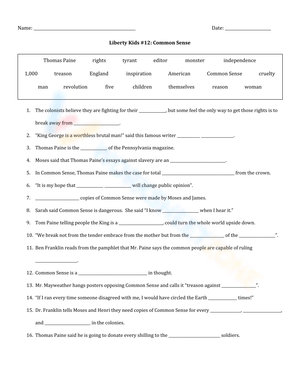
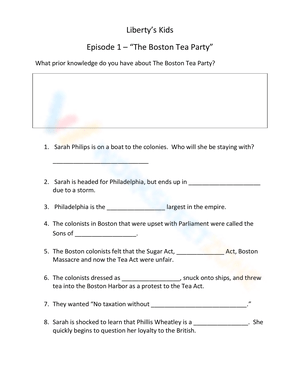
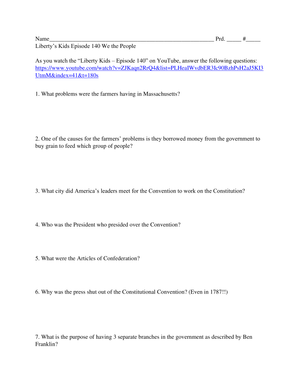
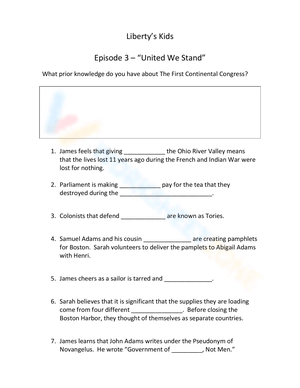
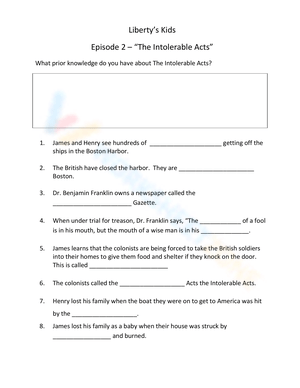
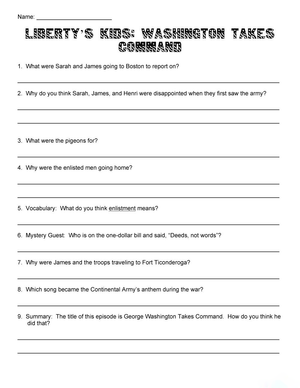
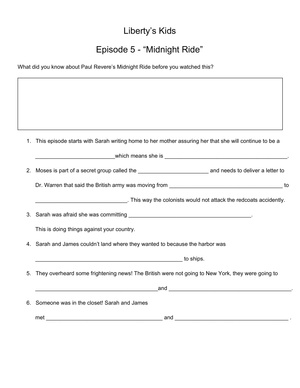
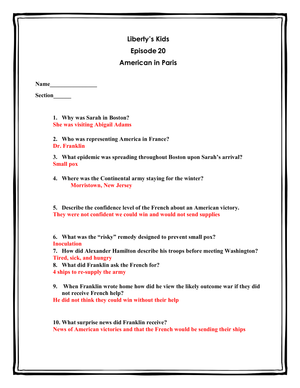
Episode viewing guides follow the chronological structure of each episode with fill-in-the-blank and short-answer prompts students complete in real time. Writing answers during playback forces selective attention — students can't absorb the episode passively when they're listening for specific information.
Character comparison charts track Sarah Phillips, James Hiller, Henri, and Moses across episodes. Because Sarah begins the series as a Loyalist and gradually shifts her sympathies, students who complete these charts build a concrete record of how perspective changes under historical pressure — something harder to grasp from a textbook than from watching a character argue with herself across 10 episodes.
Fact-vs.-fiction worksheets ask students to identify which figures and events are documented history and which are narrative additions. The series places fictional children inside genuine historical moments — the Second Continental Congress, Washington's crossing of the Delaware — so distinguishing invention from record is a skill these episodes demand in a way that purely text-based units do not.
Vocabulary matching activities pre-teach terms like "treason," "militia," "tyranny," and "boycott" before the episode runs. Students who hit unfamiliar words during video playback stall on comprehension and miss the next several lines of dialogue; loading the vocabulary in advance closes that gap before it opens.
Timeline builders give students a physical record of cause-and-effect relationships across the 1773–1789 arc. Students place episode events on a running timeline that grows across the unit, so by the time they reach the Constitutional Convention episodes, they can trace a continuous line back to the Intolerable Acts.
Frequent Student Errors Worth Watching For
The most persistent problem is treating fictional characters as historical figures. Students will write "Sarah Phillips reported on the Boston Tea Party" in a unit essay with the same confidence they write "Samuel Adams organized the Sons of Liberty." The fact-vs.-fiction worksheets surface this confusion early — before it migrates into written assessments, where it's much harder to address.
A second pattern: students conflate Sarah's evolving Loyalist perspective with a factual account of what Loyalists believed. When she expresses doubt about the Patriot cause in the early episodes, some students read her dialogue as reliable historical testimony. Viewing guide prompts that require students to label whose perspective is being expressed — and whether that character is fictional or historical — interrupt this habit before it settles.
Timeline errors are also common. Without a running visual record, students frequently place the Battle of Saratoga before the Declaration of Independence, or assume the war ended immediately after Yorktown. The timeline builder format makes the sequence visible and correctable without requiring a separate reteach lesson.
How to Build These Worksheets Into Your Lesson Plans
The most reliable structure is a three-day cycle: vocabulary and preview on day one, viewing and guide completion on day two, debrief and unit connection on day three. The preview day matters more than it seems — walking students through three or four key viewing guide questions before the episode runs converts the guide from a surprise quiz into a focused listening task. Students attend differently when they know exactly what they're listening for.
On viewing day, pause the episode at approximately the 11-minute mark. The series is structured with a natural narrative break near the midpoint, and stopping there gives students two minutes to compare viewing guide answers with a partner before the second half runs. This single intervention prevents students who fall behind from disengaging for the remaining 11 minutes, and it surfaces comprehension gaps while there's still time to address them. Without the pause, you often won't discover until the debrief that half the class missed a key plot point.
Collecting the completed guides at the end of the unit rather than after each episode gives students a cumulative study packet for the assessment. By week three, a student's set of completed guides is effectively a student-generated review document covering the full arc from colonial grievances to ratification.
Standard Alignment
These worksheets align most directly with CCSS.ELA-LITERACY.RH.6-8.6, which asks students to identify a narrator's point of view and explain how it shapes the content presented. The Sarah-vs.-James character charts address this standard concretely: students must articulate not just what happened in an episode but whose lens filtered the account and what that character's position was. For grades 4–5, the parallel standard CCSS.ELA-LITERACY.RI.4.6 — comparing firsthand and secondhand accounts of the same event — applies directly to the same perspective-tracking tasks. Both standards appear in state assessments that draw on informational reading from non-print sources, making these episode guides useful beyond the American Revolution unit itself.
The timeline and cause-and-effect worksheets address NCSS Theme 2 (Time, Continuity, and Change), which requires students to apply chronological reasoning and demonstrate that historical events have traceable causes and consequences. This theme anchors most state social studies frameworks for grades 5 through 8, placing this set squarely within a standards-based instructional scope.
Differentiating These Worksheets Across Ability Levels
For students who struggle to write quickly enough during playback, replace short-answer prompts with a word bank or multiple-choice options. The guide still functions as an accountability tool without penalizing slow writers by forcing them to choose between keeping up with the video and completing a sentence. A liberty kids printable worksheets modified this way also works cleanly for students whose IEPs specify reduced written output.
English Language Learners benefit from a paired bilingual glossary attached to the vocabulary matching worksheet. The 18th-century political vocabulary in these episodes — "sovereignty," "parliament," "redress of grievances" — creates a double comprehension barrier for students still developing English fluency. Providing the glossary removes one barrier without simplifying the historical content itself.
For students who need additional challenge, the fact-vs.-fiction format extends into a short analytical essay: after identifying what the show invented, students evaluate why those creative choices were made and whether they distort the historical record. This task requires synthesis across multiple episodes and pushes into the kind of source-evaluation thinking that appears in upper-grade social studies and history courses.
Frequently Asked Questions
What grade level do these worksheets fit?
Most classroom use falls in grades 4 through 8. Fourth and fifth graders can work through the episode guides and timeline builders with teacher support during the first few episodes; the character analysis and fact-vs.-fiction tasks are better suited to grades 6–8, where students have more experience identifying and evaluating source perspective.
Do the guides work if I can only show a handful of episodes?
Yes. Each worksheet is self-contained, so teachers who are unit-planning around specific content — the Declaration of Independence debates, the Battle of Saratoga, Washington's leadership decisions — can pull the relevant episode guides without running the full 40-episode arc. A liberty kids printable worksheets selected for a single episode delivers the same structured-viewing experience as using the complete set.
Are answer keys included?
Answer keys accompany each episode guide. For fill-in-the-blank and multiple-choice items, the keys are direct. For short-answer and analysis questions, the keys provide sample responses with notes on what constitutes a complete answer — useful both for grading and for facilitating the whole-class debrief after the episode ends. Substitute teachers can run the lesson from the materials without additional prep.
Where do I find the episodes to stream?
The WildBrain Liberty's Kids official YouTube channel carries the complete 40-episode run at no cost, and PBS LearningMedia hosts selected episodes alongside primary source documents that pair well with the more advanced analysis worksheets. Confirming a working stream source before the unit begins matters — planning a liberty kids printable worksheets lesson around a dead link on episode day costs more instructional time than the planning would have taken.