These civics and government worksheets give middle and high school social studies teachers a concrete path through topics — the three branches, federalism, the Bill of Rights — that students nominally recognize but rarely understand at any functional depth. The set spans foundational documents through active citizenship, pairing direct instruction targets with the applied reasoning that shows up on state assessments.
What Each Worksheet Covers
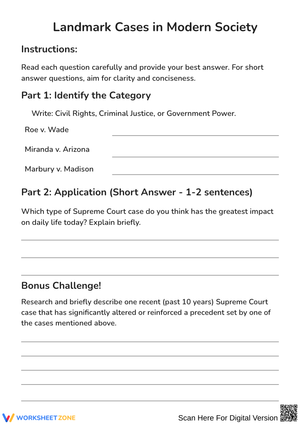
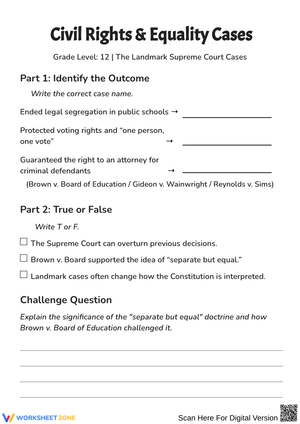
The skills across the set fall into four clusters. The first addresses foundational documents: students annotate excerpts from the Articles of Confederation and the Constitution, marking where specific problems with the earlier document were solved by the framers. The second cluster tackles governmental structure — students diagram the three branches, work through scenario-based checks and balances prompts, and sort enumerated, implied, reserved, and concurrent powers using real policy situations rather than abstract definitions. The third cluster focuses on rights: each worksheet pairs a specific amendment with a summary of a landmark court case, asking students to explain how the ruling interpreted the amendment's scope. The fourth cluster moves into civic participation — students evaluate scenarios involving voting, jury service, petitioning, and community organizing, then identify the constitutional basis for each form of engagement.
Predictable Stumbling Points in the Civics Curriculum
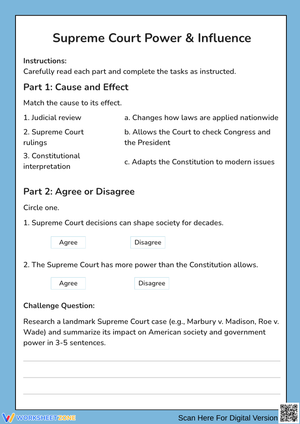
The most persistent error in civics units is not the one most teachers expect. Students who correctly label the three branches on a diagram still write "the Supreme Court makes laws" in their essays because the labeling task never required them to understand function. These worksheets surface that gap by asking students to assign actions, not names. A student who writes "Congress passed the Civil Rights Act and the President signed it, so it became a law" tends to stop there — as if the process ends at signature. The checks and balances prompts force students to reckon with judicial review as a continuing check, not a ceremonial final step.
Federalism produces a second cluster of errors. Students collapse the distinction between reserved powers and implied powers — both feel like "things the government can do," and the 10th Amendment's logic requires a kind of negative reasoning that eighth graders find genuinely difficult. The sorting activities address this directly by presenting specific policy situations — setting a minimum wage, issuing a driver's license, deploying troops — and asking students to identify not just which level of government handles it, but why that assignment follows from the Constitution's text and structure.
How to Sequence These Worksheets for Maximum Retention
The legislative process worksheet works best when it runs alongside a classroom simulation rather than before or after one. Assign students roles — committee chair, floor sponsor, executive — and have them use the worksheet as a procedural checklist as the simulation moves forward. Students who complete the worksheet cold, without any simulation, produce correct answers they cannot explain three days later. Pairing the worksheet with the role assignment produces more durable understanding because the procedural sequence gets encoded alongside a memory of doing something, not just reading about it.
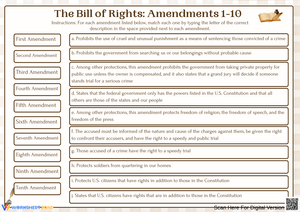
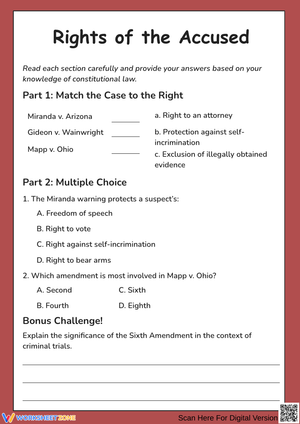
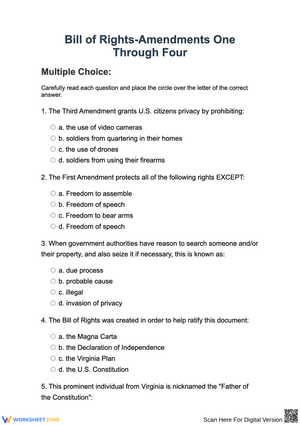
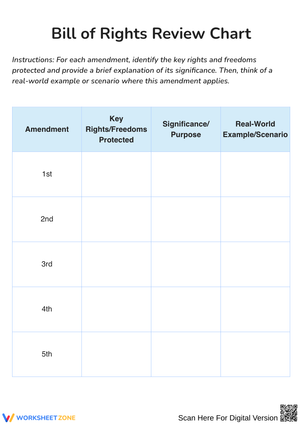
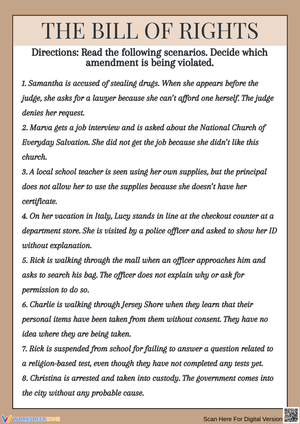
For the Bill of Rights amendment-matching activities, time them for the 10–12 minutes after a close-reading exercise rather than using them as an opening activity. Students who have just worked through a primary source excerpt retain the amendment's language well enough to handle scenario-based application; students who encounter the worksheet cold tend to guess rather than reason. The civics and government worksheets in this cluster function as retrieval-practice tools — they reward students who have already encountered the content through direct instruction or discussion, not students meeting it for the first time.
Standard Alignment
These worksheets align primarily with the C3 Framework's Civics strand, specifically D2.Civ.1 through D2.Civ.5 for grades 6–8, which ask students to distinguish the powers and responsibilities of different levels of government, explain constitutional structures, and analyze the role of citizens in a democratic republic. D2.Civ.14 — evaluating claims about the responsibilities of citizens — maps directly to the civic participation cluster. For teachers in states with explicit civics course mandates, including Florida's HB 5 requirements and Illinois's Civics Course Requirement enacted in 2016, these worksheets address the constitutional literacy components that state assessments target. They also support CCSS.ELA-Literacy.RH.6-8.1, which requires students to cite textual evidence from informational sources — a standard that transfers cleanly to constitutional document analysis.
Differentiating Across Your Civics Classes
For students who struggle with abstract governmental reasoning, the graphic organizer worksheets — particularly the three-branches diagram and the federalism Venn — provide enough visual structure to reduce cognitive load before written analysis begins. These students do better when they complete the diagram first and use it as a reference while working through scenario questions; holding the structural information in working memory while simultaneously applying it to a new situation overtaxes the task. Teachers can pre-fill the branch labels and leave only the powers and examples blank, which focuses the cognitive work on the content that actually needs practice rather than the vocabulary that has already been taught.
Advanced students rarely need more content — they need more analytical friction. Pull Federalist No. 51 or Federalist No. 10 as a companion text to the checks and balances worksheet and ask students to evaluate whether Madison's original reasoning holds in the context of a specific contemporary issue. The civics and government worksheets in the constitutional structure cluster include open-response prompts broad enough to accept sophisticated arguments, not just factually correct answers — which makes extension work feel like genuine inquiry rather than busywork.
Frequently Asked Questions
How do these worksheets handle the difference between enumerated and implied powers?
The powers worksheets take a sorting approach rather than a definition approach. Instead of asking students to define "implied powers," each prompt presents a specific federal action — regulating a new technology, setting food safety standards — and asks students to identify whether it derives from an explicit constitutional grant or from the Necessary and Proper Clause. Students who sort correctly almost always explain the distinction accurately in discussion afterward, because the application task forces the reasoning that a definition task does not.
Are there worksheets covering local and state government, or does the set focus mainly on the federal level?
The federalism cluster includes worksheets specifically on municipal and state government. Students identify a recent local ordinance — a zoning decision, a school board policy — and connect it to the level of government constitutionally authorized to make that kind of rule. This corrects the impression that civics is something that happens in Washington. Grounding the work in decisions students can actually look up, rather than in abstract structural diagrams alone, makes the federalism framework feel functional rather than theoretical.
Can these worksheets be used in a dedicated civics elective, or are they designed only for a general social studies course?
The set works in both contexts. Teachers running a semester-long civics course typically sequence the worksheets from foundational documents through active citizenship and use the civics and government worksheets as formative checkpoints at the end of each unit. Teachers embedding civics into a broader social studies sequence tend to pull individual worksheets to pair with specific textbook chapters or primary source discussions. Each worksheet is a standalone document with no dependency on the others, so the set is easy to excerpt without losing continuity.












 Interactive Worksheet Maker
 Quiz Maker
 Word Search Maker
 Crossword Puzzle Maker
 Word Scramble Generator
 Sentence Scramble Generator
 Handwriting Worksheet Generator
 Name Tracing Generator
 Fill In The Blank Generator