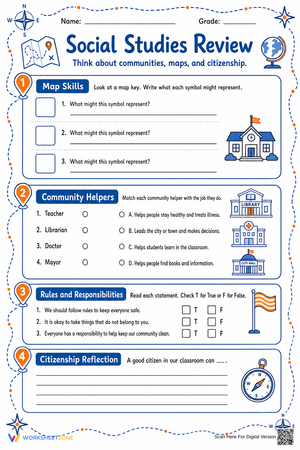
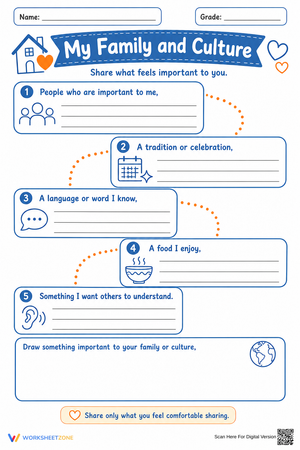
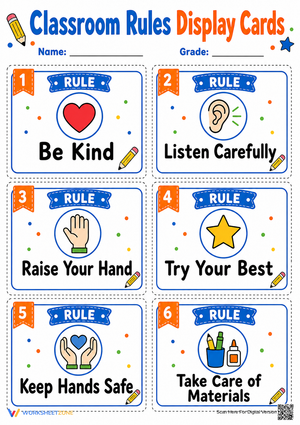
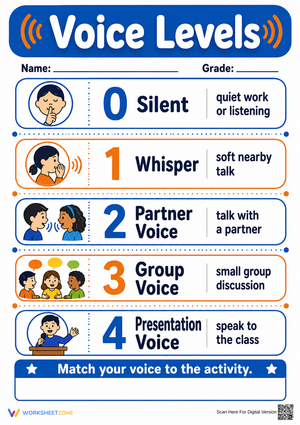
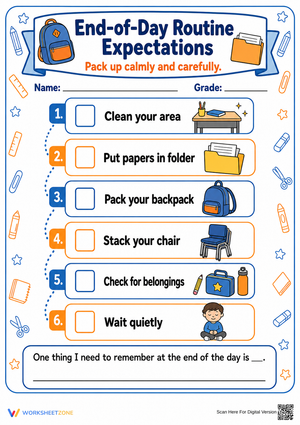
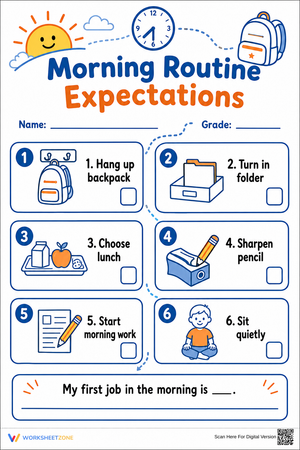
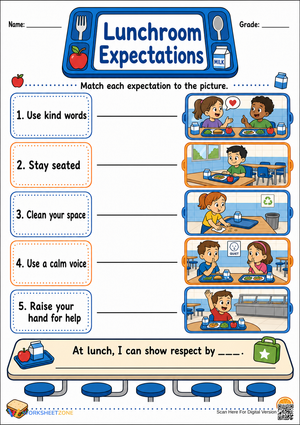
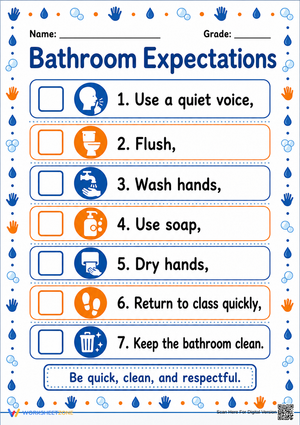
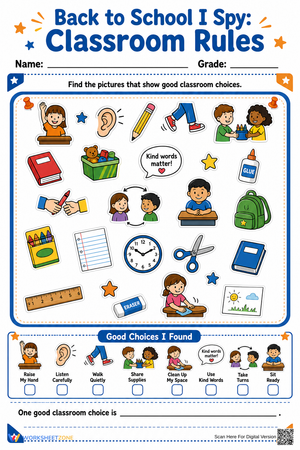
These community culture worksheets give elementary social studies teachers a structured entry point into one of the grade band's most layered topics: how neighborhoods, towns, and cities develop shared identity through tradition, civic participation, and collective history. Each worksheet targets a discrete skill — mapping local landmarks, analyzing a cultural celebration, interviewing a family member about heritage — so teachers can sequence them deliberately rather than relying on a single activity to carry all the conceptual weight at once.
The Specific Content Each Worksheet Builds
The set spans four content areas that appear consistently across state social studies frameworks in grades 2–5. Students work across genuinely different task types — reading and annotating, mapping, conducting structured interviews, writing short explanations — which keeps the unit from collapsing into a repetitive format.
- Cultural traditions and celebrations: Students read short passages about specific holidays or seasonal events, then annotate for historical origin, geographic location, and present-day practice. The goal is not a summary — it is a structured analysis of how a tradition carries meaning across time and place.
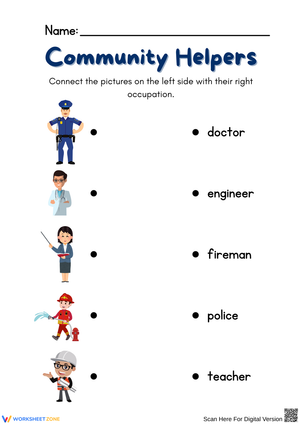
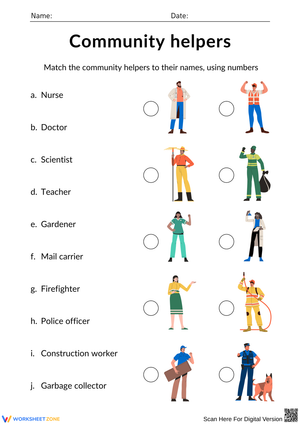
- Civic roles and community helpers: Beyond listing job titles, these worksheets ask students to trace the decision-making chain — who identifies a community need, who votes to fund it, who delivers the service. That shift from description to civic logic is where the deeper learning happens.
- Family heritage and personal identity: Graphic organizers guide students through an interview with a family member, with sentence frames to support the conversation itself. When students bring their findings back and share them, the classroom becomes a primary source archive in its own right.
- Local geography and landmarks: Mapping activities ask students to locate physical and cultural landmarks, then write a short explanation of why each site matters to the community — combining basic cartography with an argument about place and meaning.
Why This Format Works at This Grade Level
Second and third graders are at a particular developmental moment: they distinguish "my family" from "my community" as separate but overlapping units for the first time, and they are ready to ask why a community looks and functions the way it does. These worksheets build from what students already know — almost every child can name one local tradition, celebration, or community figure — and push outward toward less familiar cultural contexts. That sequence mirrors the expanding communities model that has shaped elementary social studies for decades, with one important revision: students are not asked only to observe and describe. They compare, question, and explain. That cognitive shift is where critical thinking in social studies actually starts to take hold.
Lesson-Planning Ideas to Get the Most From These Worksheets
The heritage interview worksheet pays off most when assigned as Monday homework the week before a unit launches. Students return Tuesday with notes from a real family conversation, and that material feeds the first class discussion — every student arrives as a source, not just a recipient of information. The local landmarks mapping worksheet holds up well in the 20-minute block before afternoon specials: it asks for close observation more than extended writing, so attention stays intact when the week's stamina is running low.
Pairing any worksheet in this community culture worksheets set with a physical artifact — a photograph from the town historical society, a menu from a neighborhood restaurant, a clipping from the school library's local archive — moves the lesson from abstract to concrete without changing the task itself. The student's relationship to the prompt changes. That combination of printed structure and physical evidence is more effective than either approach used alone.
Student Errors Worth Watching For and Addressing
The most consistent mistake on the cultural traditions worksheets is overgeneralization. A student who knows that Lunar New Year is celebrated by many Chinese families will write "all Asian people celebrate the same holidays" — a compression the discussion prompts are specifically built to push back on. Watch for it in written responses, not just the graphic organizer boxes, and address it directly during share-out before it carries over into peer presentations or the summative task.
On the civic roles worksheet, students routinely list job titles without connecting them to interdependence. "The librarian keeps books organized" is a common response that stops before the more important idea: who funds the library, who sets its hours, how the neighborhood changes if it closes. A simple protocol works here — ask students to add a "so that..." clause to every civic role they describe. That one addition surfaces the gap before it reaches assessment work.
Standard Alignment
The worksheets connect to the NCSS C3 Framework across Dimension 2 in both Civics and History. D2.Civ.1 asks students to explain how rules and laws help communities function; the civic roles worksheet addresses this directly by tracing how a community need moves from identification to vote to service delivery. D2.His.1 asks students to explain why historical events happened and how they connect to the present — the cultural traditions worksheet builds this through its historical origin questions, which require students to situate a practice in time before describing how it is observed today. These standards appear in most state frameworks under equivalent language, so teachers adapting the worksheets to a state-specific course of study find the alignment direct.
Differentiating These Worksheets Across Ability Levels
For students still building reading fluency, a 90-second teacher-recorded voice memo of the passage — posted to the class platform before the lesson — removes the decoding load without modifying the content task. The graphic organizers accept labeled diagrams alongside written phrases, which allows students to demonstrate genuine understanding of community and culture concepts without the added weight of sentence construction pulling their attention away from the ideas.
Students who move through grade-level work quickly extend naturally into source-based inquiry using the heritage and traditions worksheets. After completing the standard graphic organizer, they compare their family's cultural practice with documented historical accounts of the same tradition, identifying what has changed over time and why. This community culture worksheets extension moves the task from personal knowledge into the kind of historical thinking — comparing sources, identifying continuity and change — that appears on upper elementary assessments but benefits from early, personally grounded practice.
Frequently Asked Questions
What grade range do these worksheets fit?
The set works primarily in grades 2–5. The community helpers and local landmarks worksheets fit best at the 2nd–3rd grade level, where the expanding communities sequence puts neighborhood and town study at the center of the social studies year. The heritage interview and cultural comparison worksheets align more naturally with 4th–5th grade, when students are expected to move from observation to analysis and to support claims with evidence from sources rather than personal experience alone.
Can these be assigned as homework or in a remote setting?
Because each worksheet is self-contained, teachers assign them independently — for homework or asynchronously — without breaking the instructional sequence. The family interview worksheet is particularly effective as a take-home task because it positions the student's own household as a primary source. One practical note: students without a parent or guardian available for the interview benefit from an alternate prompt that asks them to research a local community figure instead, keeping the task parallel without requiring family access.
How well do these worksheets support English language learners?
Several worksheets include vocabulary lists and sentence frames that give students still acquiring English the language structures they need to work with the content. The graphic organizers accept labeled drawings alongside written responses, lowering the language demand without lowering the cognitive one. Teachers who pair a community culture worksheets graphic organizer with a bilingual word wall consistently find that ELL students produce work reflecting genuine understanding of the material — not just the boundaries of their current English vocabulary.












 Interactive Worksheet Maker
 Quiz Maker
 Word Search Maker
 Crossword Puzzle Maker
 Word Scramble Generator
 Sentence Scramble Generator
 Handwriting Worksheet Generator
 Name Tracing Generator
 Fill In The Blank Generator