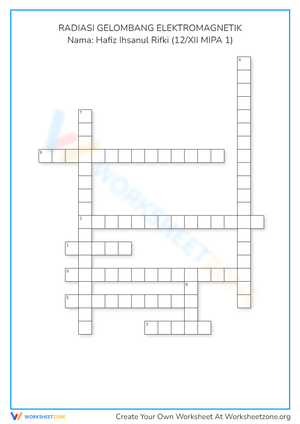
Electromagnetic spectrum worksheets give physical science teachers a fast way to move students from vague ideas about light and radio into a structured model of wave behavior. The spectrum stretches across radio waves, microwaves, infrared, visible light, ultraviolet, X-rays, and gamma rays, ordered by wavelength and frequency. That range gives teachers a natural sequence for building lessons, because each wave category connects to a device or phenomenon students already recognize, from car radios to hospital imaging. A well-sequenced worksheet set turns that recognition into vocabulary, ordering skills, and eventually quantitative reasoning about wave speed, frequency, and wavelength.
Sequencing Worksheets for Middle School NGSS Waves Instruction
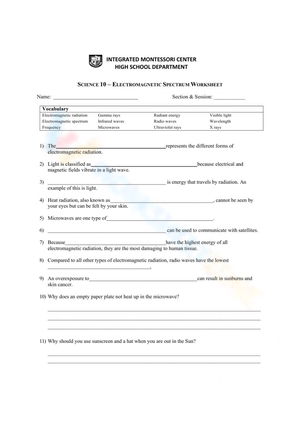
Middle school physical science units built around MS.Waves and Electromagnetic Radiation should open with worksheets that ask students to order the spectrum and label everyday sources before asking them to explain absorption, reflection, or transmission. Start with a labeling worksheet that has students place radio waves through gamma rays in order, then pair it with a short-answer worksheet asking why sunscreen blocks ultraviolet light but not visible light. This sequence keeps the reasoning focused on models rather than pure memorization, which matches how NGSS frames middle school performance expectations. A third worksheet in the sequence can ask students to sketch a simple model showing what happens when light hits a mirror versus a dark surface, reinforcing reflection and absorption before the unit test.
Building Quantitative Practice for High School HS-PS4 Instruction
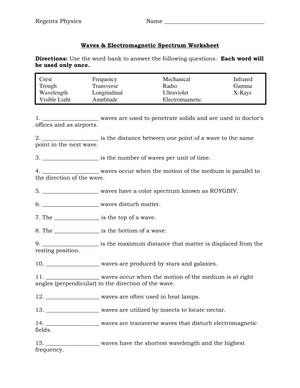
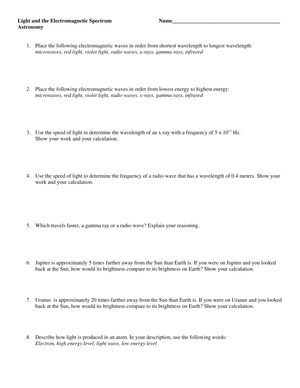
High school classrooms working through HS-PS4 need worksheets that push past labeling and into the wave speed, frequency, and wavelength relationship. A strong worksheet progression starts with a formula practice sheet using the wave equation, then moves to problems where students calculate frequency from a given wavelength within a specific spectrum band, such as visible light or X-rays. Because HS-PS4 expects greater mathematical depth than the middle school topic, worksheets at this level should include mixed units and ask students to justify which spectrum region a calculated frequency falls into. This keeps the quantitative work tied to conceptual understanding instead of isolated number crunching.
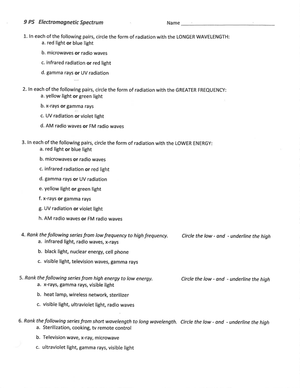
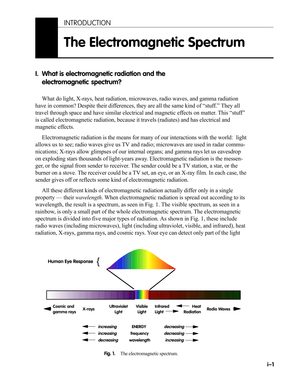
One detail that trips up many students is scale. The electromagnetic spectrum spans roughly fifteen orders of magnitude in wavelength, from radio waves that stretch for kilometers down to gamma rays smaller than an atomic nucleus. A worksheet that only lists the seven categories in order will not build proportional reasoning about that scale gap. Pairing an ordering worksheet with a logarithmic scale diagram, where students plot two or three wavelengths themselves, does more to fix the misconception that all spectrum bands are roughly similar in size.
Connecting the Spectrum to Real-World Technology
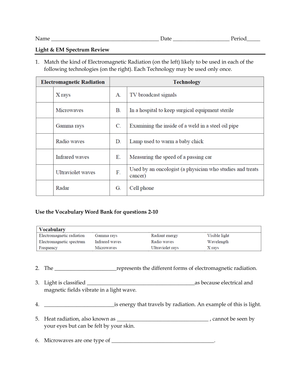
Students engage more with electromagnetic spectrum content when a worksheet ties each wave type to a familiar technology. Radio waves connect to car radios and broadcast television, microwaves to kitchen appliances and cell phone signals, infrared to remote controls and thermal cameras, ultraviolet to sunscreen and tanning warnings, and X-rays and gamma rays to medical imaging and cancer treatment. A worksheet built around a matching or short-response format using these examples gives students a memory hook for the abstract ordering of the spectrum. This approach also opens a natural discussion about why certain wave types are safe for household use while others require protective equipment or medical supervision.
Classroom Implementation
Plan electromagnetic spectrum worksheets in a short sequence rather than as a single standalone assignment. Begin the unit with an ordering and vocabulary worksheet, follow with an absorption, reflection, and transmission worksheet, and finish with either a model-based task for middle school or a calculation-based task for high school. Pair at least one worksheet with a hands-on demonstration, such as testing which materials block a remote control signal or building a simple spectroscope, so students see the concepts before working through them on paper. Keep a folder of single-skill worksheets separate from your mixed-review worksheets so you can pull the right resource whether you are reteaching one small group or reviewing the whole class before an assessment.
Frequently Asked Questions
1. What grade levels are electromagnetic spectrum worksheets appropriate for?
These worksheets fit both middle school and high school physical science classrooms. Middle school worksheets should emphasize ordering, vocabulary, and model-based reasoning about absorption, reflection, and transmission. High school worksheets should add quantitative practice with wave speed, frequency, and wavelength calculations.
2. How do these worksheets align to NGSS standards for waves and electromagnetic radiation?
Middle school worksheets connect to the MS.Waves and Electromagnetic Radiation topic, which focuses on modeling and investigation rather than memorization alone. High school worksheets connect to HS-PS4, which builds on that foundation with more mathematical depth around wave properties.
3. How can teachers use electromagnetic spectrum worksheets for review versus new instruction?
For new instruction, use worksheets in a sequence that builds from ordering and vocabulary toward reasoning or calculation. For review, use a mixed-format worksheet that samples each skill in one sitting so students can practice retrieval across the full unit before an assessment.
4. What skills do electromagnetic spectrum worksheets typically reinforce?
Common skills include ordering wave types by wavelength and frequency, explaining absorption and reflection with everyday examples, matching wave types to real-world technology, and, at the high school level, calculating frequency or wavelength using the wave equation.
5. How can these worksheets support students who need extra practice with wave concepts?
Single-skill worksheets let teachers isolate exactly where a student is struggling, whether that is basic ordering, conceptual reasoning about absorption and transmission, or the math behind frequency and wavelength. Using these in small groups allows more targeted feedback than a single mixed-review worksheet can provide.












 Interactive Worksheet Maker
 Quiz Maker
 Word Search Maker
 Crossword Puzzle Maker
 Word Scramble Generator
 Sentence Scramble Generator
 Handwriting Worksheet Generator
 Name Tracing Generator
 Fill In The Blank Generator