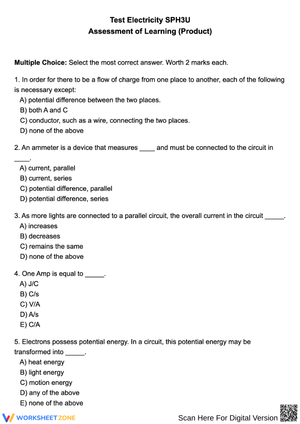
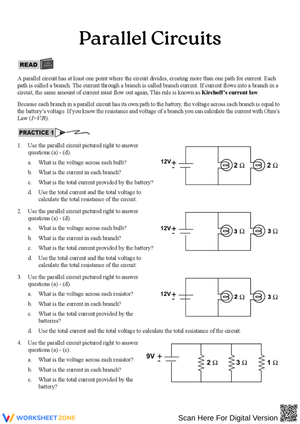
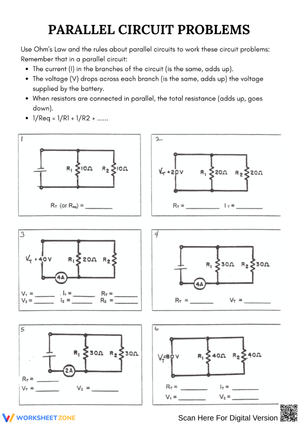
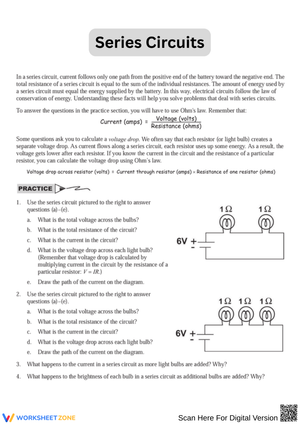
When you introduce electric circuits, students need more than a single lecture on V=IR before they can apply it with any confidence. Ohm's law worksheets give you a repeatable way to build that fluency, because they let students practice solving for voltage, current, or resistance across a stack of problems instead of just one or two examples on the board. That repetition matters in physical science and physics classrooms alike, where students often see the formula once and then struggle the moment a problem asks them to solve for a different variable than the one they just practiced.
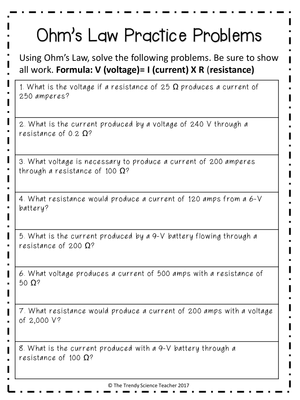
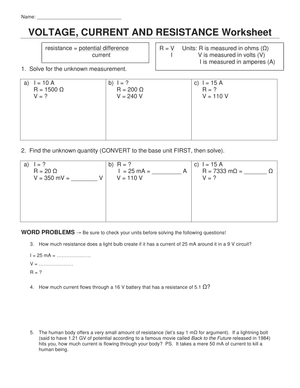
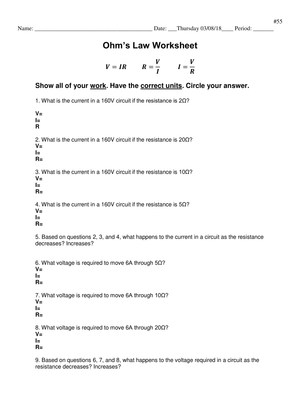
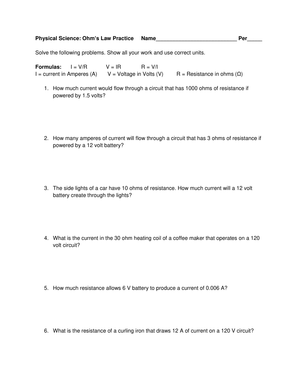
A well-built worksheet set does not isolate one variable at a time. Instead it mixes voltage-solving, current-solving, and resistance-solving problems on the same page, which forces students to identify which quantity is missing before they can even start the algebra. That mix is what separates a useful Ohm's law worksheet from a simple formula-recall exercise, and it is worth checking for before you hand a set to your class.
Differentiating Ohm's Law Worksheets for Mixed-Ability Classes
Not every student in your room needs the same version of the practice set. For students who are still building number sense with the formula, whole-number values keep the arithmetic simple so the focus stays on selecting the right variable and setting up the equation correctly. For students ready for more challenge, decimal and fractional values push them to apply the same reasoning with less forgiving numbers, which mirrors the kind of precision expected in a high school physics course.
This kind of tiering does not require writing entirely new worksheets. Swapping the numbers in an existing problem set while keeping the structure and variable mix the same is often enough to create a version for struggling students and a version for advanced students, without doubling your prep time.
Connecting Worksheet Practice to Hands-On Circuit Building
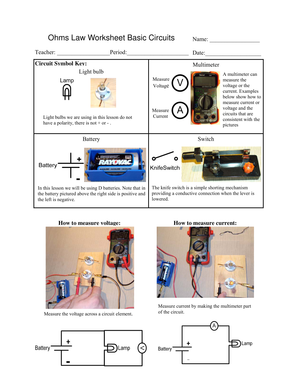
Students who only ever see Ohm's law on paper tend to treat V, I, and R as three unrelated symbols rather than three measurements of the same physical event. Pairing a worksheet set with even a short hands-on circuit-building activity, before or after the math practice, gives students a concrete circuit to reference when a problem feels abstract, and it is often the single change that turns a memorized formula into an understood relationship.
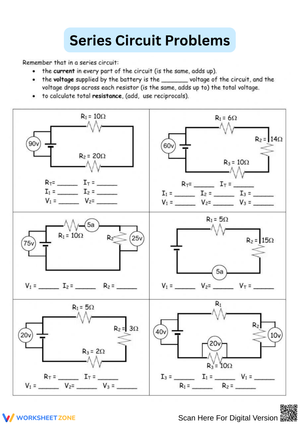
If a full lab is not possible on a given day, a brief demonstration circuit that students can observe still gives the worksheet numbers something real to attach to. Even referencing that demonstration verbally while students work through diagram-based problems can reduce the disconnect between the math and the physical circuit.
Classroom Implementation
Start a circuits unit with a short vocabulary and formula-review worksheet, then move to single-variable drills over one or two class periods. Once students can solve for any of the three variables independently, introduce a mixed-variable worksheet as guided practice, followed by a diagram-based worksheet that ties the numbers to a visual circuit. Reserve one mixed-variable worksheet, ideally with decimal values for advanced groups and whole-number values for others, as a formative checkpoint a day or two before your quiz or test.
For middle school physical science classes, keep the worksheet sequence conceptual and whole-number based, focusing on the basic V=IR relationship as introduced under the electric and magnetic force strand of the NGSS Physical Science standards. For high school physics classes, extend the same sequence into multi-step problems, decimal precision, and series versus parallel circuit distinctions, since energy and circuit relationships are expected to deepen at that level.
Frequently Asked Questions
1. What grade level is Ohm's law typically taught at in US schools?
Electric and magnetic force concepts, including the foundation for Ohm's law, are introduced at the middle school level under the NGSS Physical Science strand, with the energy and circuit relationships extended further in high school physics courses.
2. What is the formula on an Ohm's law worksheet and how do students use it?
The formula is V=IR, where voltage in volts equals current in amps multiplied by resistance in ohms. Students rearrange the formula depending on which variable a given problem asks them to solve for.
3. How can teachers use Ohm's law worksheets for review versus formative assessment?
Review worksheets are best used with partner or group discussion to reinforce the formula, while a formative assessment worksheet should be completed independently so you can see which variable-solving skill each student still needs support with.
4. What common mistakes should teachers watch for on these worksheets?
Watch for unit confusion, such as mixing milliamps with amps, and for students applying series-circuit values to parallel-circuit problems, or the reverse, before they apply the Ohm's law formula.
5. How do Ohm's law worksheets fit into a broader circuits or electricity unit?
They typically sit in the middle of a circuits unit, following vocabulary instruction and single-variable drills, and lead into diagram-based problems and a hands-on circuit-building activity before a formative checkpoint and unit quiz.












 Interactive Worksheet Maker
 Quiz Maker
 Word Search Maker
 Crossword Puzzle Maker
 Word Scramble Generator
 Sentence Scramble Generator
 Handwriting Worksheet Generator
 Name Tracing Generator
 Fill In The Blank Generator