When a chemistry unit turns to Boyle's Law, Charles's Law, Gay-Lussac's Law, and the Ideal Gas Law, students often stall not on the concepts but on the algebra and unit conversions layered on top of them. Gas laws worksheets give teachers a structured way to isolate each relationship, build calculation fluency, and check readiness before moving into combined and ideal gas law problems.
Why Gas Laws Worksheets Matter in a Chemistry Sequence
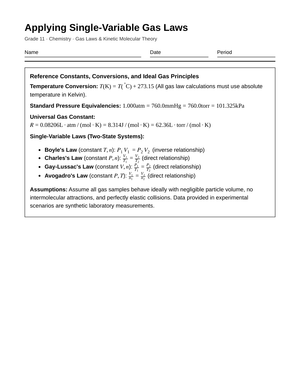
Gas law units ask students to connect what they can see and measure, such as a syringe plunger moving or a balloon shrinking in a cold room, to particle-level explanations of matter. Worksheets that isolate pressure, volume, and temperature relationships one at a time let students practice the math before they have to also reason about kinetic theory. That separation matters most for students who are still building confidence with algebraic manipulation of formulas like P1V1 = P2V2.
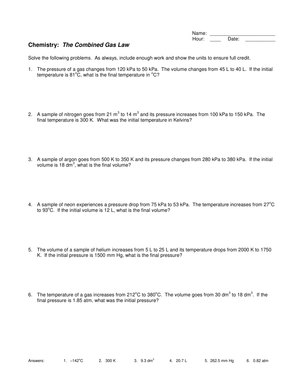
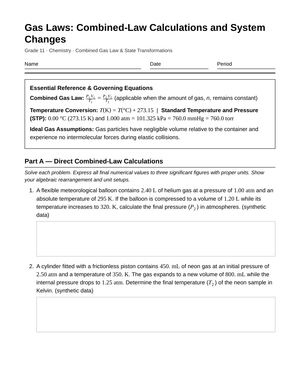
A practical pacing move is to sequence single-variable law worksheets, Boyle's, Charles's, and Gay-Lussac's, before introducing the combined gas law or PV = nRT. Each of these three laws holds two variables constant and varies only two others, which keeps the algebra simple and isolates one relationship (direct or inverse) at a time. Once students can reliably identify which variable is constant and which two are changing, the jump to the combined gas law becomes a matter of recognizing a familiar pattern rather than learning something entirely new.
Connecting Practice to NGSS HS-PS1-5
Gas law instruction in a US high school chemistry or physical science classroom typically supports NGSS HS-PS1-5, which asks students to apply scientific principles and evidence to explain macroscopic properties of matter in terms of atomic-scale structure and interactions. Gas laws worksheets are a natural fit for this standard because they require students to move between a symbolic equation and a physical explanation of why pressure rises when volume drops, or why volume expands as temperature increases at constant pressure.
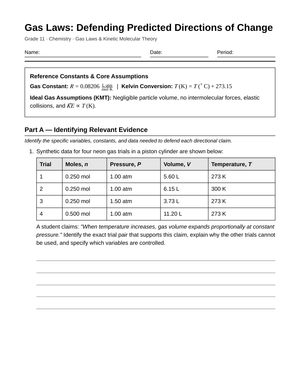
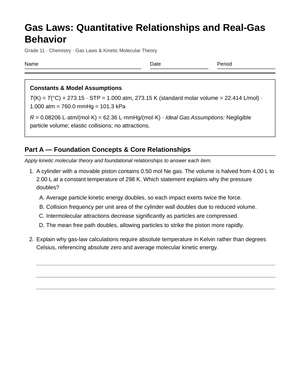
When you build or select worksheet items, look for problems that ask students to justify an answer in a sentence or two, not just solve for a variable. A problem that pairs a numeric answer with a short explanation of particle collisions or average kinetic energy gives you a quick check on whether a student memorized a formula or actually understands the relationship it represents.
Boyle's Law: Where Most Sequences Begin
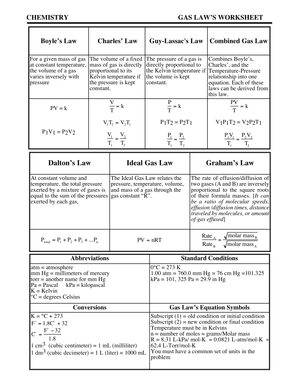
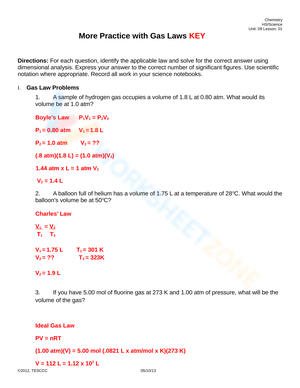
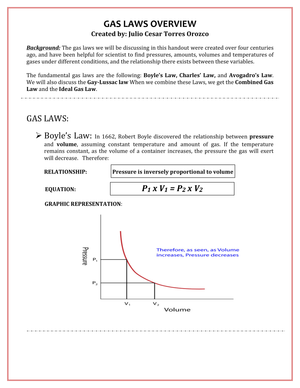
Boyle's Law describes pressure and volume as inversely proportional when temperature and the amount of gas stay constant, expressed as P1V1 = P2V2. Because it involves only two variables and a single inverse relationship, it is the most common starting point for gas law practice. Worksheets built around Boyle's Law let students practice isolating a variable and checking whether their answer direction makes sense, since volume should shrink when pressure increases and grow when pressure decreases.
This law also pairs well with a quick classroom demonstration, such as compressing air in a sealed syringe, so a worksheet can follow a hands-on observation rather than stand alone as an abstract calculation set.
Charles's Law and Gay-Lussac's Law
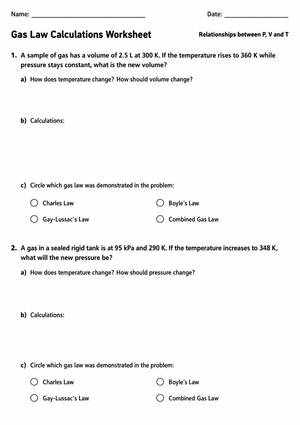
Charles's Law describes volume and temperature as directly proportional at constant pressure, written as V1/T1 = V2/T2. Gay-Lussac's Law relates pressure and temperature directly at constant volume, written as P1/T1 = P2/T2. Both laws require every temperature value to be converted to Kelvin before it goes into the equation, since the direct proportionality only holds on an absolute temperature scale.
Worksheets that mix Celsius and Kelvin values on purpose, then ask students to convert before calculating, catch the single most common error in this part of the unit. Building that conversion step into every practice set, rather than treating it as a separate mini-lesson, helps it become automatic before students reach multi-step problems.
Building Toward the Ideal Gas Law
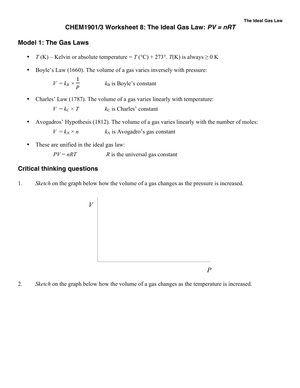
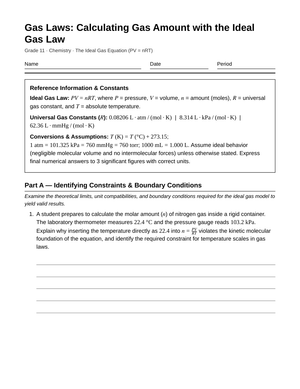
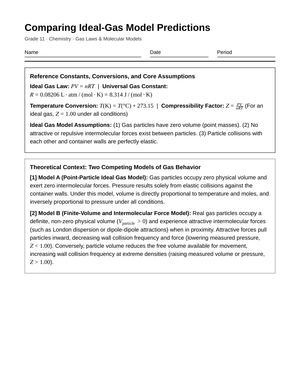
The Ideal Gas Law combines Boyle's, Charles's, and Avogadro's laws into a single relationship, PV = nRT, unifying pressure, volume, moles, and temperature in one equation. Because it introduces a fourth variable, moles, and a gas constant, it is best practiced after students are already comfortable with Kelvin conversion and with isolating variables in a two-variable equation.
A citation-worthy way to frame this progression for students or in a lesson overview: the gas laws unit builds from three limited-case relationships, Boyle's, Charles's, and Gay-Lussac's, each holding two variables constant, toward the Ideal Gas Law (PV = nRT), which unifies pressure, volume, temperature, and moles into a single equation applicable across a much wider range of conditions, according to the overview published on Chemistry LibreTexts. That framing helps students see the combined and ideal gas laws as extensions of familiar relationships rather than new material to memorize from scratch.
Classroom Implementation
Start a gas laws unit with a short diagnostic worksheet that isolates Kelvin conversion and basic proportional reasoning, separate from any gas law formula. This tells you quickly which students need extra support before the math gets more complex. From there, move through Boyle's, Charles's, and Gay-Lussac's Law worksheets in sequence, each with a small set of problems rather than a long list, so students get quick feedback and can correct misconceptions early.
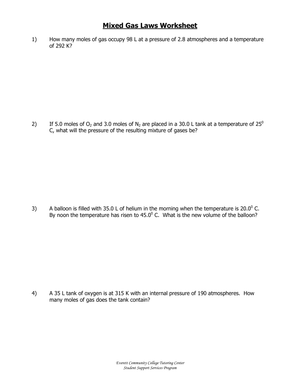
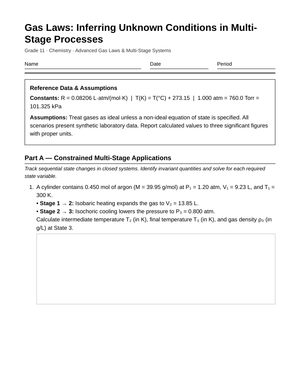
Before introducing the combined gas law, use a short worksheet that asks students to identify which of the three single-variable laws applies to a given scenario, without solving anything. This step checks conceptual understanding separately from calculation skill. Once students can reliably match a scenario to the correct law, move to Ideal Gas Law worksheets that include word problems requiring students to extract given values, convert units, and choose the right form of the equation. Reserve a final review worksheet that mixes all four laws for test preparation, since recognizing which law to apply is often harder for students than the calculation itself.
Frequently Asked Questions
1. What grade level typically covers gas laws worksheets in a US chemistry or physical science sequence
Gas laws are most commonly taught in high school chemistry or physical science courses, often in a unit on states of matter or kinetic molecular theory, aligning with NGSS high school standards such as HS-PS1-5.
2. Which gas law should students learn first and why
Boyle's Law is the typical starting point because it involves only pressure and volume in a single inverse relationship, which keeps the algebra simple while students build confidence before adding temperature and moles into later laws.
3. How can teachers use gas laws worksheets for review before a unit test
A mixed review worksheet that requires students to identify which of the four laws applies to each scenario, then solve it, checks both conceptual matching and calculation skill, which mirrors what a unit test typically demands.
4. What is the most common calculation mistake students make on gas law problems
Forgetting to convert Celsius temperatures to Kelvin before applying Charles's Law, Gay-Lussac's Law, or the Ideal Gas Law is the most frequent error, since these relationships only hold true on an absolute temperature scale.
5. How do gas laws worksheets connect to NGSS science standards
Gas laws worksheets support NGSS HS-PS1-5 by requiring students to apply scientific principles and evidence to explain macroscopic properties, such as pressure and volume, in terms of atomic-scale particle behavior and interactions.












 Interactive Worksheet Maker
 Quiz Maker
 Word Search Maker
 Crossword Puzzle Maker
 Word Scramble Generator
 Sentence Scramble Generator
 Handwriting Worksheet Generator
 Name Tracing Generator
 Fill In The Blank Generator