What Boyle's Law Worksheets Should Actually Practice
Boyle's Law tells students that the pressure and volume of a gas are inversely proportional when temperature stays constant, written as P1V1 = P2V2. A worksheet set that works in a real classroom does more than ask students to plug numbers into that equation. It asks them to reason about why squeezing a gas into half the space doubles its pressure, and it gives them enough varied practice to hold onto that idea after the unit ends.
Robert Boyle confirmed the relationship experimentally in 1662 using a J-shaped tube, and the physics has not changed since. What changes is how you scaffold the practice so a physical science section and an honors chemistry section both get problems pitched at the right level. The best worksheet packets let you differentiate without writing three separate lessons, and they leave room for reasoning, not just arithmetic.
Build Problem Sets from Plug-and-Solve to Word Problems
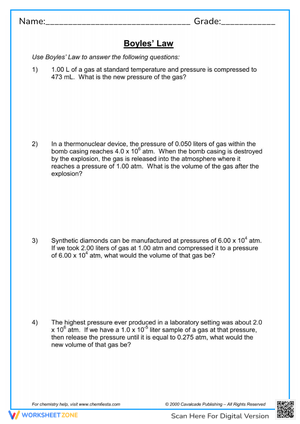
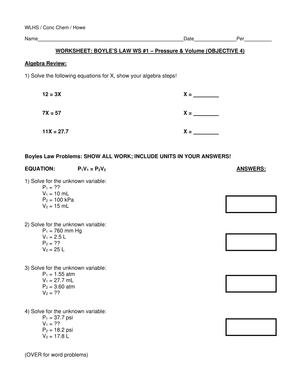
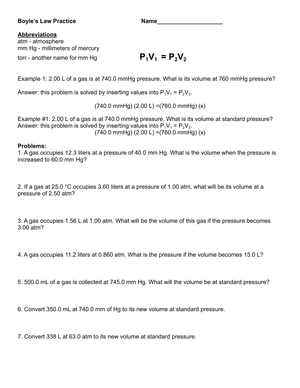
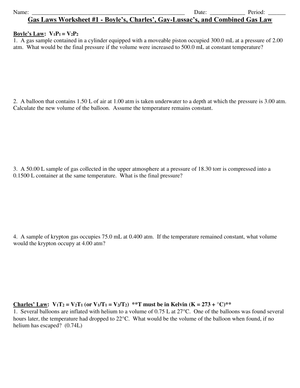
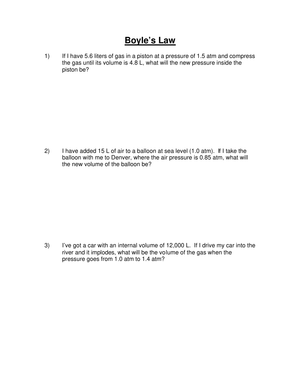
Start with clean plug-and-solve items where all three known values share the same units, so students practice isolating the unknown variable before unit conversion adds friction. Once they can rearrange P1V1 = P2V2 confidently, move to problems that mix atmospheres, kilopascals, and millimeters of mercury so dimensional analysis becomes part of the routine rather than a surprise.
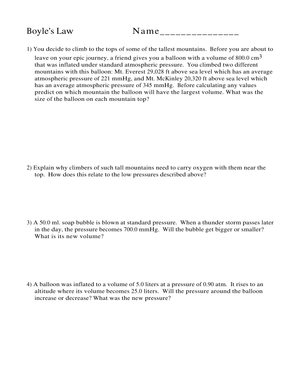
The next tier is multi-step word problems: a scuba tank at depth, a syringe under a thumb, a weather balloon rising through thinning air. These force students to decide which quantity is pressure and which is volume before any arithmetic happens. Layering difficulty this way turns one worksheet into a differentiation tool, letting you assign the first tier to intervention groups and the later tiers to students ready to stretch.
Pair Worksheets with a Phenomenon-First Demo
Students remember the inverse relationship far better when they see it before they calculate it. A sealed syringe with a finger over the tip, a marshmallow in a vacuum chamber, or a collapsing can gives them a concrete image to attach the math to. Run the demo first, ask students to sketch what happened, then hand out the worksheet so the numbers explain something they already witnessed.
The most common place students stumble is not the algebra but the direction of the relationship: under pressure they will multiply when they should divide. Sequencing a demo before the worksheet cuts down on this because students carry a physical memory of volume shrinking as pressure climbs. When a computed answer comes back larger than the starting volume after a pressure increase, they catch their own error instead of waiting for you to mark it.
Add Graphing Practice to the Numerical Work
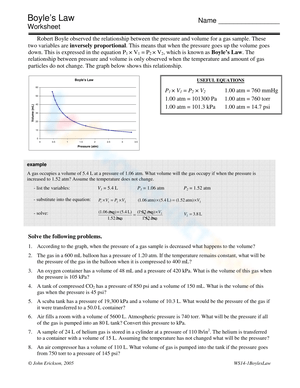
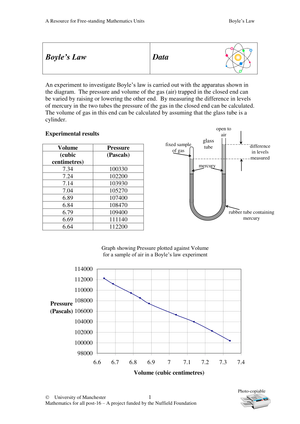
Numerical worksheets pair naturally with a graphing task. When students plot pressure against volume, the curve bends into a hyperbola; plotting pressure against the reciprocal of volume straightens it into a line. Seeing both graphs side by side cements that inversely proportional names a specific mathematical shape, not just a phrase to memorize before a quiz.
According to NASA's Glenn Research Center, Boyle's Law states that the volume of a gas decreases as its pressure increases when temperature is held constant, a relationship physicist Robert Boyle established experimentally in 1662. Framing the rule with that date and that source gives students a credible anchor for classroom discussion.
Connect Problems to Contexts Students Recognize
Boyle's Law shows up in places students already know. Scuba divers manage air volume as pressure changes with depth, aerosol cans hold gas under pressure, weather balloons expand as they rise, and lungs move air much the way a syringe does. Writing worksheet problems around these scenarios answers the "when will I ever use this" question before students think to ask it.
These contexts also work as quick formative checks. Ask students to predict, in one sentence, what happens to a balloon's volume as it climbs to where air pressure is about a third of what it was at ground level. Their answer tells you whether they own the inverse relationship or are only pattern-matching numbers on a page.
Scaffold Support for Students Who Struggle
Students who lose their footing on Boyle's Law problems usually trip on one of three things: rearranging the equation, converting units, or deciding which value is pressure and which is volume. Pull those apart on the worksheet instead of bundling them. A short block of pure rearrangement practice, then a block of pure unit conversion, then combined problems keeps the cognitive load manageable and the errors easy to diagnose.
Dimensional analysis reminders help here. A boxed note listing common pressure units and how they relate, kept right on the worksheet, saves students from stalling on a conversion they half-remember. Worked-example fading does the rest: show a fully solved problem, then a half-solved one, then a bare prompt, so support drops away one step at a time until students solve unaided.
Classroom Implementation
Plan Boyle's Law across two to three class periods. Day one runs a demo and the first worksheet tier. Day two moves into word problems and graphing. A short third session works well for small-group intervention with students who confuse Boyle's Law with Charles's Law or the Combined Gas Law.
Keep intervention worksheets focused on one skill at a time, and hold a mixed-law problem in reserve so students practice choosing the right relationship rather than defaulting to the last formula they saw.
- Assign tier-one problems to intervention groups and word problems to students ready for more.
- Use a pressure-versus-volume graph as an exit ticket to check the inverse relationship.
- Keep a Charles's Law problem in the mix so students practice choosing the right law, not just the right arithmetic.
Frequently Asked Questions
1. What grade level and course usually teach Boyle's Law?
Boyle's Law appears first in middle school physical science as a qualitative idea and returns in high school chemistry and physics with the full P1V1 = P2V2 calculation. NGSS High School Physical Science standards HS-PS1-5 and HS-PS1-6 connect gas law reasoning to explaining the properties of matter from atomic-scale interactions.
2. How is Boyle's Law different from Charles's Law and the Combined Gas Law?
Boyle's Law holds temperature constant and relates pressure and volume. Charles's Law holds pressure constant and relates volume and temperature. The Combined Gas Law ties all three together. Worksheets that mix the laws push students to identify which quantity stays constant before choosing an equation.
3. How can I check understanding beyond plug-and-chug problems?
Ask students to explain a prediction in words, sketch a pressure-versus-volume graph, or spot the error in a wrong worked example. These tasks reveal whether students understand the inverse relationship or are only rearranging numbers by habit.
4. Which real-world examples work best?
Syringes, scuba diving, aerosol cans, weather balloons, and breathing all show the pressure-volume trade-off. Pick contexts your students recognize so the math feels connected to something real rather than abstract and distant.
5. How much class time does mastery usually take?
Most classes need two to three periods: one for the phenomenon and basic practice, one for word problems and graphing, and a short follow-up for intervention. Twelve to fifteen varied practice problems are typically enough to build fluency.












 Interactive Worksheet Maker
 Quiz Maker
 Word Search Maker
 Crossword Puzzle Maker
 Word Scramble Generator
 Sentence Scramble Generator
 Handwriting Worksheet Generator
 Name Tracing Generator
 Fill In The Blank Generator