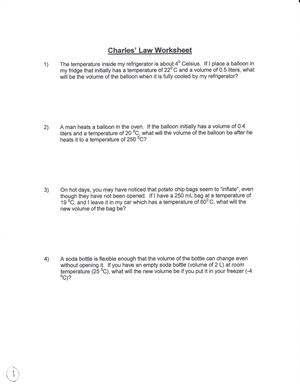
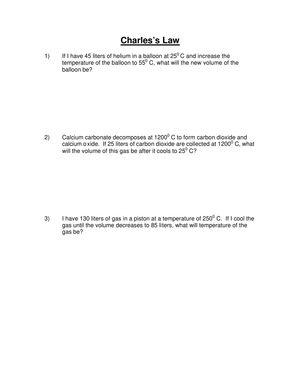
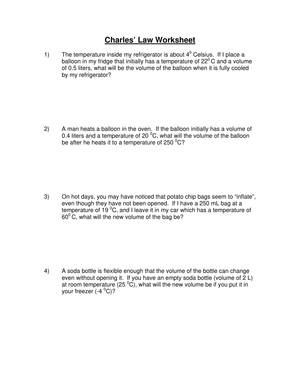
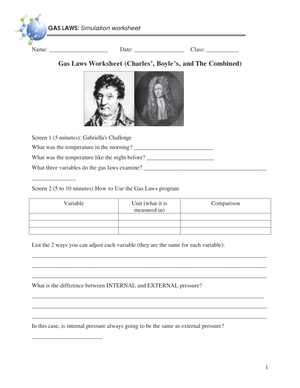
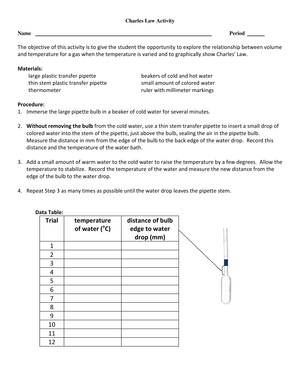
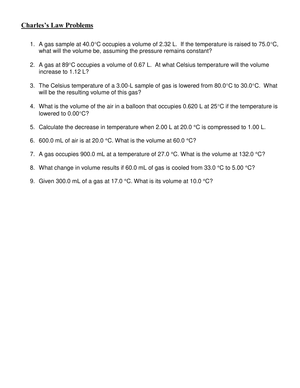
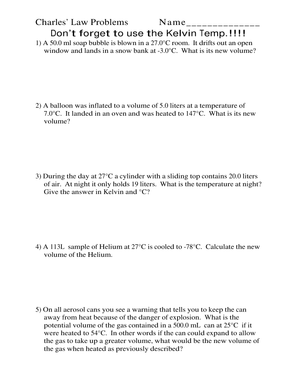
The ability to transition from anecdotal observation to quantifiable measurement is essential for success in introductory physics and chemistry. A well-designed set of Charles' law worksheets gives teachers and parents a precise instrument for evaluating how accurately students can apply the V1/T1 = V2/T2 relationship. Each worksheet in this collection is engineered to function as both a learning tool and a reliable assessment metric, allowing classroom instructors to record measurable benchmarks rather than rely on guesswork during a single laboratory demonstration.
The structured progression within these exercises is intentional. Early items present direct substitution problems where students convert Celsius to Kelvin, isolate the unknown variable, and report the result with appropriate units. Subsequent items introduce multi-step calculations, unit conversions between liters and milliliters, and short conceptual prompts that ask learners to predict how a sealed balloon responds to a refrigerator versus a warm car interior. This deliberate sequencing reveals exactly where comprehension breaks down, whether at the algebraic step, the unit conversion stage, or the conceptual connection between molecular motion and macroscopic volume.
Built-in answer keys accompany every printable so educators can grade rapidly and redirect instructional time toward addressing specific error patterns. Rather than collecting student work for overnight review, teachers can confirm accuracy within minutes and provide same-class feedback. Parents supporting at-home study benefit equally, since the worked solutions clarify the proportional reasoning behind each step. The keys also include alternate solution paths, which support differentiated instruction for advanced learners exploring the broader gas laws and for students who require additional scaffolding before moving to a related pressure and volume practice set.
Tracking student performance across multiple exercises produces actionable data on retention, procedural fluency, and conceptual transfer. Teachers can compare individual scores across the warm-up, calculation, and application sections to determine whether reteaching should focus on temperature-scale conversion, ratio setup, or interpretation of physical scenarios. This evidence-based approach replaces subjective judgments with documented progress, supporting parent conferences, individualized education plans, and grade-level benchmarking for any classroom that values measurable physics outcomes. For educators seeking complementary STEM activities, our companion guide to hands-on physical science investigations pairs naturally with these exercises.
Worksheetzone publishes these resources to support teachers, parents, and students who require precision in their lesson plan execution. Every worksheet is printable, formatted for standard classroom paper, and aligned with common physics curriculum sequences that introduce Charles' law alongside Boyle's law and the combined gas law. By integrating these Charles' law worksheets into weekly instruction, educators gain a reliable mechanism for converting classroom effort into measurable, defensible learning gains that students can carry into higher-level coursework and laboratory practice.
Frequently Asked Questions
Question 1: What grade level are Charles' law worksheets best suited for?
These worksheets are most effective for students in grades 8 through 11, particularly those enrolled in introductory physical science, chemistry, or physics courses. The problems assume basic algebra skills and familiarity with the Kelvin temperature scale. Advanced middle school classes preparing for high school science can also use the early sections as enrichment, while honors students benefit from the multi-step application problems near the end of each printable set.
Question 2: How do these worksheets reinforce the V1/T1 = V2/T2 relationship?
The exercises walk students through direct substitution problems before introducing word scenarios that require setting up the proportion independently. Learners practice isolating each variable, converting Celsius readings to Kelvin, and reporting answers with correct units. By encountering the same proportional relationship across many contexts, students build the procedural fluency and conceptual understanding needed to apply Charles's principle on quizzes, laboratory write-ups, and standardized assessments.
Question 3: Can parents use these worksheets without a science background?
Yes. Each printable includes a complete answer key with worked solutions, so parents can verify student work and explain the reasoning even without prior physics training. The structured progression and clear formatting allow caregivers to identify where a learner is stuck, whether that involves a unit conversion, an algebraic rearrangement, or a conceptual gap. The materials are designed to be self-contained for home study sessions.
Question 4: How can teachers track progress using these printables?
Teachers can score each section separately to generate diagnostic data on temperature conversion accuracy, ratio setup, calculation fluency, and conceptual transfer. Recording these subscores across several worksheets reveals individual learning trajectories and class-wide patterns. The data supports targeted reteaching, differentiated grouping, and evidence-based reporting for parent conferences, intervention plans, and grade-level benchmarking throughout a physics or chemistry unit.












 Interactive Worksheet Maker
 Quiz Maker
 Word Search Maker
 Crossword Puzzle Maker
 Word Scramble Generator
 Sentence Scramble Generator
 Handwriting Worksheet Generator
 Name Tracing Generator
 Fill In The Blank Generator