


























Views
Downloads

Essential Electromagnetic Spectrum Worksheet | Grade 9-12
Paste this activity's link or code into your existing LMS (Google Classroom, Canvas, Teams, Schoology, Moodle, etc.).
Students can open and work on the activity right away, with no student login required.
You'll still be able to track student progress and results from your teacher account.
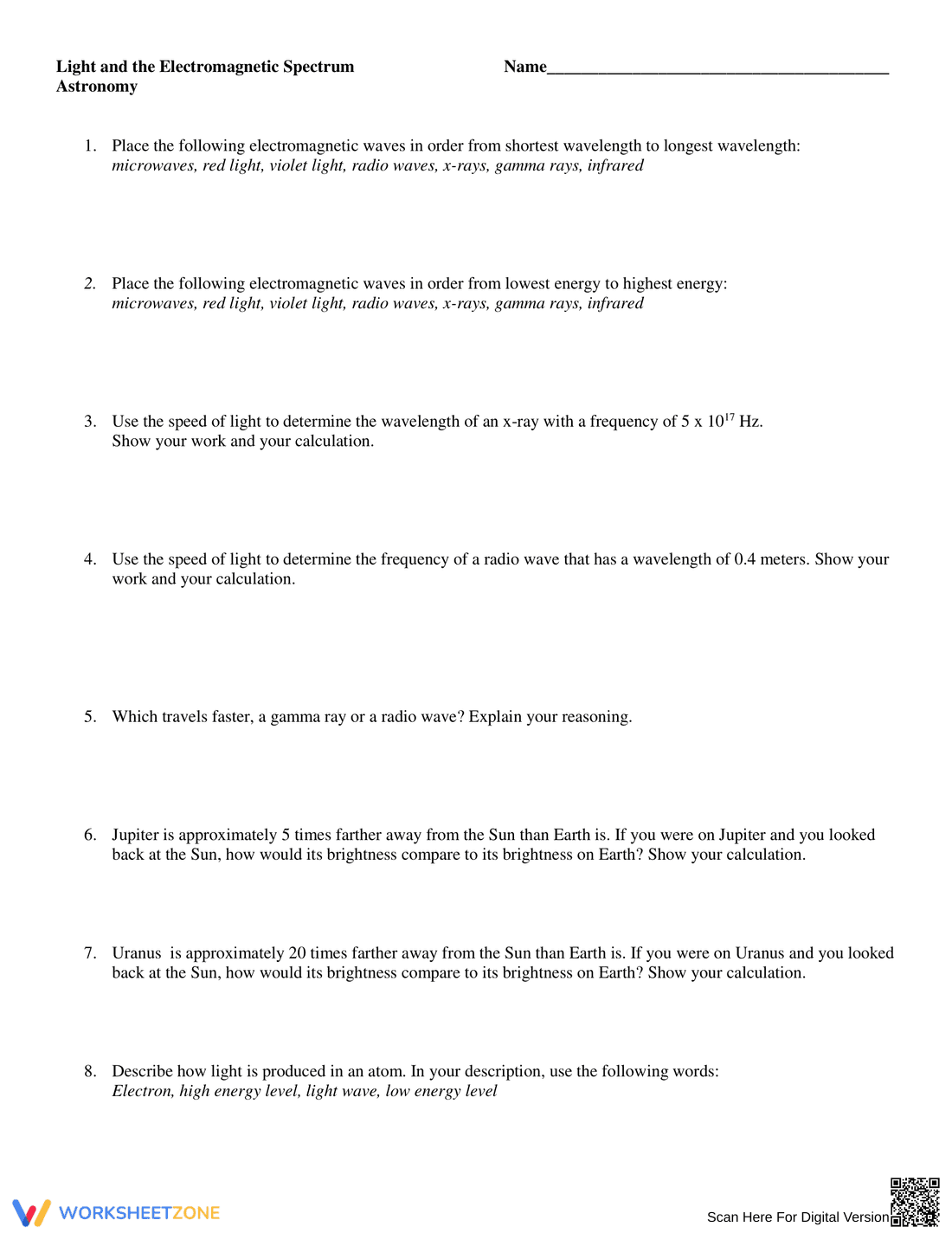
This comprehensive Grade 9-12 physics worksheet guides students through the complexities of light and the electromagnetic spectrum. Students will calculate wave properties, analyze spectral lines, and understand the relationship between energy and frequency. It provides a rigorous framework for mastering wave mechanics and astronomical observations through 13 targeted problems.
At a Glance
- Grade: 9-12 · Subject: Physics / Astronomy
- Standard:
HS-PS4-1— Use mathematical representations to support a claim regarding relationships among wave properties- Skill Focus: EM Spectrum properties and wave calculations
- Format: 2 pages · 13 problems · Answer key included · PDF
- Best For: Independent practice or sub plans
- Time: 40–50 minutes
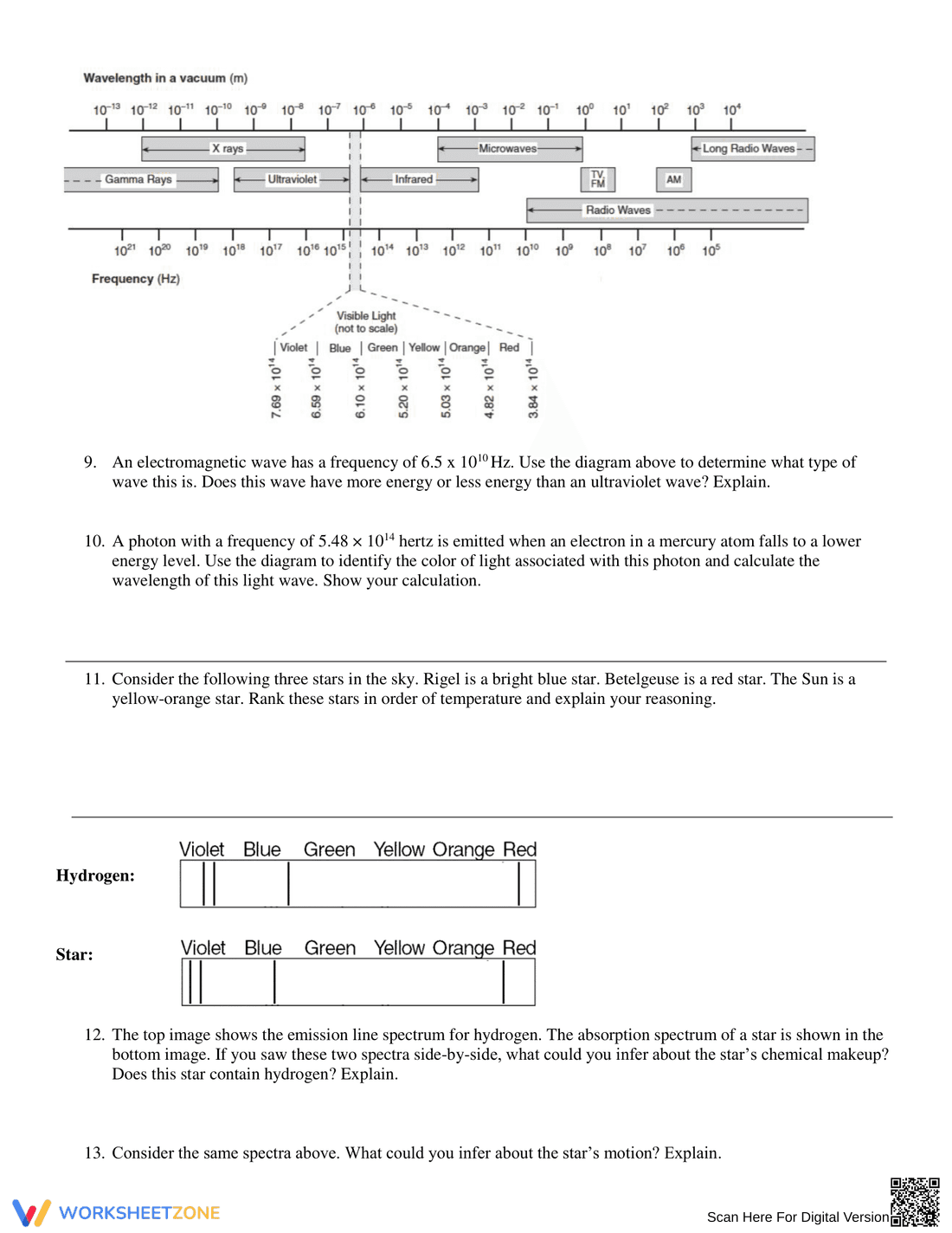
The resource consists of two high-density pages featuring a mix of conceptual and mathematical tasks. Page one focuses on ordering waves by wavelength and energy, alongside four calculation-based problems involving the speed of light. Page two introduces a detailed electromagnetic spectrum diagram, requiring students to identify wave types and analyze hydrogen emission versus stellar absorption spectra.
Zero-Prep Workflow
- Print: Generate the two-page PDF in under 1 minute for your entire class.
- Distribute: Hand out the worksheet as a standalone activity; the included diagram ensures students have all necessary reference data.
- Review: Grade or peer-review the 13 responses in approximately 10 minutes using the provided answer key.
This streamlined process makes the worksheet an ideal solution for emergency sub plans or busy instructional days where teacher prep time is limited to under 2 minutes.
Standards Alignment
Aligned primarily to `HS-PS4-1`, this worksheet requires students to use the wave equation to determine frequency and wavelength. It also supports `HS-ESS1-2` by asking students to identify the composition and motion of stars based on spectral shifts. Both standard codes can be copied directly into lesson plans, IEP goals, or district curriculum mapping tools.
How to Use It
Use this as a formative assessment after introducing the wave equation. The transition from simple ordering to complex spectral analysis provides a natural scaffold. It is also effective as a review tool before a unit test on light. Expect students to spend 45 minutes completing the calculations and the written description of light production in atoms.
Who It's For
This is built for high school physics or Earth and space science students. It is particularly useful for learners who need visual aids, as the included EM diagram provides a constant reference point. Pair this with a diffraction grating lab or a digital spectroscopy simulation for a complete instructional cycle.
According to the RAND AIRS 2024 report, structured problem sets that integrate visual diagrams with mathematical application significantly improve retention in secondary science. This worksheet utilizes that dual-coding approach by pairing a detailed electromagnetic spectrum chart with 13 rigorous tasks. By requiring students to move between conceptual ordering and precise calculations using the speed of light, the resource reinforces the mathematical literacy required by modern standards. Research from Fisher & Frey (2014) suggests that such scaffolded independent practice is essential for moving students toward mastery of complex physical phenomena. The inclusion of spectral analysis further bridges the gap between abstract physics and observable astronomical data, ensuring that students understand the real-world utility of the HS-PS4-1 standard. This resource provides the necessary repetition and cognitive load to solidify student understanding of wave-matter interactions.


