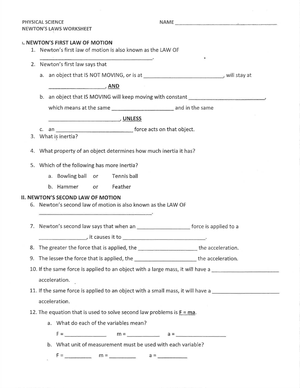
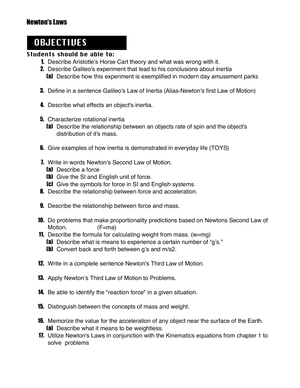
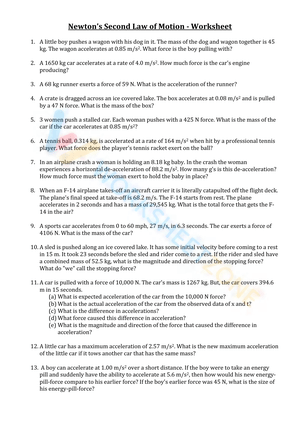
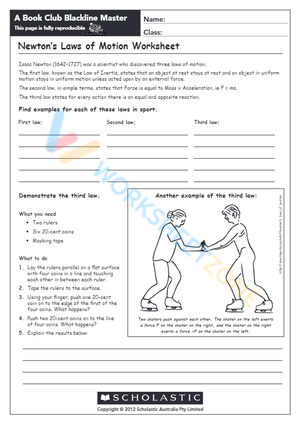
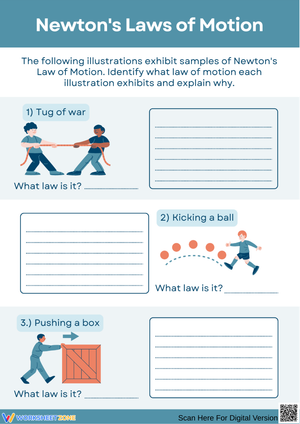
If you searched for newtons laws worksheets, you are probably planning a forces and motion unit and need practice pages that do more than ask students to define inertia. Strong newtons laws worksheets give students scenarios to reason through: a soccer ball rolling to a stop, a loaded cart resisting a push, a skateboarder recoiling off a wall. That kind of applied practice is what separates a worksheet students rush through from one that surfaces real misconceptions during small-group work or a warm-up.
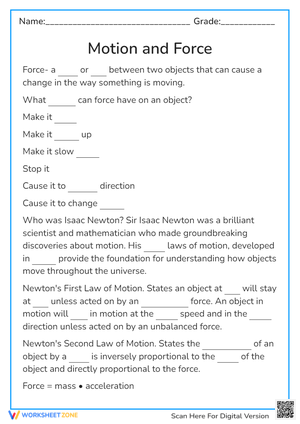
These materials work for middle school physical science, high school physics, review before a unit test, or targeted intervention with students who mix up mass, force, and acceleration. Because the three laws build on each other, the way you sequence newtons laws worksheets across a unit matters as much as the questions themselves.
Sequencing Newtons Laws Worksheets from Middle School to High School
Middle grades emphasize qualitative, conceptual understanding of the three laws before high school introduces quantitative problem-solving with formulas. That progression should shape how you assign newtons laws worksheets. Sixth through eighth graders benefit from scenario-based questions that ask them to predict and explain what happens to an object's motion, without requiring algebraic manipulation. High schoolers are ready to layer in numeric problem sets once they can already explain force interactions in plain language.
A useful check before assigning a new worksheet: read the first three questions and ask whether a student could answer them by memorizing a definition. If so, the worksheet is testing recall rather than the reasoning NGSS expects. Scenario-based items that require students to identify the forces at play do a better job preparing them for lab write-ups and quantitative work later in the unit.
The First Law: Building Conceptual Understanding of Inertia
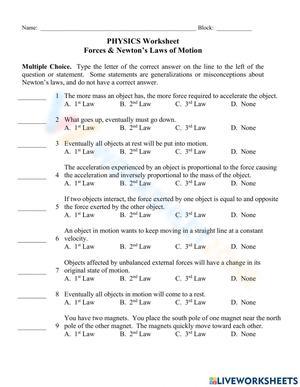
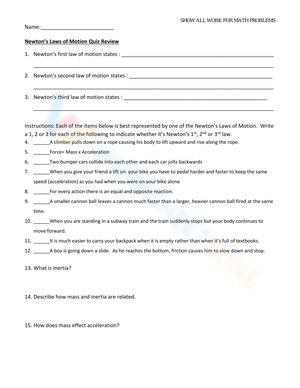
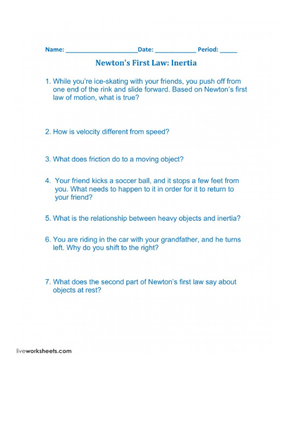
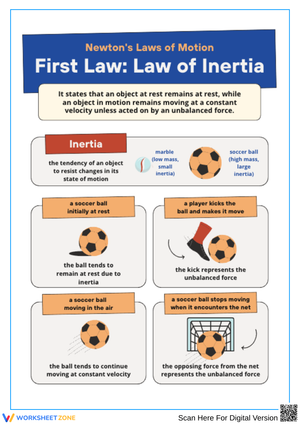
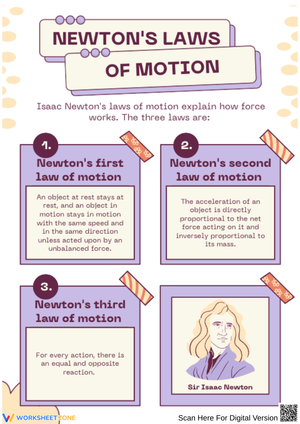
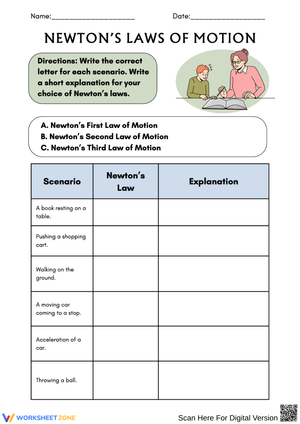
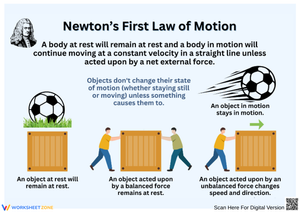
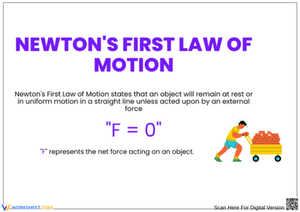
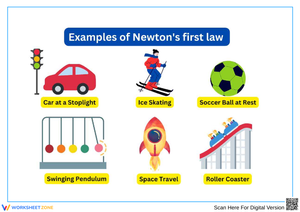
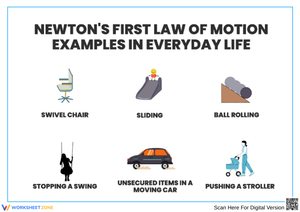
Newtons laws worksheets on the first law work best when they use everyday, US classroom-relevant scenarios: a backpack sliding across a desk, a bus passenger lurching forward when the driver brakes, a ball on a table that stays put until someone pushes it. Ask students to identify what force is present or absent in each case, then explain why the object's motion does or does not change.
Avoid worksheets that only ask students to restate the law from memory. Instead, look for items that require students to apply inertia to a new situation they have not seen in class, since that transfer is what shows whether the concept has actually stuck.
The Second Law: From Qualitative Reasoning to F Equals m a
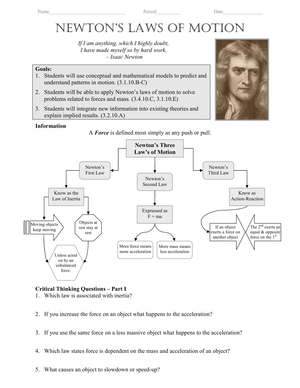
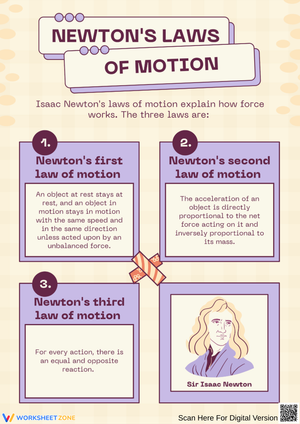
NGSS MS-PS2-2 addresses Newton's second law qualitatively: unbalanced force changes an object's motion, and greater mass requires greater force for the same change. Middle school newtons laws worksheets should stay in this qualitative zone, comparing two carts of different mass and asking students to predict which needs more force to reach the same speed change.
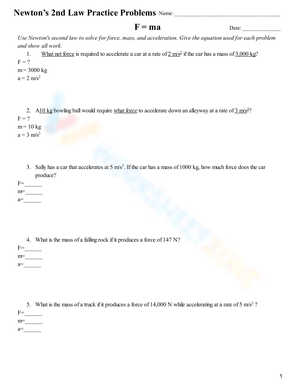
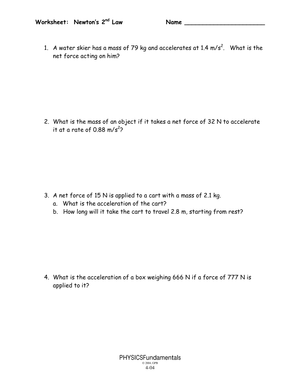
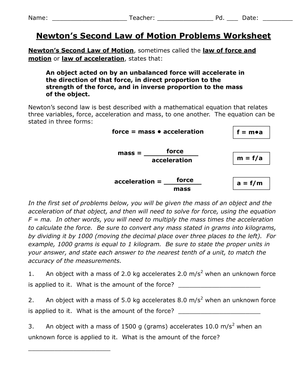
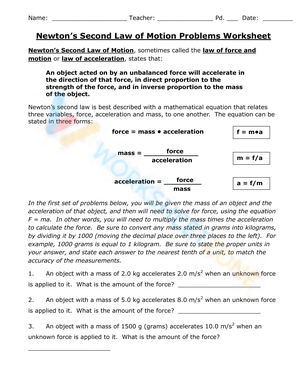
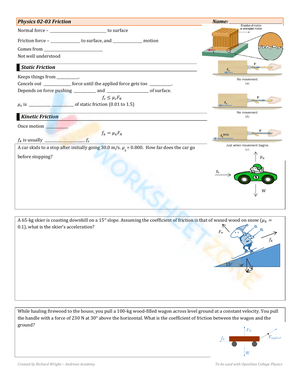
High school worksheets shift to quantitative application. NGSS HS-PS2-1 expects students to use Newton's second law, F equals m times a, to accurately predict changes in motion of macroscopic objects. Good worksheet sets for this standard mix straightforward plug-and-solve problems with at least a few multi-step items where students must rearrange the formula to solve for mass or acceleration, not just force.
One planning detail that is easy to miss: the jump from MS-PS2-2 to HS-PS2-1 is not just adding numbers to a familiar idea, it is a genuine shift in cognitive demand. Students who can correctly reason that a heavier cart needs more force to speed up at the same rate often still struggle to isolate a variable in F equals m times a under test conditions. Building a short bridge worksheet that pairs a qualitative prediction with the matching numeric calculation, side by side on the same page, helps students see the formula as a tool for the reasoning they already trust rather than a new topic to memorize.
The Third Law: Action-Reaction Pairs in Real Scenarios
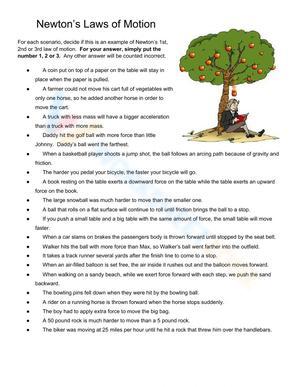
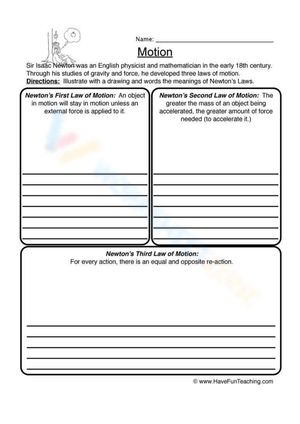
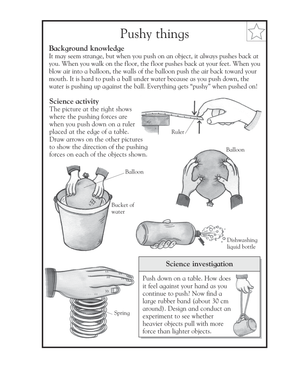
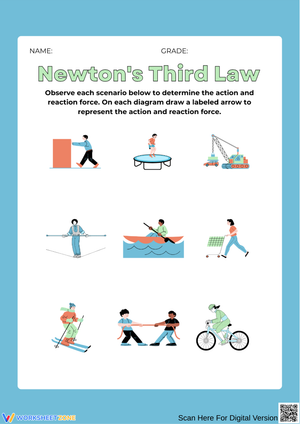
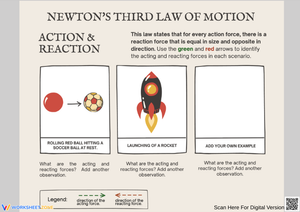
NGSS MS-PS2-1 focuses on Newton's third law: forces between interacting objects are equal in strength and opposite in direction. Newtons laws worksheets on the third law work well when they pull from sports and everyday equipment: a swimmer pushing off a pool wall, two students on rolling chairs pushing apart, a rocket balloon releasing air. Ask students to name both forces in each pair, including their direction, rather than just labeling one side of the interaction.
A common misconception appears in student responses: describing only one force in an action-reaction pair instead of both. Worksheet questions that require students to name every force present, and its direction, help surface this gap directly and support the reasoning NGSS MS-PS2-1 demands.
Classroom Implementation
For a two-week forces and motion unit, consider this rough sequence:
- Day 1 to 2: First law demo plus a qualitative inertia worksheet as a formative check.
- Day 3 to 5: Second law demo with carts, paired with a qualitative worksheet for middle school or a mixed qualitative and quantitative worksheet for high school.
- Day 6 to 8: Third law demo, such as balloon rockets, paired with an action-reaction pairs worksheet.
- Day 9 to 10: A review worksheet mixing all three laws, used as a formative checkpoint before the unit test.
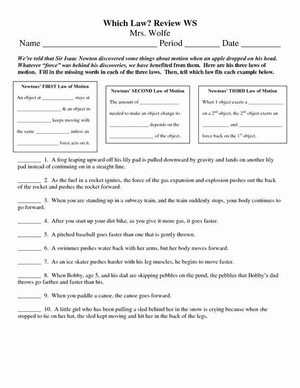
For intervention groups, select newtons laws worksheets tied to whichever law the student's exit ticket or quiz data flagged, rather than assigning a general review page. A student confusing inertia with balanced force needs different practice than one who cannot identify an action-reaction pair, and mixed-topic worksheets can mask which specific misconception still needs attention.
Frequently Asked Questions
1. What grade level is appropriate for teaching Newton's three laws with worksheets?
Middle school, typically grades 6 through 8, is where qualitative worksheet practice on all three laws usually begins under NGSS MS-PS2-1 and MS-PS2-2. High school physics, under HS-PS2-1, adds quantitative F equals m times a practice once students already reason clearly about the second law in words.
2. How do newtons laws worksheets align with NGSS standards like MS-PS2-1, MS-PS2-2, and HS-PS2-1?
MS-PS2-1 focuses on Newton's third law and equal, opposite forces between interacting objects. MS-PS2-2 addresses the second law qualitatively. HS-PS2-1 shifts to quantitative application of the second law for predicting changes in motion of macroscopic objects.
3. What is the difference between qualitative and quantitative practice for Newton's second law?
Qualitative practice asks students to compare and predict, such as identifying which of two objects needs more force for the same speed change. Quantitative practice has students plug values into F equals m times a and solve for force, mass, or acceleration.
4. How can teachers use these worksheets for review or reteaching after a lab activity?
Assign a worksheet that mirrors the specific scenario from the lab, then a second worksheet with a new, unfamiliar scenario testing the same law. If students succeed on the familiar version but struggle with the new one, that gap points to a recall issue rather than genuine conceptual understanding.
5. What common misconceptions about Newton's laws should worksheet questions target?
Frequent misconceptions include believing a moving object needs a constant force to keep moving, confusing mass with weight when reasoning about the second law, and describing only one force in an action-reaction pair instead of both. Worksheet questions that require students to name every force present, and its direction, help surface these gaps directly.












 Interactive Worksheet Maker
 Quiz Maker
 Word Search Maker
 Crossword Puzzle Maker
 Word Scramble Generator
 Sentence Scramble Generator
 Handwriting Worksheet Generator
 Name Tracing Generator
 Fill In The Blank Generator