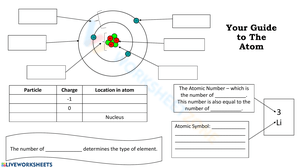
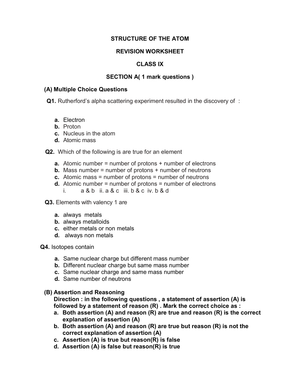
Structure of the atom worksheets give sixth through eighth graders a concrete way to practice identifying protons, neutrons, and electrons, and to connect those particles to atomic number and mass number. Rather than lecturing through another slide deck, a well-designed worksheet asks students to label a diagram, fill in a particle count, or sketch a simple Bohr-style model, which turns a passive lesson into an active check of understanding.
This kind of practice fits directly into a matter and interactions unit, where atomic structure is usually the entry point before students move on to how atoms bond into molecules. Teachers planning a multi-day sequence often find that a single worksheet, used at two different points in the unit, does double duty: once as guided practice right after direct instruction, and again later as a review before a quiz.
Aligning Atom Structure Practice with NGSS MS-PS1-1
Structure of the atom worksheets support NGSS MS-PS1-1, which asks students to develop models describing the atomic composition of simple molecules and extended structures. This performance expectation sits inside the Matter and Its Interactions disciplinary core idea for grades 6-8, and it explicitly names modeling as the science and engineering practice students need to demonstrate.
That framing matters for how a worksheet should be built. A worksheet that only asks students to define terms like proton or electron checks recall but not modeling. A worksheet that asks students to draw or complete a diagram showing the arrangement of particles, then use that diagram to explain a property of the atom, gives students a genuine opportunity to practice the modeling practice named in MS-PS1-1, not just the vocabulary underneath it.
What an Atomic Structure Worksheet Should Cover
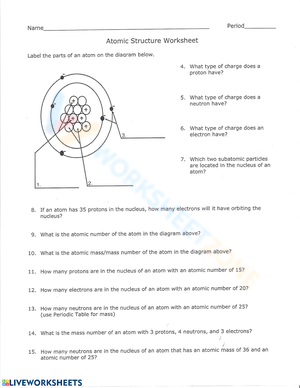
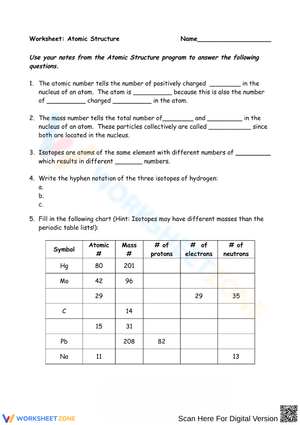
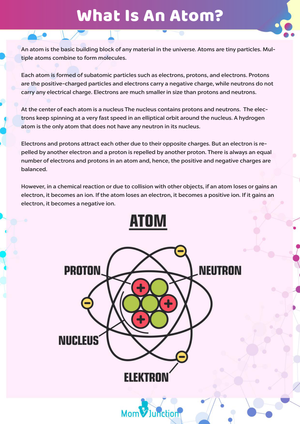
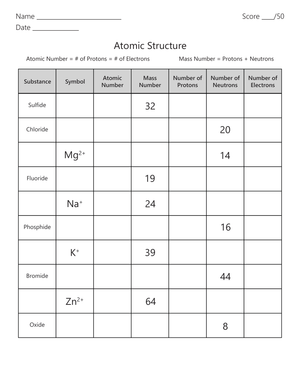
For grades 6-8, atomic structure worksheets typically walk through a consistent set of ideas: protons, neutrons, and electrons; where each particle sits in the atom; atomic number as the count of protons; and mass number as the sum of protons and neutrons. Many worksheets also include a basic Bohr-style diagram, where students place electrons into shells around a nucleus.
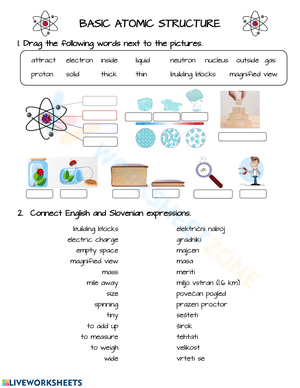
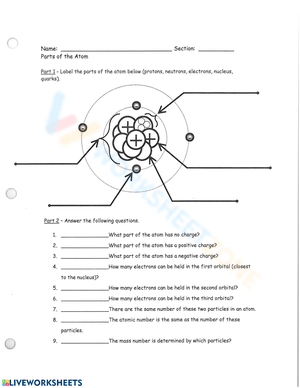
- Labeling tasks that identify proton, neutron, and electron on a diagram
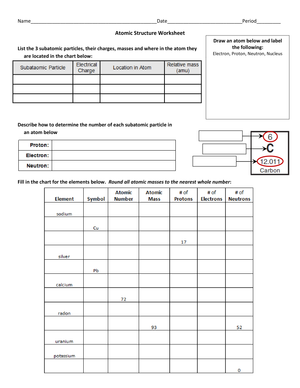
- Fill-in tables connecting element symbol, atomic number, and mass number
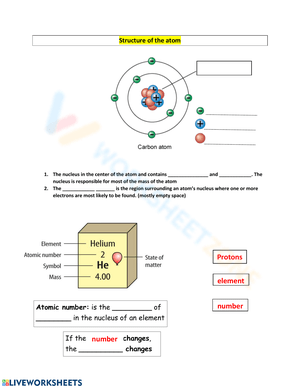
- Simple Bohr model diagrams for electron placement practice
- Short response items asking students to explain how changing one particle count changes the atom
A worksheet that includes even two or three of these formats gives a teacher flexibility to use the same resource for direct instruction practice, a partner activity, or an independent check.
Classroom Implementation
In practice, atomic structure worksheets work best paired with a hands-on model. After introducing protons, neutrons, and electrons, many teachers have students build a simple physical or drawn Bohr model before completing a matching worksheet, so the paper task reinforces something they just built with their hands. Marshmallow or bead-based atom models, paired with a labeling worksheet, give kinesthetic learners a second way into the same content.
For pacing, a single class period can realistically cover direct instruction, a hands-on model activity, and a short worksheet, provided the worksheet stays focused on two or three particle-related skills rather than trying to cover every possible atomic structure concept at once. Saving the isotope and ion extensions for a second day, once basic particle counting is solid, tends to produce better results than introducing everything in one sitting.
Frequently Asked Questions
1. What grade level typically covers structure of the atom worksheets?
Structure of the atom worksheets are most commonly used in grades 6-8 physical science classrooms, where atomic structure is introduced as part of a broader matter and interactions unit.
2. How do these worksheets align with NGSS MS-PS1-1?
MS-PS1-1 asks students to develop models describing the atomic composition of simple molecules and extended structures. Worksheets that require labeling, diagramming, or building an atomic model give students direct practice with this modeling expectation, rather than only testing vocabulary recall.
3. What atomic structure concepts should a worksheet cover for middle school?
A middle school worksheet should generally address protons, neutrons, and electrons, atomic number, mass number, and a basic diagram showing how these particles are arranged, often using a simple Bohr-style model.
4. How can teachers use these worksheets for review versus formative assessment?
The same worksheet format can serve both purposes depending on timing. Used right after instruction, it functions as guided review; used as a short warm-up or exit ticket, it becomes a quick formative check on whether students are ready to move forward.
5. How do atom structure worksheets connect to lessons on molecules and bonding?
Since MS-PS1-1 extends into how atoms combine into molecules and repeating structures like sodium chloride and graphene, solid atomic structure practice sets up the modeling skills students will need once the unit shifts to molecules and bonding.












 Interactive Worksheet Maker
 Quiz Maker
 Word Search Maker
 Crossword Puzzle Maker
 Word Scramble Generator
 Sentence Scramble Generator
 Handwriting Worksheet Generator
 Name Tracing Generator
 Fill In The Blank Generator