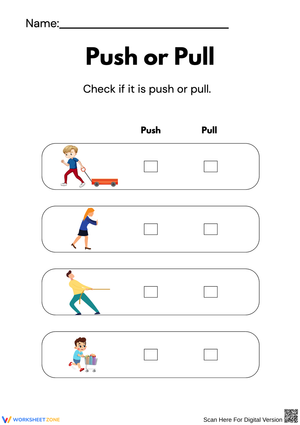
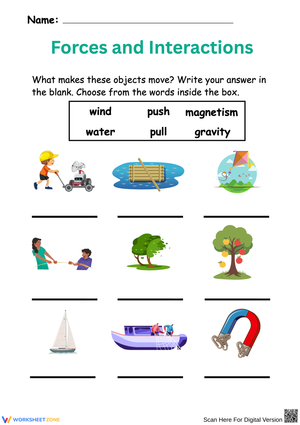
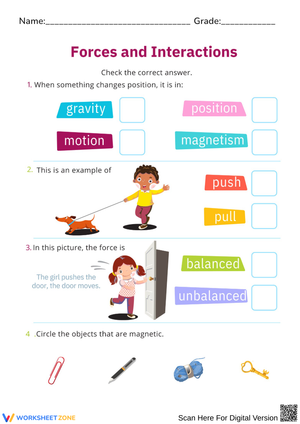
Forces and interactions printable worksheets give middle school science teachers a precise, ready-to-assign tool for the conceptual work that runs from basic pushes and pulls through Newton's three laws — a stretch that typically spans several weeks and surfaces persistent student confusion at every turn. Each worksheet targets one defined skill, so teachers can sequence them as a unit or pull individual worksheets to address gaps spotted during lab work or whole-class discussion.
The Specific Skills Each Worksheet Targets
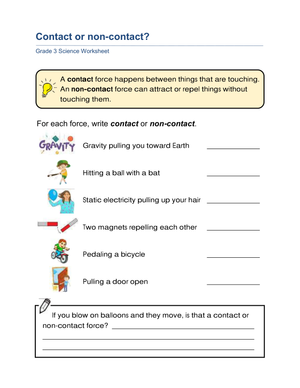
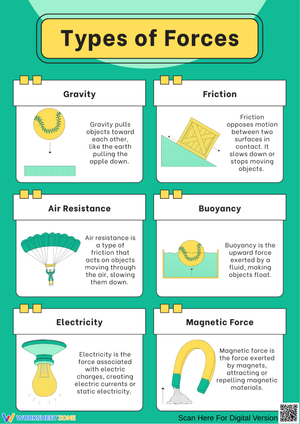
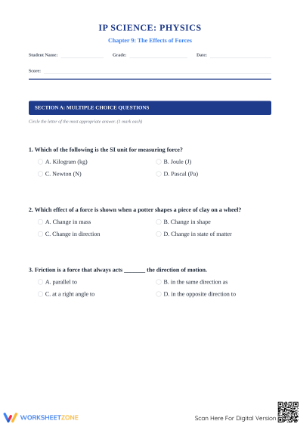
The set covers both contact and non-contact forces, organized around the distinctions students most consistently blur. On the contact side, students practice identifying applied force, normal force, tension, and friction — including, critically, friction's direction relative to motion, which is where student errors concentrate far more heavily than most teachers anticipate. On the non-contact side, worksheets address gravitational force, magnetic force, and electrostatic interactions, with explicit attention to the mass-versus-weight distinction that produces compounding errors in any calculation problem that follows.
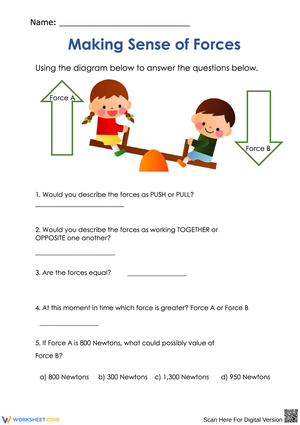
Free-body diagrams run throughout the set. Forces and interactions printable worksheets that include diagram work ask students not just to label forces but to draw arrows proportional to magnitude and correctly oriented — a harder demand than labeling alone. Newton's law worksheets are divided by law: inertia-based reasoning problems for the First, F = ma calculation sets for the Second, and action-reaction identification tasks for the Third. Net force is addressed in multiple formats, starting with collinear problems and moving toward scenarios where students must determine whether an object will accelerate, decelerate, or remain in equilibrium.
Student Mistakes Teachers Should Catch Before They Solidify
Friction direction is the most stubborn error in this unit. Students consistently draw the friction arrow pointing in the direction of motion rather than opposing it — and because that error carries a sign into the net force calculation, it produces wrong numerical answers even when the arithmetic is correct. The most direct fix is to require students to identify the direction of motion before drawing anything: "Which way is this object moving? Which way must friction point?" That sequence catches the vast majority of arrow errors before they're committed to paper.
Newton's Third Law generates a separate problem. Students accept "equal and opposite" in the abstract but reject it in asymmetric-looking scenarios — ask a class whether a tennis ball pushes on a wall with the same force the wall pushes on the ball, and most will say no, because the wall is so much larger. Simply restating the law rarely dislodges this. Worksheets that work around it ask students to reason from what actually happens to the ball: if it bounces back, something exerted force on it. That inferential move is more durable than repeating the rule.
A third pattern surfaces in Second Law calculations: students confuse mass and weight. They correctly recall F = ma but substitute kilograms for the weight term because weight is "how heavy something is" and heavy things are measured in kilograms. A brief unit-chain reference — kg × m/s² = N — posted during calculation worksheets lets students catch their own substitution errors without waiting for teacher feedback.
Standard Alignment
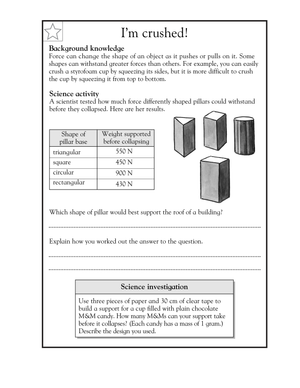
These worksheets align to NGSS PS2.A: Forces and Motion and PS2.B: Types of Interactions. The relevant middle school performance expectations are MS-PS2-1 (applying Newton's Third Law to design a solution to a problem), MS-PS2-2 (analyzing data to describe the effects of balanced and unbalanced forces on an object's motion), and MS-PS2-3 (investigating factors that affect the strength of electric and magnetic forces). Free-body diagram tasks fulfill the NGSS modeling science practice; the calculation-based worksheets address the quantitative component embedded in MS-PS2-2, where students are expected to move beyond qualitative description and work with actual force values.
Building These Worksheets Into Your Planning Cycle
The most reliable entry point for this set is immediately after a demonstration — not as homework. Assigning a free-body diagram worksheet the same period as a hands-on demo (two students pushing a cart from opposite ends with spring scales attached) gives students a physical referent to draw from. The final eight minutes of a lab period is typically enough time to complete one focused worksheet, and the results give you same-day data on which students grasped the diagram model and which ones are still conflating force direction with motion direction.
For week-to-week planning, forces and interactions printable worksheets fit naturally into a spaced retrieval structure: a short identification task on Monday to reactivate the previous week's contact force vocabulary, a free-body diagram worksheet mid-week, and a calculation problem set on Friday that draws on both. This distribution spreads practice across the unit rather than piling review into a single session — which matters for a topic where students need repeated exposure to revise intuitions they've held since early childhood.
Making These Worksheets Work for Every Learner in the Room
For students who are still consolidating force as a vector quantity, the contact-force identification worksheets — where students circle forces from a scenario description and match them to diagram labels — serve as a lower-entry version of the full free-body diagram tasks. These students work with the same physical scenarios the rest of the class encounters but focus on one representational demand at a time rather than constructing the entire diagram independently.
Students ready for extension benefit from the net force calculation worksheets where the diagram is not provided — they draw it themselves before solving, which shifts the task from interpretation to construction. That change in cognitive demand is meaningful. Teachers can push further by pairing Third Law worksheets with a brief lab write-up: students calculate the force each object exerts on the other, then explain in writing why the accelerations differ even though the forces are equal in magnitude.
Frequently Asked Questions
At what grade level do these worksheets fit best?
The core alignment is grades 6–8, where NGSS places the PS2.A and PS2.B performance expectations. That said, the contact-force identification and vocabulary-focused worksheets translate well to upper elementary (grades 4–5) when teachers want to build force vocabulary before the formal Newton's laws unit arrives. High school physics teachers also use these worksheets as a diagnostic in the first week of a mechanics unit — the free-body diagram tasks in particular are reliable at surfacing middle school gaps before instruction moves into vector decomposition and trigonometric components.
Do these worksheets require lab equipment or special materials?
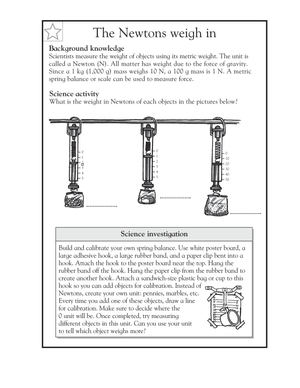
Forces and interactions printable worksheets are built for paper-based use — students draw diagrams, complete calculations, and analyze scenarios using information printed on the worksheet itself. No equipment is required. That said, pairing at least one worksheet per skill with a brief physical demonstration consistently improves results; even something as minimal as a rubber band stretched across two fingers gives students a tactile reference for tension that transfers directly to the diagram they're about to draw.
Which worksheets work best for summative assessment?
The net force calculation sets and Newton's Third Law identification tasks translate directly into quiz-ready formats — answers are specific, scoring is objective, and the problems are difficult to complete correctly without conceptual understanding. Free-body diagram worksheets are better suited to formative use, because students vary considerably in how they represent arrows, spacing, and labels. What looks like a wrong answer on paper sometimes reflects a drawing convention rather than a conceptual gap, and that distinction requires a brief conversation to resolve.












 Interactive Worksheet Maker
 Quiz Maker
 Word Search Maker
 Crossword Puzzle Maker
 Word Scramble Generator
 Sentence Scramble Generator
 Handwriting Worksheet Generator
 Name Tracing Generator
 Fill In The Blank Generator