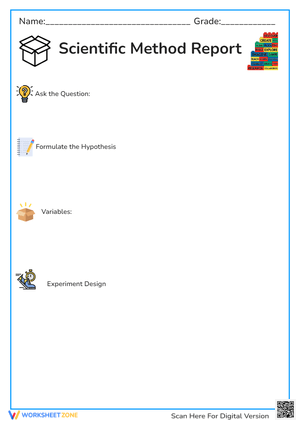
Why identifying variables worksheets belong in science planning
Identifying variables worksheets give teachers a direct way to teach one of the hardest parts of experimental design: helping students separate what changes, what gets measured, and what stays the same. In grades 5-9 science, that distinction matters because students are often asked to design fair tests before they have the language to explain why one setup is valid and another is not. A focused worksheet turns that abstract idea into repeated, visible practice.
That is why identifying variables worksheets fit naturally into lessons on the scientific method, fair tests, and lab readiness. Instead of introducing independent, dependent, and controlled variables only once, teachers can revisit them through short experiment scenarios. A quick prompt about plant growth, paper airplanes, or temperature changes lets students label the parts of an investigation before they collect any data. The result is better discussion, clearer lab plans, and fewer student misconceptions when hands-on work begins.
What students need to identify in each investigation
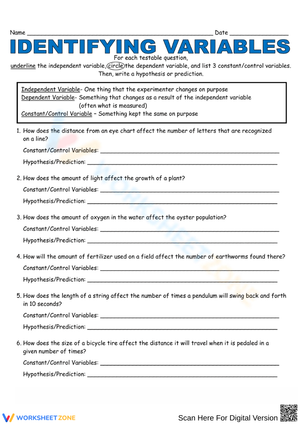
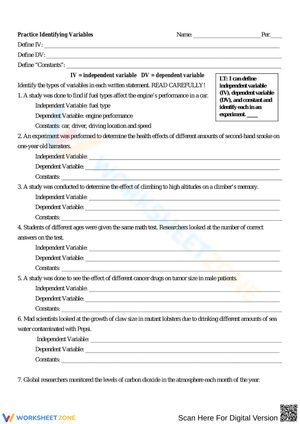
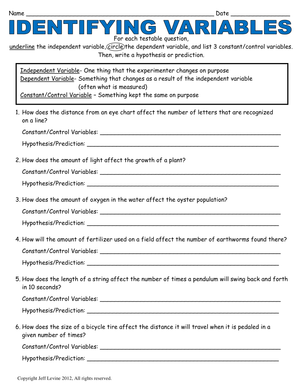
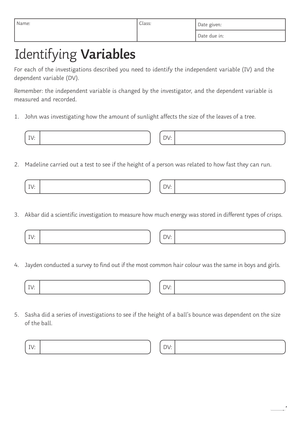
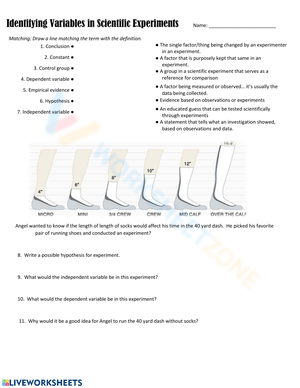
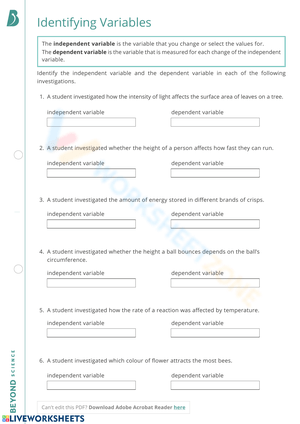
Most identifying variables worksheets center on three core ideas: the independent variable, the dependent variable, and controlled variables. Students first need to spot the independent variable, which is the factor the investigator changes on purpose. Then they identify the dependent variable, which is the result that gets observed or measured. Controlled variables are the conditions that stay the same so the test remains fair.
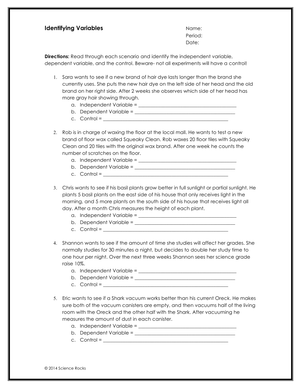
For many learners, the challenge is not memorizing definitions. The challenge is applying those definitions to a realistic classroom scenario. A worksheet might describe two groups of seeds receiving different amounts of light, then ask students which factor changed, what outcome was measured, and what conditions should stay constant. Another item might describe changing ramp height to measure toy car speed, or changing water temperature to observe how quickly sugar dissolves. These short cases help students connect variable language to actual investigations.
Strong practice also asks students to justify their answers. Labeling is useful, but explanation is better. When students can explain why amount of sunlight is the manipulated factor and plant height is the measured outcome, teachers gain a clearer picture of whether they understand cause and effect. That extra reasoning step makes identifying variables worksheets more than a matching activity. It turns them into a bridge between vocabulary and scientific thinking.
How scenario-based practice improves experimental design
Scenario-based questions are effective because they mirror the decisions students must make before a lab starts. When a worksheet presents a short investigation setup, students have to read for purpose, sort relevant information, and decide what matters to the test. That is the same thinking they need during lab prep, even if the worksheet itself is brief.
One practical advantage of this format is that it reveals partial understanding fast. A student may correctly identify the dependent variable but confuse the independent variable with a constant condition. That pattern tells the teacher the student can spot what is measured but still needs support understanding what is intentionally changed. In classroom terms, that is more actionable than a single right-or-wrong score because it points to the exact misconception that could disrupt a fair test later.
Science Buddies emphasizes defining variables before conducting an investigation so the test stays focused and the results can be interpreted clearly. That guidance matters because students often rush to the procedure stage. A 48-word takeaway teachers can use is this: clear variable definitions lead to clearer conclusions, and unclear variables lead to weak evidence.
Classroom Implementation
Teachers can place identifying variables worksheets at several points in a lesson sequence without adding unnecessary prep. As a bell ringer, a single scenario can activate prior knowledge in under five minutes. Before a lab, a worksheet can function as a readiness check to confirm that students understand the experiment they are about to run. After instruction, the same format works as a formative assessment to see whether students can transfer the idea to a new context.
In small groups, these worksheets support productive discussion because students can compare reasoning instead of only comparing answers. One student may argue that the amount of fertilizer is the independent variable while another points out that plant height is the dependent variable. That exchange gives the teacher evidence of thinking and creates a natural opening for academic vocabulary. During stations, teachers can mix printable sheets with oral discussion prompts so students identify variables in both written and spoken forms.
- Use one scenario at the start of class to rehearse vocabulary before new content.
- Assign a short set before labs to reduce confusion during hands-on work.
- Use partner talk so students justify each variable instead of naming it only.
- Keep a mixed set of printable and digital options for stations, homework, and quick reteaching.
What to look for in strong identifying variables worksheets
The best identifying variables worksheets are specific, concise, and grounded in believable science situations. They should not overload students with long reading passages. Instead, they should provide short investigation descriptions with enough detail for students to identify the manipulated factor, the measured result, and the conditions that remain constant. This keeps the focus on reasoning rather than decoding.
Look for materials that ask students to explain their choices at least some of the time. Explanation prompts make grading slightly slower, but they produce better evidence. They also help teachers decide whether a student needs vocabulary review, help distinguishing controls from measured outcomes, or more guided practice with fair tests. When the worksheet supports both quick checks and deeper reasoning, it becomes more valuable across a full unit instead of a single lesson.
How these worksheets scale across grades 5-9
Although the core skill stays the same, teachers can scale identifying variables worksheets by adjusting language, scenario complexity, and the amount of explanation required. In upper elementary grades, students often benefit from simple scenarios and direct prompts such as, What is changed? What is measured? What stays the same? Those questions reduce cognitive load while building accurate vocabulary.
By middle school, the same skill can become more analytical. Students can compare two experimental setups, determine whether a test is fair, or revise a flawed scenario by identifying which control was not held constant. At that level, the worksheet supports more than identification. It supports evaluation and revision, which are important parts of experimental design.
This flexibility is why many teachers keep identifying variables worksheets in circulation throughout a unit instead of teaching the concept once and moving on. Early in the sequence, the worksheet introduces terms. In the middle, it prepares students for labs. Later, it helps review evidence and procedure quality. That repeated use is one reason the format remains effective for both classroom practitioners and curriculum teams looking for reliable science practice materials.
Why printable and interactive formats both matter
Teachers rarely use one delivery format for an entire unit, so it helps when identifying variables worksheets can move between print and screen without changing the instructional goal. A printable version is useful for annotation, quick collection, substitute plans, and science notebooks. A digital version works well for stations, fast checks, or whole-class modeling when the teacher wants to discuss one scenario at a time.
Frequently Asked Questions
1. What is the difference between independent, dependent, and controlled variables?
The independent variable is what the investigator changes on purpose. The dependent variable is what gets measured or observed as a result. Controlled variables are the conditions that stay the same so the test remains fair. Identifying variables worksheets help students practice telling those roles apart in realistic experiment scenarios.
2. What grade levels are identifying variables worksheets best for?
They fit especially well in grades 5-9 because that is when students begin working more often with experimental design, fair tests, and lab planning. Teachers can scale the same concept by simplifying the language for younger learners or adding explanation and critique tasks for middle school classes.
3. How can teachers use variable-identification worksheets before a lab?
Before a lab, teachers can assign one or two short scenarios as a readiness check. If students can correctly label the independent, dependent, and controlled variables before the investigation starts, they are more likely to follow the procedure accurately and understand what evidence the lab is supposed to generate.
4. What should students look for when identifying variables in an experiment?
Students should ask three questions: What is being changed? What result is being measured? What conditions should stay the same? That structure helps them sort the information in any experiment setup and recognize whether the investigation is designed as a fair test.












 Interactive Worksheet Maker
 Quiz Maker
 Word Search Maker
 Crossword Puzzle Maker
 Word Scramble Generator
 Sentence Scramble Generator
 Handwriting Worksheet Generator
 Name Tracing Generator
 Fill In The Blank Generator