




























Views
Downloads
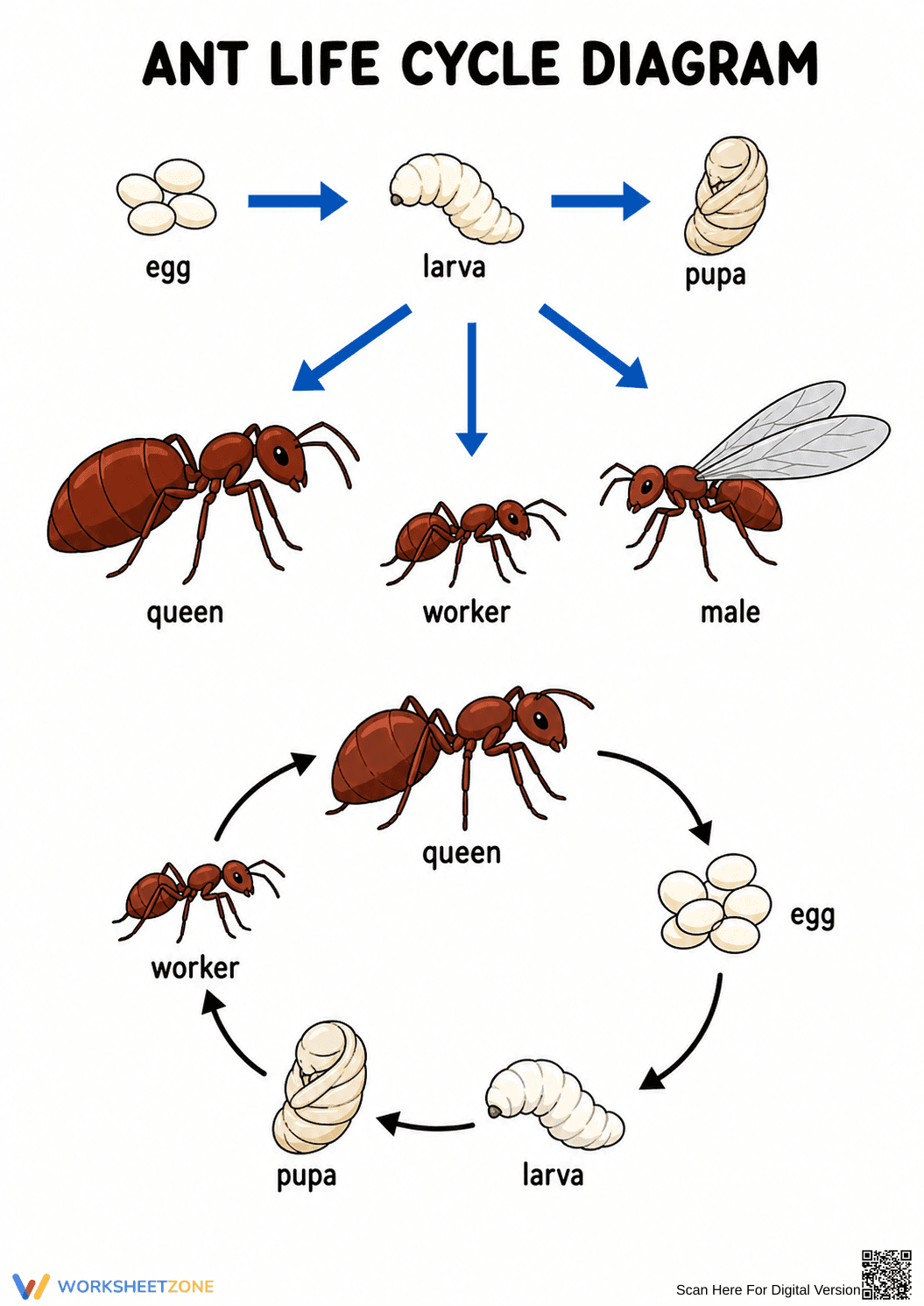

Printable Ant Life Cycle Diagram | Grade 3 Science

Paste this activity's link or code into your existing LMS (Google Classroom, Canvas, Teams, Schoology, Moodle, etc.).
Students can open and work on the activity right away, with no student login required.
You'll still be able to track student progress and results from your teacher account.
This Grade 3 ant life cycle diagram provides a clear visual model for students to identify and sequence the stages of insect metamorphosis. By observing the transition from egg to adult, learners develop a foundational understanding of biological growth and development. This resource serves as a primary reference for science notebooks and classroom displays.
At a Glance
- Grade: 3 · Subject: Science
- Standard:
3-LS1-1— Develop models to describe unique and diverse organism life cycles.- Skill Focus: Metamorphosis sequencing
- Format: 1 page · 1 diagram · Reference guide · PDF
- Best For: Visual aid and science notebooking
- Time: 10–15 minutes
This single-page PDF features a high-resolution, color-coded diagram of the ant life cycle. It includes labeled illustrations for the egg, larva, and pupa stages, along with a breakdown of adult roles including the queen, worker, and male ants. The layout uses directional arrows to demonstrate the cyclical nature of insect development, providing a clear path for student observation and vocabulary acquisition.
Zero-Prep Workflow:
- Print: Select the color or grayscale version and print enough copies for your class in under 60 seconds.
- Distribute: Hand out the diagrams as a reference sheet during your direct instruction on life cycles or insect anatomy.
- Review: Spend 5 minutes tracing the arrows together, identifying the physical changes at each stage of the metamorphosis process.
Total teacher preparation time is less than 2 minutes, making this an ideal resource for emergency sub plans or last-minute science centers.
Standards Alignment
This resource is aligned with `3-LS1-1`: "Develop models to describe that organisms have unique and diverse life cycles but all have in common birth, growth, reproduction, and death." It specifically addresses the "birth" and "growth" components of the standard through the visualization of the egg, larva, and pupa stages. This standard code can be copied directly into lesson plans, IEP goals, or district curriculum mapping tools.
How to Use It
Use this diagram as a visual anchor during the "Explain" phase of a 5E lesson model. Students can glue the diagram into their science journals to serve as a permanent reference for future units on animal classification or ecosystems. As a formative assessment, ask students to describe one physical difference between the larva and pupa stages based on the visual evidence provided. Completion time for a guided discussion is approximately 15 minutes.
Who It's For
This worksheet is designed for third-grade students but is highly effective for English Language Learners (ELLs) due to its heavy reliance on visual cues and clear labeling. It pairs naturally with an ant farm observation kit or a non-fiction text about social insects to provide a multi-modal learning experience.
According to the RAND AIRS 2024 report on elementary science instruction, the use of high-quality visual models is critical for helping Grade 3 students internalize complex biological processes like metamorphosis. This ant life cycle diagram aligns with the 3-LS1-1 standard by providing a concrete representation of birth and growth stages. Research from Fisher & Frey (2014) emphasizes that visual aids serve as essential scaffolds during the gradual release of responsibility, allowing students to transition from teacher-led observation to independent scientific inquiry. By clearly distinguishing between the egg, larva, pupa, and adult forms, this resource helps students build the domain-specific vocabulary necessary for meeting national science benchmarks. The inclusion of specific adult roles, such as the queen and worker, further supports the understanding of social structures within animal populations, a key component of early life science curricula.


