




























Views
Downloads

Ant Life Cycle Printable Worksheet | Grade 6-12 Biology

Paste this activity's link or code into your existing LMS (Google Classroom, Canvas, Teams, Schoology, Moodle, etc.).
Students can open and work on the activity right away, with no student login required.
You'll still be able to track student progress and results from your teacher account.
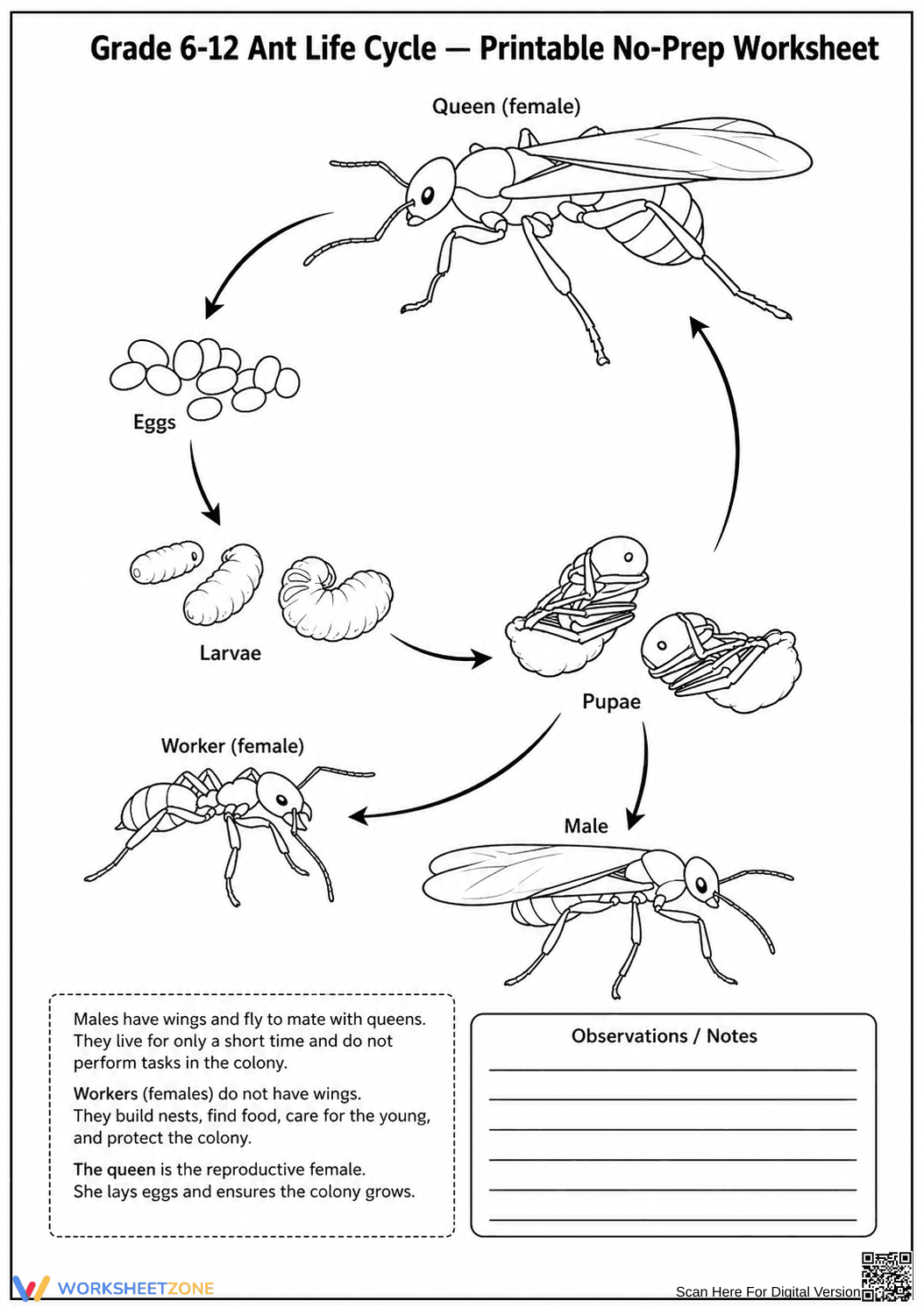
This Grade 6-12 biology worksheet provides a clear visual representation of the ant life cycle, allowing students to trace the development from egg to adult. By focusing on the roles of queens, workers, and males, students gain a deeper understanding of social insect structures and reproductive success in biological systems.
At a Glance
- Grade: 6-12 · Subject: Biology
- Standard:
MS-LS1-4— Explain how animal behaviors and structures affect the probability of successful reproduction- Skill Focus: Insect Metamorphosis
- Format: 1 page · 1 diagram · Reference sheet · PDF
- Best For: Supplemental biology diagrams and sub plans
- Time: 15–20 minutes
The resource features a high-quality line-art diagram illustrating the four primary stages of ant development: eggs, larvae, pupae, and the adult forms (Queen, Worker, and Male). It includes descriptive text explaining the specific roles of males and females within the colony, providing a comprehensive overview of the species' reproductive cycle on a single page.
This zero-prep workflow ensures immediate classroom utility. First, print the single-page PDF (30 seconds). Second, distribute to students as a visual anchor or coloring activity during a lecture on metamorphosis (1 minute). Third, review the anatomical differences between the castes using the provided text (5 minutes). Total teacher preparation time is under 2 minutes.
This worksheet aligns with MS-LS1-4. Students use the diagram to support explanations of how specialized structures, such as the queen's reproductive capacity and the worker's role, contribute to the colony's survival. It also supports HS-LS1-4 regarding cellular division and differentiation during growth. Both standard codes can be copied directly into lesson plans, IEP goals, or district curriculum mapping tools.
Use this as a "Do Now" activity to activate prior knowledge about life cycles before a deeper exploration of entomology. It also serves as an excellent formative assessment tool; ask students to label the transition arrows with the biological processes occurring between stages. Expected completion time is 15 to 20 minutes depending on the depth of discussion.
This resource is designed for middle and high school life science students, including those requiring visual aids or simplified text. It pairs naturally with an insect observation lab or a digital presentation on social insects. It is particularly effective for English Language Learners (ELL) due to the clear visual-to-text associations.
Research by Fisher & Frey (2014) emphasizes the importance of visual non-linguistic representations in science education to help students internalize complex biological sequences. This ant life cycle worksheet utilizes clear schematic arrows and distinct anatomical drawings to reduce cognitive load while teaching the MS-LS1-4 standard. By identifying the specific roles of the queen, worker, and male, students move beyond simple memorization toward an understanding of how social structures influence reproductive success. According to the NAEP science framework, the ability to interpret diagrams is a foundational skill for scientific literacy in secondary education. This 1-page resource provides the necessary scaffolding for students to master the concept of complete metamorphosis in insects. It serves as a reliable, evidence-based tool for biology classrooms seeking to bridge the gap between abstract life cycle concepts and concrete visual evidence.


