




























Views
Downloads
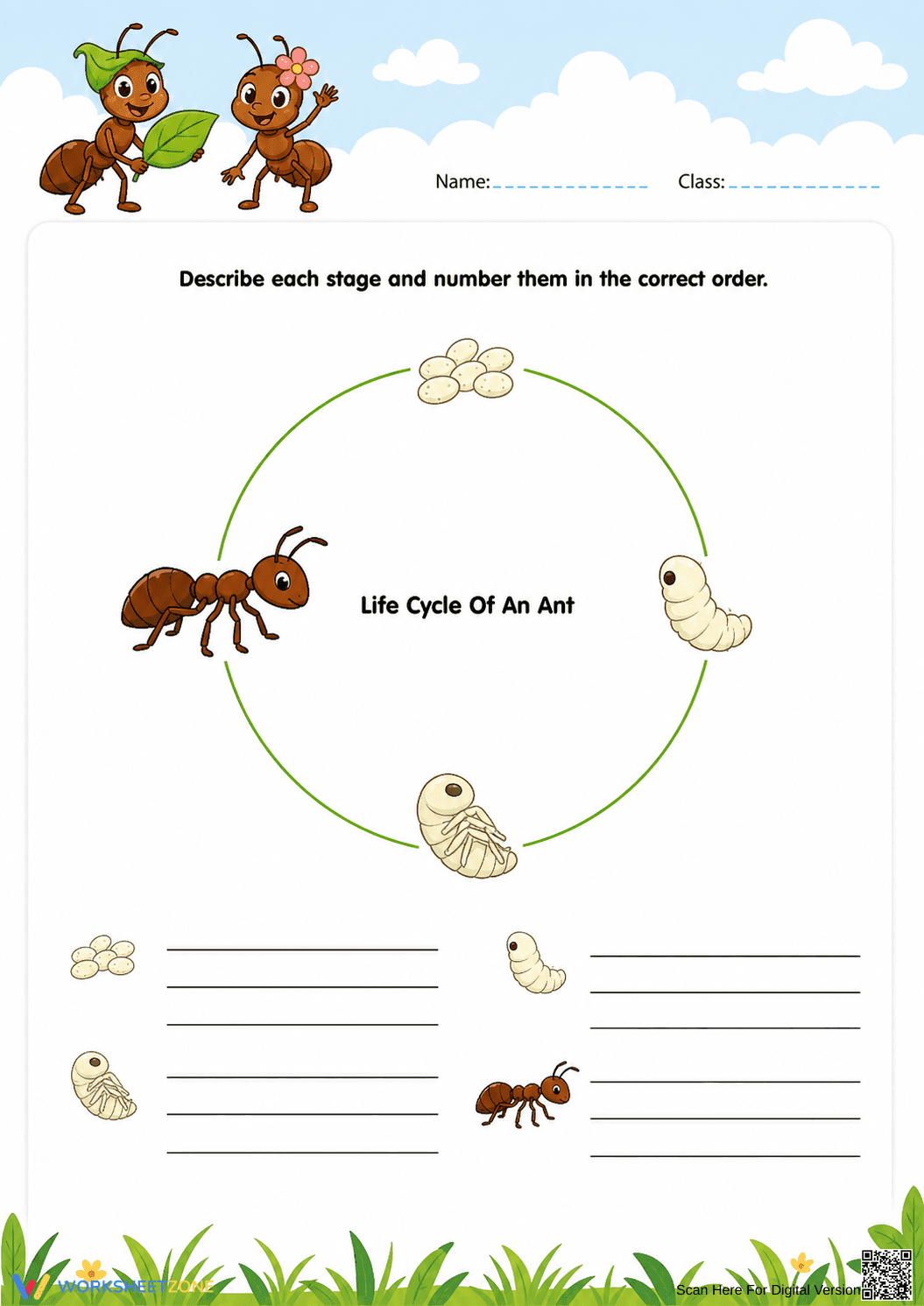

Grade 3 Ant Life Cycle — Printable No-Prep Worksheet

Paste this activity's link or code into your existing LMS (Google Classroom, Canvas, Teams, Schoology, Moodle, etc.).
Students can open and work on the activity right away, with no student login required.
You'll still be able to track student progress and results from your teacher account.
This printable science worksheet helps students master the stages of an ant's development by sequencing and describing its life cycle. By observing a clear, circular diagram, learners will identify the egg, larva, pupa, and adult stages, translating visual models into written explanations to solidify their foundational biology skills.
At a Glance
- Grade: 3 · Subject: Science
- Standard:
3-LS1-1— Describe the unique and diverse life cycles of organisms.- Skill Focus: Sequencing and describing life cycle stages
- Format: 1 page · 4 problems · PDF
- Best For: Independent practice or science centers
- Time: 15–20 minutes
Inside this single-page resource, educators will find a clearly illustrated circular diagram detailing the four distinct phases of an ant's life. Below the visual model, the worksheet provides four structured writing sections corresponding to each developmental stage. Students are prompted to number the stages in the correct chronological order and write a brief description of what occurs during each phase, reinforcing both scientific observation and informational writing skills.
This resource offers a zero-prep workflow:
- Print (1 minute): Simply download the PDF and print a class set.
- Distribute (1 minute): Hand out the worksheets during your science block or place them in a designated center folder.
- Review (3 minutes): Quickly check student descriptions and sequencing numbers for accuracy.
With under two minutes of total teacher prep time required, this activity is perfect for immediate classroom use or as a reliable, self-explanatory component of a substitute teacher plan.
This worksheet is directly aligned to the Next Generation Science Standards, specifically 3-LS1-1: Develop models to describe that organisms have unique and diverse life cycles but all have in common birth, growth, reproduction, and death. Both standard codes can be copied directly into lesson plans, IEP goals, or district curriculum mapping tools.
Teachers can utilize this worksheet effectively after a direct instruction lesson on insect life cycles. It serves as an excellent independent practice activity where students can apply what they have learned about metamorphosis. Alternatively, it functions well as a formative assessment tool; while students write their descriptions, teachers can circulate the room to observe whether learners correctly identify the sequence from egg to adult. Expect students to complete this activity within a 15 to 20-minute timeframe.
This resource is primarily designed for third-grade science students, though it is highly adaptable for second or fourth graders studying basic biology. The clear visual scaffolds make it accessible for English Language Learners and students who benefit from graphic organizers. It pairs perfectly with an introductory reading passage about ant colonies or a broader unit on insect metamorphosis.
Effectively teaching biological concepts requires tools that bridge visual models with written expression. This worksheet targets 3-LS1-1, helping students describe the unique and diverse life cycles of organisms through structured sequencing tasks. According to Fisher & Frey (2014), integrating visual diagrams with writing prompts significantly enhances content retention and deepens students' conceptual understanding in the science classroom. By requiring learners to observe the ant's developmental stages and immediately translate those observations into written descriptions, this resource supports cognitive transfer and reinforces critical academic vocabulary. The combination of a clear graphic model and targeted writing lines ensures that students actively process the biological sequence rather than just memorizing facts. This evidence-based approach provides a reliable method for educators to assess student comprehension of life cycles while simultaneously building essential literacy skills in a scientific context.


