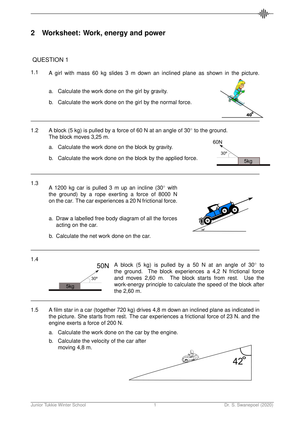
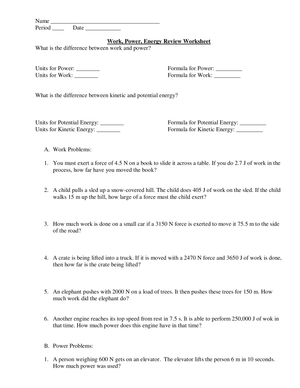
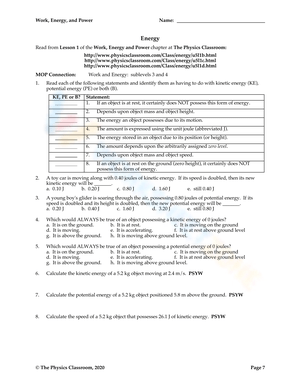
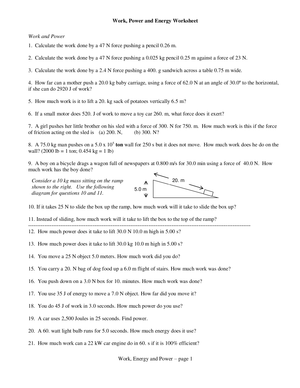
Middle school physical science teachers know that work, power, and energy sit at the center of nearly every forces-and-motion unit. Students arrive with everyday ideas about these words that do not match the science definitions, and that gap is exactly where well-sequenced worksheets earn their place. A good set of practice sheets lets you introduce the formulas, check for understanding in small chunks, and catch misconceptions before they harden into test-day errors.
For grades 6-8, the goal is not just calculation drills. Worksheets should move students from concrete force-and-distance scenarios toward the more abstract idea that energy transfers and transforms as objects interact. That progression matches how NGSS MS-PS3 standards are written, which makes worksheet sequencing a curriculum decision as much as an instructional one.
Teaching Work: Force Over Distance Made Concrete
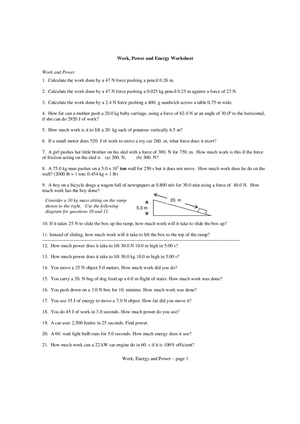
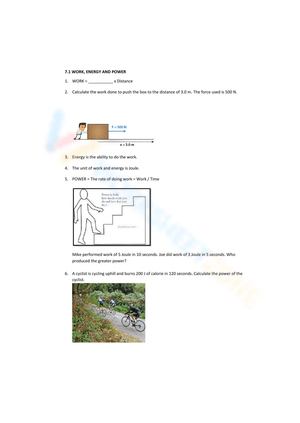
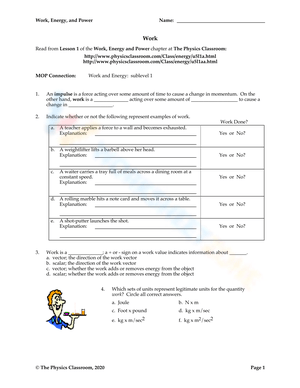
Work in physical science is defined as force applied over a distance, expressed as W = F x d and measured in joules. Students often confuse work with simply pushing hard, so worksheets that pair a labeled diagram with a calculation prompt help separate the physics definition from the everyday one. Start with single-step problems: given force and distance, find work. Once students are comfortable, flip the problem so they solve for force or distance given the other two values.
Word problems set in a school or gym context tend to land best with this age group. A student pushing a lunch tray, a custodian moving a cart, or a PE class pulling a rope all give you a force-and-distance scenario without needing lab equipment. Worksheets built around these scenes also make a natural bridge into the simple machines unit that typically follows.
Building Power Practice: Adding the Time Variable
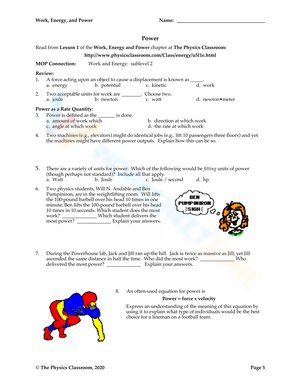
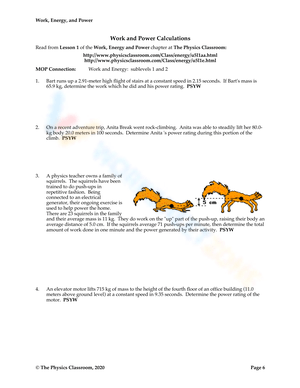
Power is the rate at which work is done, P = W/t, measured in watts. This is where a second common misconception shows up: students frequently equate power with speed alone, ignoring the work component entirely. Worksheets that require students to calculate work first and then divide by time, rather than jumping straight to a power formula, reinforce that power depends on both quantities together.
In practice, the most persistent error on power worksheets is not a math mistake but a units mistake: students plug in force and time without ever calculating work in joules first, which produces an answer with no physical meaning. Building a mandatory intermediate step into the worksheet, where students must write the work value before touching the power formula, cuts this error dramatically because it forces the calculation to follow the actual physics rather than a shortcut.
Connecting Worksheets to Kinetic and Potential Energy Under NGSS MS-PS3
Once work and power calculations feel routine, worksheets should pivot to kinetic and potential energy, which is where the NGSS energy standards become directly relevant. MS-PS3-1 focuses on the kinetic energy of an object based on its mass and speed, while MS-PS3-2 asks students to model how potential energy changes with the arrangement of interacting objects, with an emphasis on relative amounts rather than precise calculations.
That distinction matters for worksheet design. Kinetic energy worksheets can include numeric practice, since mass and speed are measurable quantities students can compute with. Potential energy worksheets, by contrast, work better as comparison tasks: which configuration has more stored energy, and why, rather than solving for a joule value. Matching the worksheet format to what each standard actually asks for keeps practice aligned to the assessment students will eventually face.
According to the Next Generation Science Standards MS-PS3 Energy framework, middle school students are expected to reason about energy transfer and conservation using models rather than memorized definitions, with MS-PS3-2 explicitly prioritizing qualitative comparisons of potential energy over exact numerical answers. This framing should guide how much emphasis worksheets place on calculation versus conceptual reasoning.
Classroom Implementation
Sequence worksheets to match your unit arc rather than handing out every sheet at once. A workable order looks like this:
- Force and distance warm-up problems before introducing the word work
- Single-step work calculation worksheets, then mixed practice solving for force or distance
- Power worksheets that require a written work step before the power formula
- Kinetic energy calculation practice tied to MS-PS3-1
- Potential energy comparison tasks tied to MS-PS3-2
- A combined review worksheet before the unit test
Use short, low-stakes worksheets as formative checks between these stages rather than saving all assessment for the end. A five-question exit ticket after the power lesson, for example, tells you within minutes whether students are ready to move on to energy or need another day of practice. For mixed-ability classrooms, keep a scaffolded version with formulas pre-written alongside a version that requires students to select and set up the correct formula themselves, so both groups can work on the same content at an appropriate challenge level.
Frequently Asked Questions
1. What grade level typically covers work, power, and energy in science class?
Work, power, and energy are core middle school physical science topics, most often taught in grades 6 through 8 as part of a forces, motion, and machines unit.
2. How do these worksheets align with NGSS energy standards?
Kinetic energy worksheets connect to MS-PS3-1, which addresses kinetic energy based on mass and speed, while potential energy worksheets connect to MS-PS3-2, which focuses on how potential energy changes with the arrangement of interacting objects.
3. What is the difference between work and power in simple terms for students?
Work measures how much force is applied over a distance, while power measures how quickly that work gets done. Two students can do the same amount of work, but the one who finishes faster has more power.
4. How can teachers use these worksheets for both practice and assessment?
Use scaffolded worksheets during initial instruction for guided practice, then switch to mixed-format worksheets without formula prompts as a formative check, and reserve a combined work-power-energy worksheet as review before a summative unit test.












 Interactive Worksheet Maker
 Quiz Maker
 Word Search Maker
 Crossword Puzzle Maker
 Word Scramble Generator
 Sentence Scramble Generator
 Handwriting Worksheet Generator
 Name Tracing Generator
 Fill In The Blank Generator