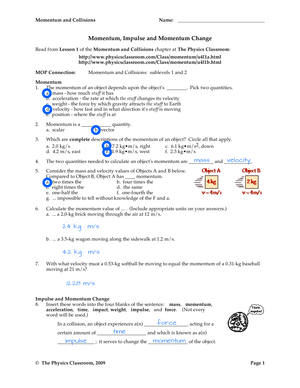
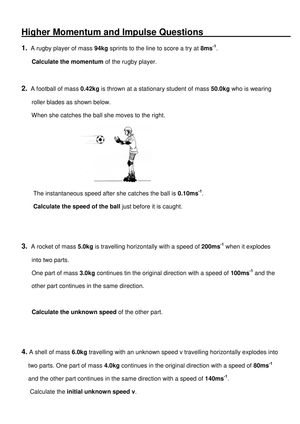
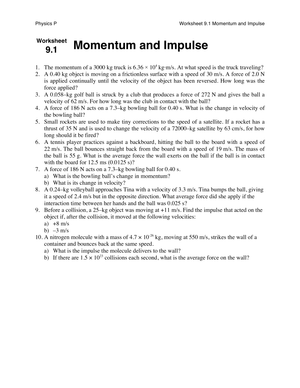
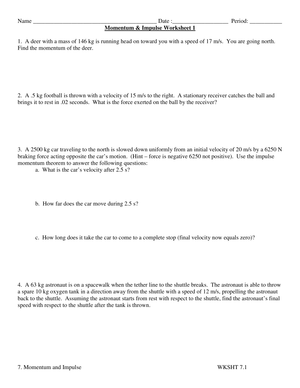
A soccer ball flying across the field, a car slowing at a stoplight, and a skateboarder landing a jump all have something in common: motion changes when forces act over time. Momentum and impulse worksheets help students make sense of these everyday events through physics. Instead of seeing formulas as random symbols, learners begin to understand how mass, velocity, force, and time work together to explain collisions, stops, pushes, and rebounds.
Momentum is often introduced with the formula p = mv, where momentum equals mass times velocity. Students use this relationship to compare moving objects and explain why a heavier or faster object can be harder to stop. Impulse connects closely to this idea because it describes how force applied over time changes an object’s momentum. These worksheets give students practice calculating momentum, finding impulse, interpreting units, and explaining what happens when motion changes during real-world scenarios.
Momentum and impulse worksheets are especially useful after students have learned the basics of force and motion. Teachers can connect this topic to Newton's second law practice so learners see how force, mass, and acceleration support deeper physics reasoning. Once students understand how force affects motion, they are better prepared to analyze why airbags reduce injury, why helmets extend impact time, or why athletes bend their knees when landing.
These worksheets can also support hands-on science learning. Students might analyze toy car collisions, compare bouncing balls, measure stopping distance, or discuss safety equipment in sports and vehicles. Teachers looking for classroom demonstrations can use this middle school science lab guide to connect worksheet practice with simple experiments. When students see motion in action first, the equations feel less abstract and more connected to what they observe.
Worksheetzone’s momentum and impulse worksheets are designed to help students practice both calculations and conceptual explanations. Teachers can use them for guided lessons, homework, review, lab follow-ups, exit tickets, or test preparation. Some activities may focus on formula practice, while others ask students to compare situations, interpret graphs, or explain collisions in words. With consistent practice, learners can build confidence in physics and understand how motion changes in the real world.
Frequently Asked Questions
Question 1: What do students learn from momentum and impulse worksheets?
Students learn how to calculate momentum using mass and velocity, find impulse using force and time, and explain how impulse changes momentum. They also practice applying these concepts to collisions, sports, vehicle safety, and other real-world motion examples.
Question 2: What grade levels are these worksheets best for?
Momentum and impulse worksheets are most useful for middle school physical science, high school physics, and introductory science courses. Younger students can focus on basic concepts and examples, while older students can solve multi-step problems involving formulas, units, graphs, and collision analysis.
Question 3: Why do students often confuse momentum and impulse?
Students often confuse the two because they are closely related. Momentum describes the motion an object has, while impulse describes the force applied over time that changes that motion. Worksheet practice helps students compare the formulas, units, and meanings side by side.
Question 4: How can teachers use momentum and impulse worksheets in class?
Teachers can use these worksheets after lessons on forces, motion, Newton’s laws, or collisions. They work well as warm-ups, guided practice, homework, lab follow-ups, review pages, or small-group support for students who need extra help connecting formulas to physical situations.












 Interactive Worksheet Maker
 Quiz Maker
 Word Search Maker
 Crossword Puzzle Maker
 Word Scramble Generator
 Sentence Scramble Generator
 Handwriting Worksheet Generator
 Name Tracing Generator
 Fill In The Blank Generator