


























Views
Downloads


Essential Unknown Resistance Worksheet | Grade 12 Physics
Paste this activity's link or code into your existing LMS (Google Classroom, Canvas, Teams, Schoology, Moodle, etc.).
Students can open and work on the activity right away, with no student login required.
You'll still be able to track student progress and results from your teacher account.
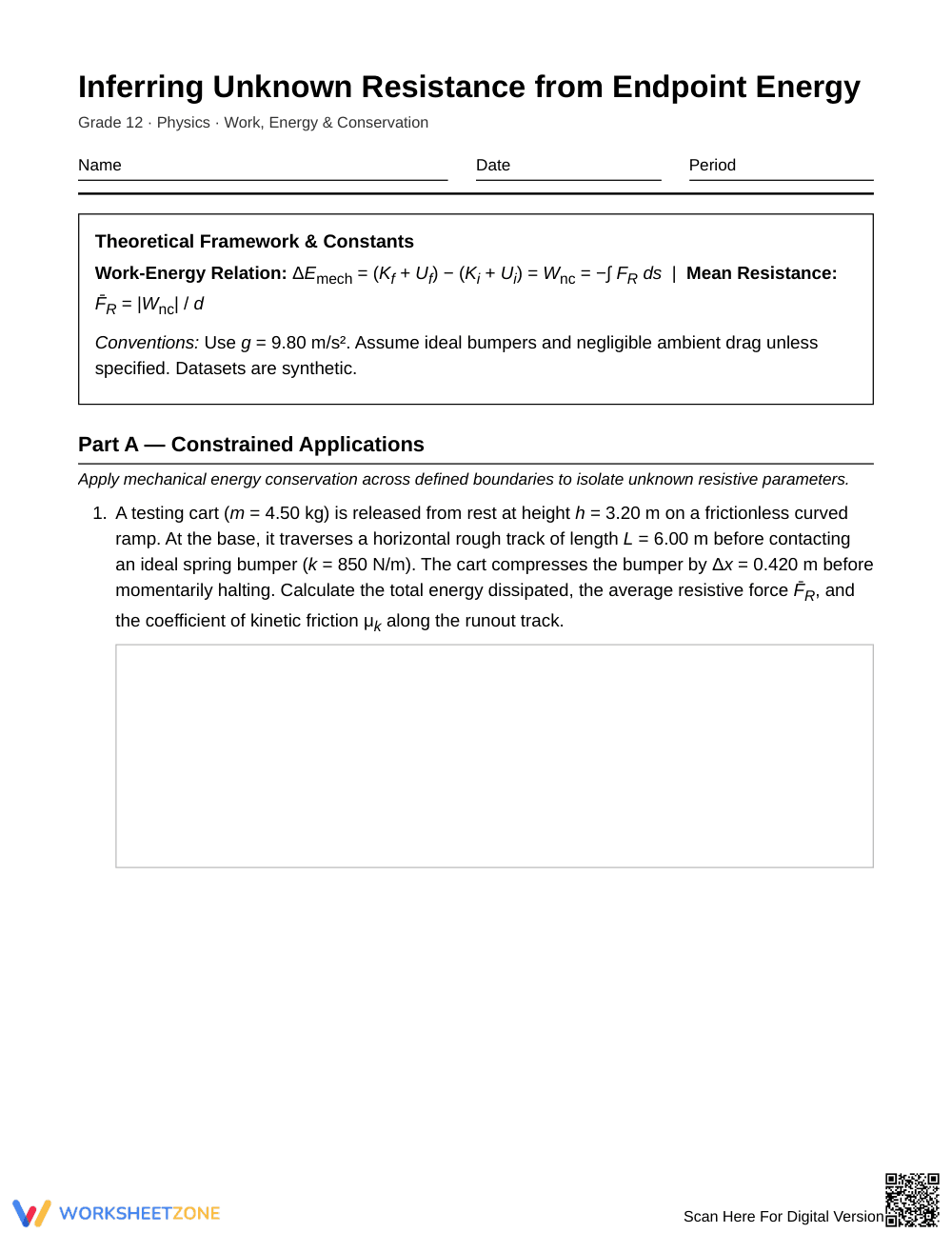
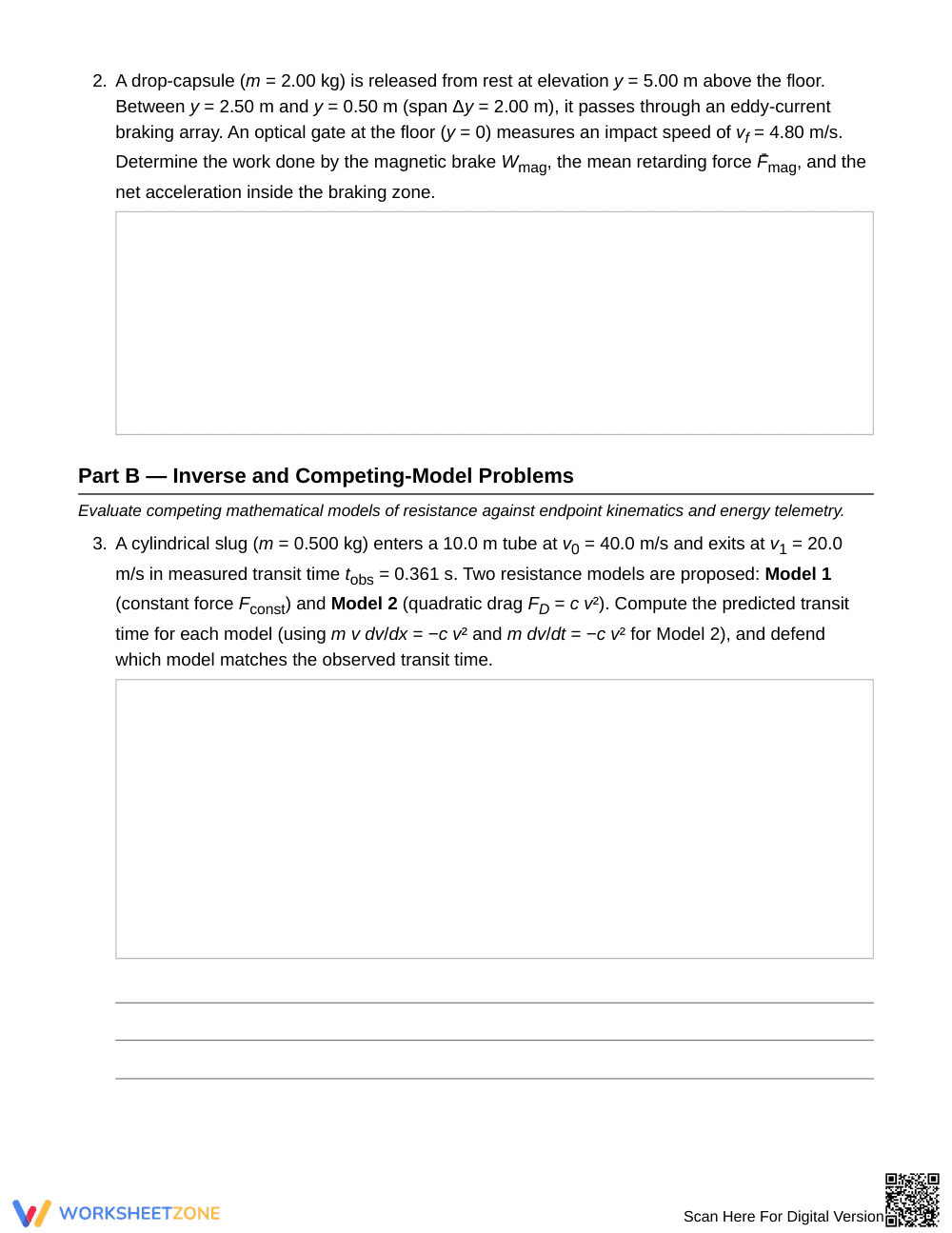
This Grade 12 physics worksheet equips students to infer unknown resistive forces and non-conservative work from mechanical energy endpoints. High school physicists analyze kinematics, spring compression, and deceleration telemetry to quantify dissipation across diverse mechanical systems, establishing rigorous mastery of work-energy conservation.
At a Glance
- Grade: 12 · Subject: Physics
- Standard: Work-Energy — Calculate non-conservative work and infer resistive forces from endpoint data
- Skill Focus: Infer an Unknown Resistance from Endpoint Energy
- Format: 5 pages · 6 problems · Answer key included · PDF
- Best For: Advanced mechanics practice and review
- Time: 45–60 minutes
What's Inside
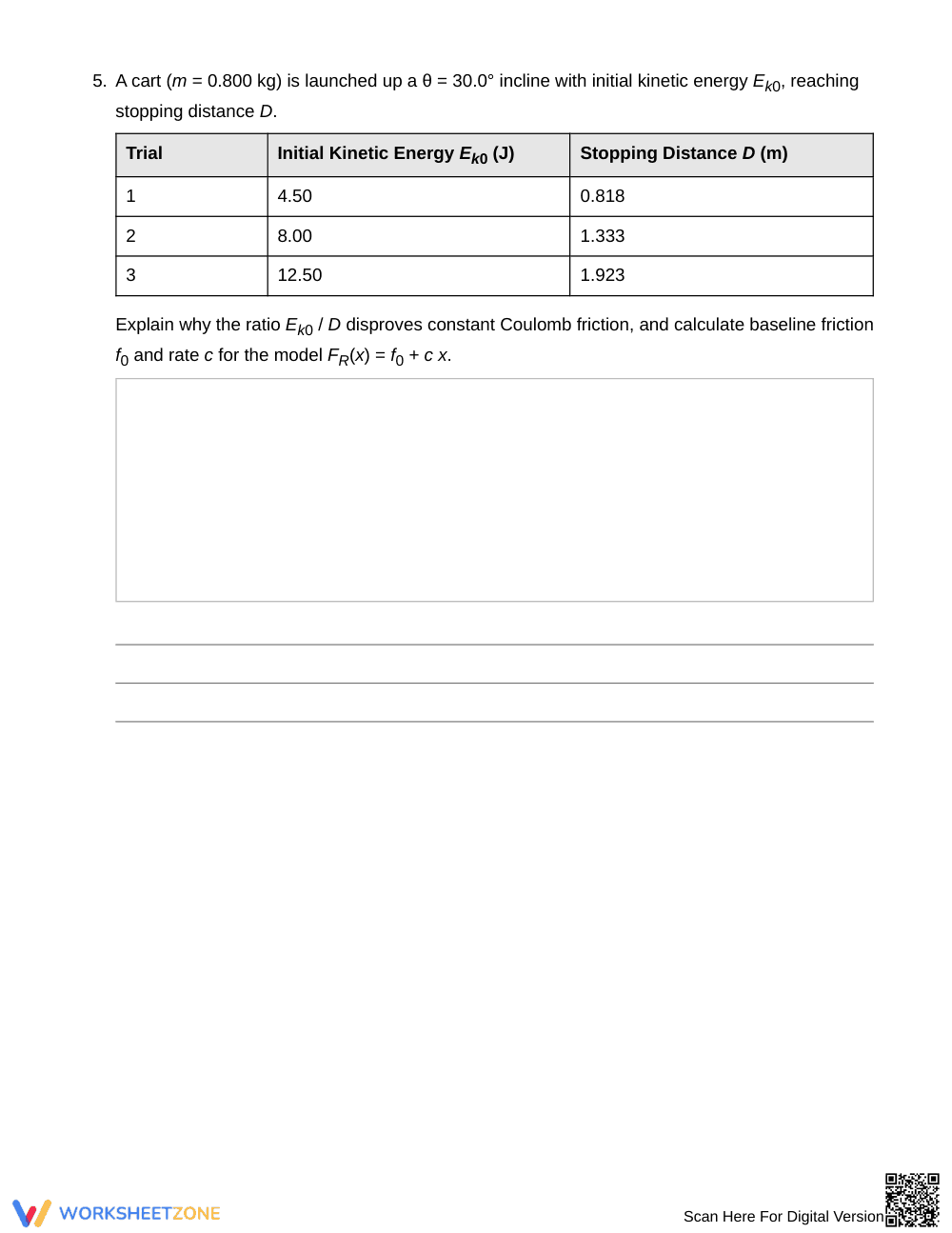
This 5-page worksheet presents 6 rigorous analytical problems across 3 scaffolded parts. A Theoretical Framework and Constants box provides governing work-energy equations and physical parameters. Students examine synthetic telemetry tables, multi-model differential drag setups, and a detailed 3-page worked solution key.
Skill Progression
- Guided Practice (Part A, Problems 1–2): Students apply mechanical energy conservation across defined boundaries to isolate resistive forces and friction coefficients in spring and magnetic braking systems.
- Supported Practice (Part B, Problems 3–5): Learners evaluate quadratic drag, bearing torque, and position-dependent friction models against kinematic endpoints.
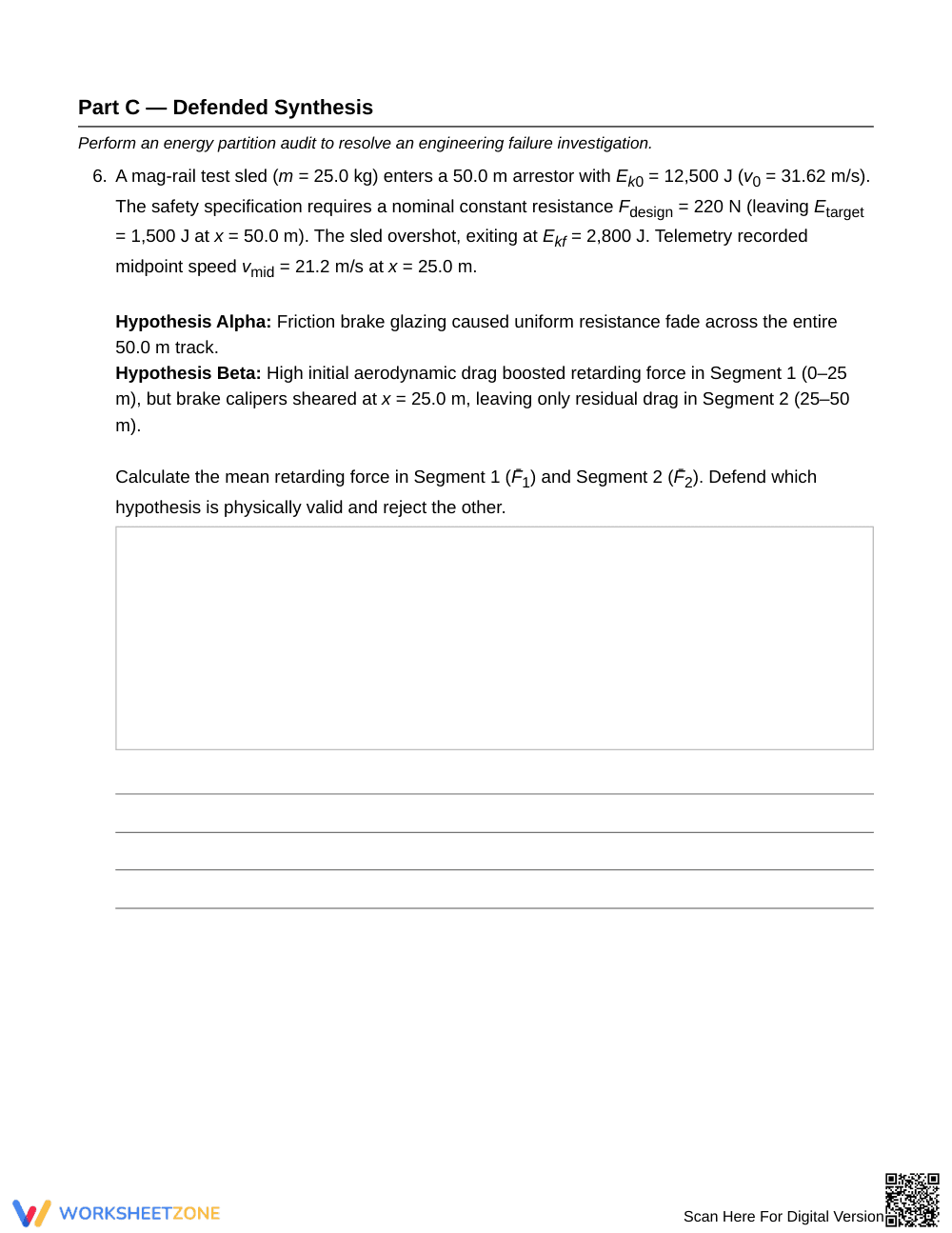
- Independent Practice (Part C, Problem 6): Students perform an energy partition audit to resolve an engineering failure investigation, defending physical hypotheses with telemetry.
This gradual-release sequence guides students from foundational energy balances to independent physical modeling.
Standards Alignment
This activity aligns with high school physics standards for work, energy, and non-conservative forces. Students apply the work-energy theorem to quantify energy dissipation and model variable resistance. Supporting standards emphasize mathematical modeling and empirical hypothesis testing. Both standard codes can be copied directly into lesson plans, IEP goals, or district curriculum mapping tools.
How to Use It
Assign this worksheet following direct instruction on non-conservative work to reinforce analytical problem-solving. Alternatively, use Part C as a small-group capstone investigation auditing failure telemetry. Formatively check whether students correctly establish work integrals before computing dissipation values. The 6 problems require 45 to 60 minutes to complete.
Who It's For
This resource serves Grade 12 AP and honors physics students mastering advanced mechanics. Differentiate by assigning Part A for targeted practice or Parts B and C for advanced differential drag modeling. Pair this worksheet with a deceleration lab experiment to connect theory with physical data.
According to Fisher & Frey (2014), structured instructional progressions that systematically transition from guided practice to independent inquiry significantly deepen secondary students' conceptual mastery in rigorous scientific disciplines. This Grade 12 physics worksheet embodies that evidence-based instructional framework by providing 6 structured analytical tasks designed to help students infer unknown resistance from endpoint energy states. Throughout the multi-part investigation, learners calculate work performed by non-conservative forces, isolate kinetic friction coefficients, evaluate quadratic drag versus constant resistance models, and conduct an energy partition audit to resolve an engineering failure scenario. By linking kinematic endpoint measurements directly to mechanical energy conservation principles, students build essential quantitative modeling and scientific reasoning skills. The included 3-page comprehensive answer key details complete mathematical solutions and model defenses, supporting formative evaluation and targeted feedback across advanced high school physics curricula.


