




























Essential Work Power & Energy Worksheet | Grade 8-12 Science
Paste this activity's link or code into your existing LMS (Google Classroom, Canvas, Teams, Schoology, Moodle, etc.).
Students can open and work on the activity right away, with no student login required.
You'll still be able to track student progress and results from your teacher account.
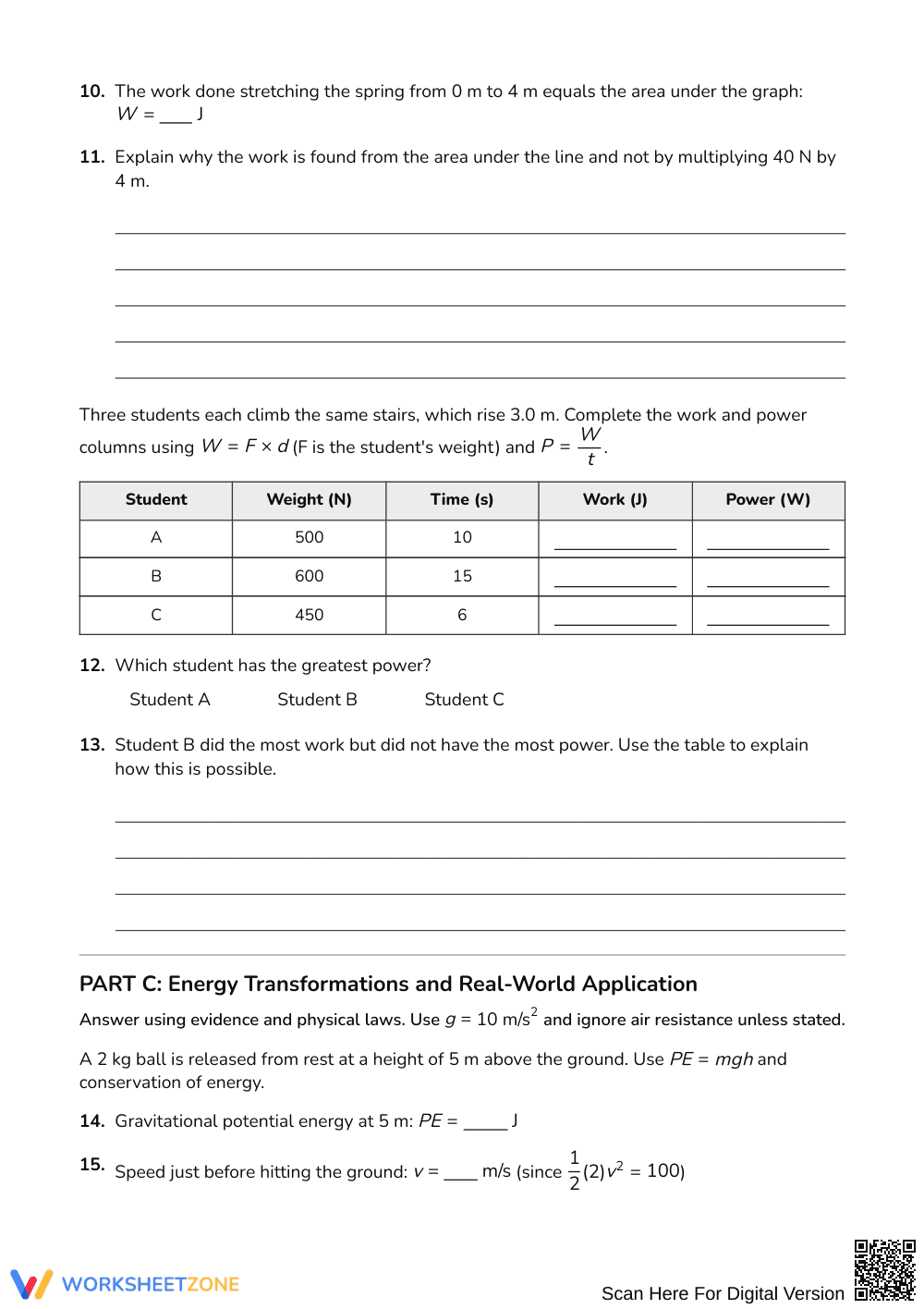
This rigorous cumulative assessment worksheet targets work, power, and energy for Grades 8‑12 Science students. It guides learners through 24 problems that require calculating work, determining power output, and analyzing energy transformations, ending with clear, real‑world, physics‑based explanations in the class.
At a Glance
- Grade: Grades 8-12 · Subject: Science (high school, public school setting, district)
- Standard:
— students will calculate work, power, and energy and explain transformations- Skill Focus: Work Power and Energy: Cumulative Assessment (physics calculations)
- Format: 4 pages · 24 problems · Answer key included · PDF (ready‑to‑print)
- Best For: cumulative unit review & assessment; teacher‑led or independent practice
- Time: 30–45 minutes per class session
What's Inside
The packet spans four double‑sided pages and contains 24 mixed‑format items: multiple‑choice questions, short‑answer calculations, table‑based data analysis, and three extended‑response prompts that ask students to explain energy loss. An answer key on the final page mirrors the problem order for quick grading.
Skill Progression
- Guided practice (8 problems): Students work through multiple‑choice items with a formula reference box.
- Supported practice (8 problems): Short‑answer calculations include a worked example and a word‑bank for units.
- Independent practice (8 problems): Extended‑response questions require full explanations without scaffolds.
This structure follows the classic I Do, We Do, You Do release model, moving students from teacher‑led guidance to autonomous problem solving.
Standards Alignment
` ` Students will calculate work (W = F × d), power (P = W/t), and kinetic or potential energy, then explain how energy is transferred or transformed in real situations. This aligns with typical high‑school physics standards on work‑energy concepts. Both standard references can be copied directly into lesson plans, IEP goals, or district curriculum mapping tools.
How to Use It
Use the worksheet as a pre‑test to gauge students’ baseline understanding before the unit review, then collect the short‑answer responses for immediate formative feedback. Alternatively, assign it as a post‑lesson consolidation activity; teachers can observe whether students correctly apply formulas during the extended‑response items. Completion time ranges from 30 to 45 minutes.
Who It's For
The worksheet is designed for high‑school science students in Grades 8‑12, especially those preparing for a unit exam on work, power, and energy. While the core items meet grade‑level expectations, teachers can offer the worked‑example set as a scaffold for struggling learners. Pair it with an anchor chart of the key formulas for quick reference.
Research shows that explicit formula practice combined with real‑world contexts improves high‑school students’ mastery of work, power, and energy concepts (Fisher & Frey, 2014). This worksheet delivers exactly that blend: 24 targeted problems require students to calculate work (W = F × d), power (P = W/t), and kinetic or potential energy, then articulate the underlying energy transformations in concise written responses. By providing a worked example, a word‑bank, and progressive independence, the tasks align with the skill focus “Work Power and Energy: Cumulative Assessment,” supporting both formative assessment and summative readiness. Teachers can immediately use the answer key to give feedback, reinforcing the research‑based cycle of practice, feedback, and reflection. The design also meets typical state science standards for work‑energy, making it a ready‑to‑implement resource for any Grade 8‑12 physics classroom. Implementing this resource aligns with evidence‑based instruction and prepares students for standardized assessments.


