


























Views
Downloads

Complete Work-Energy Balance Worksheet | Grade 12 Physics
Paste this activity's link or code into your existing LMS (Google Classroom, Canvas, Teams, Schoology, Moodle, etc.).
Students can open and work on the activity right away, with no student login required.
You'll still be able to track student progress and results from your teacher account.
Mastering work-energy calculations requires students to account for thermal dissipation alongside kinetic and potential energy shifts. This Grade 12 physics worksheet equips students to solve work-energy balances across non-conservative mechanical systems. Through 10 structured tasks, learners calculate friction loss, spring compression, and boundary changes to build deep quantitative mastery.
At a Glance
- Grade: 12 · Subject: Physics
- Standard: Advanced Physics — Solve work-energy balance equations in non-conservative mechanical systems
- Skill Focus: Solve a Work-Energy Balance
- Format: 4 pages · 10 problems · Answer key included · PDF
- Best For: Advanced mechanics practice and review
- Time: 45–60 minutes
What's Inside
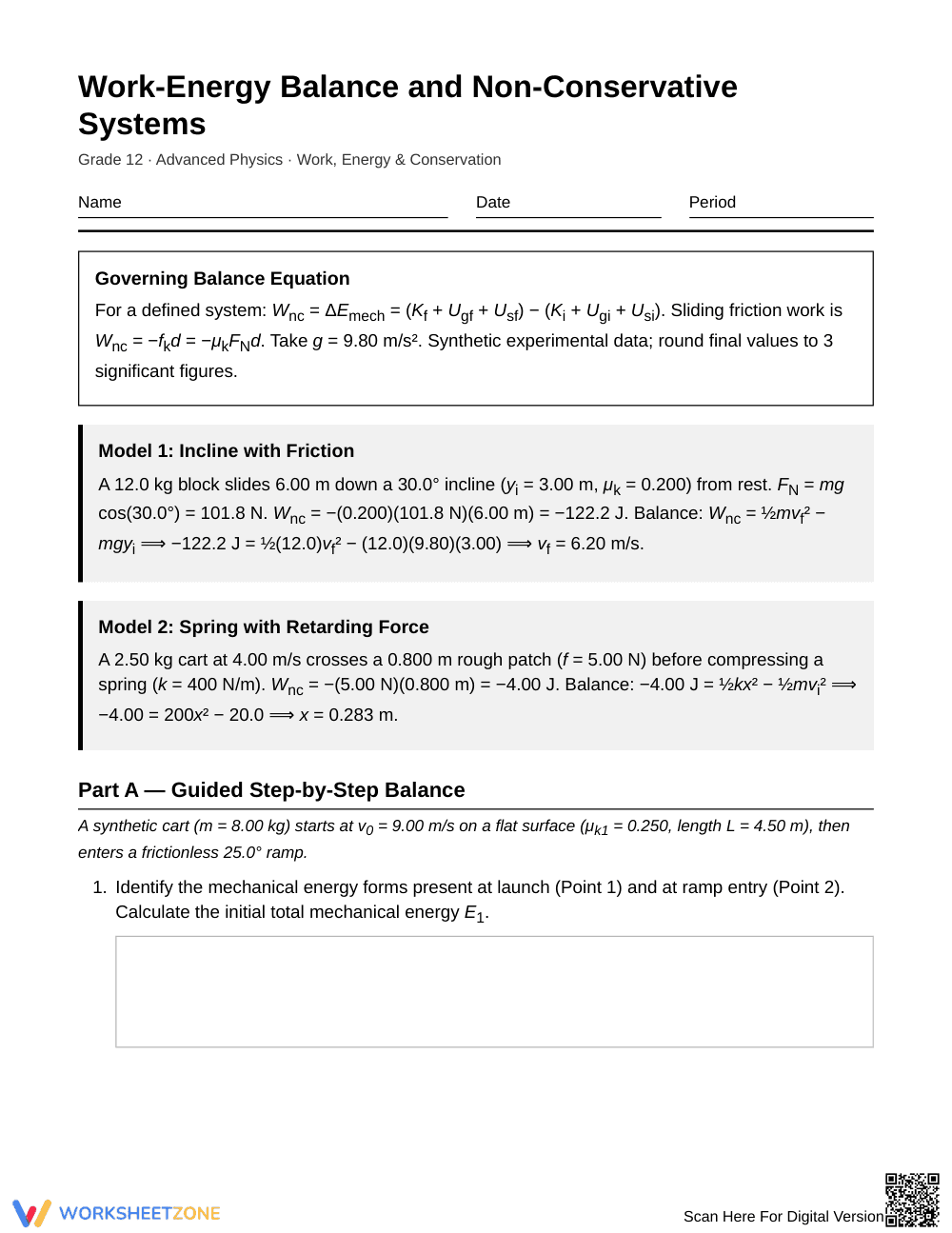
The 4-page student worksheet begins with the governing balance equation and two worked reference models: sliding down an incline with friction and decelerating into a spring. Students then complete 10 problems: a three-part guided cart scenario, five independent multi-step calculation items, and two conceptual boundary questions, supported by a 3-page worked solution key.
Skill Progression
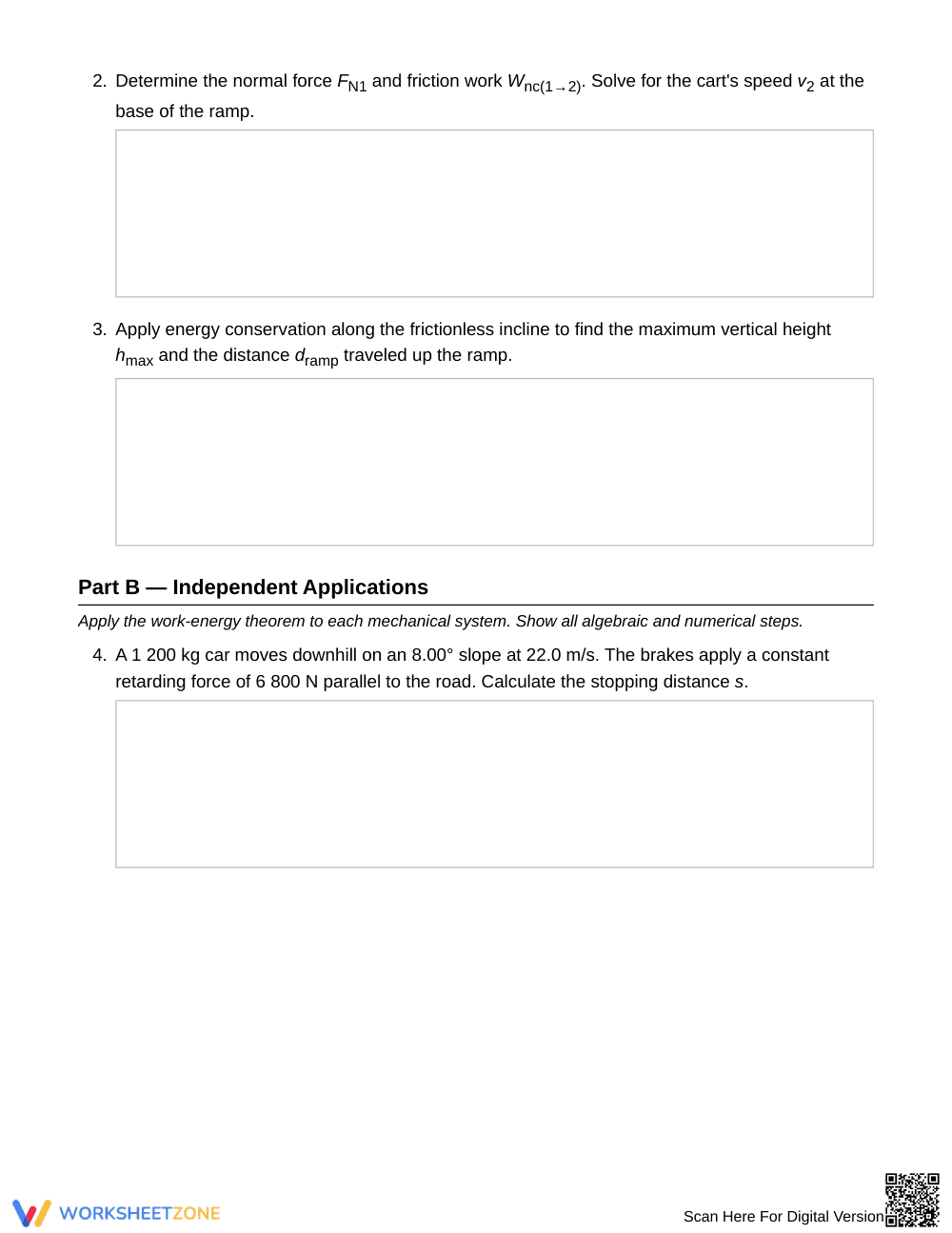
- Guided practice (Tasks 1–3): Students analyze a cart on a rough flat track and incline, finding initial energy, friction work, and peak vertical height with step-by-step guidance.
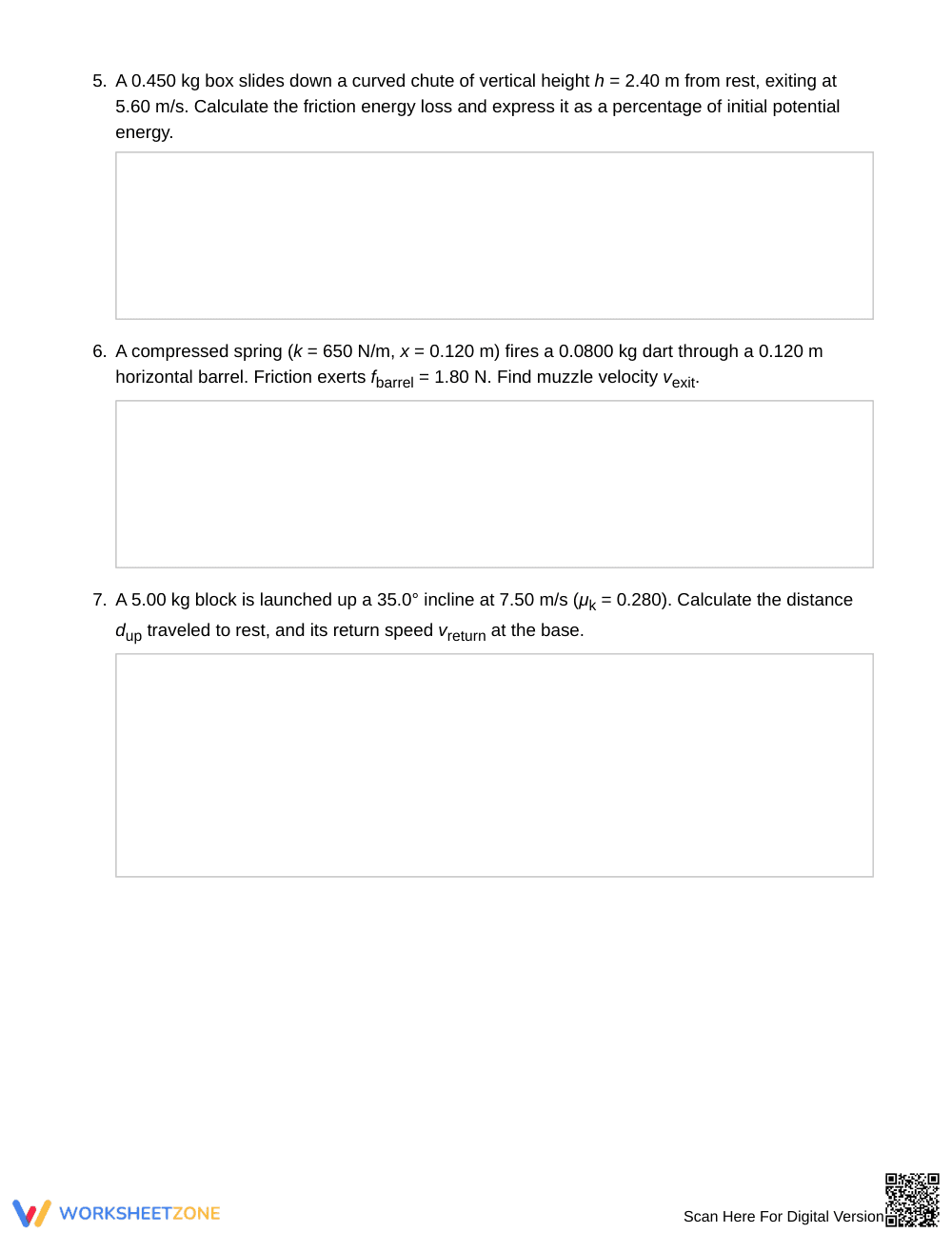
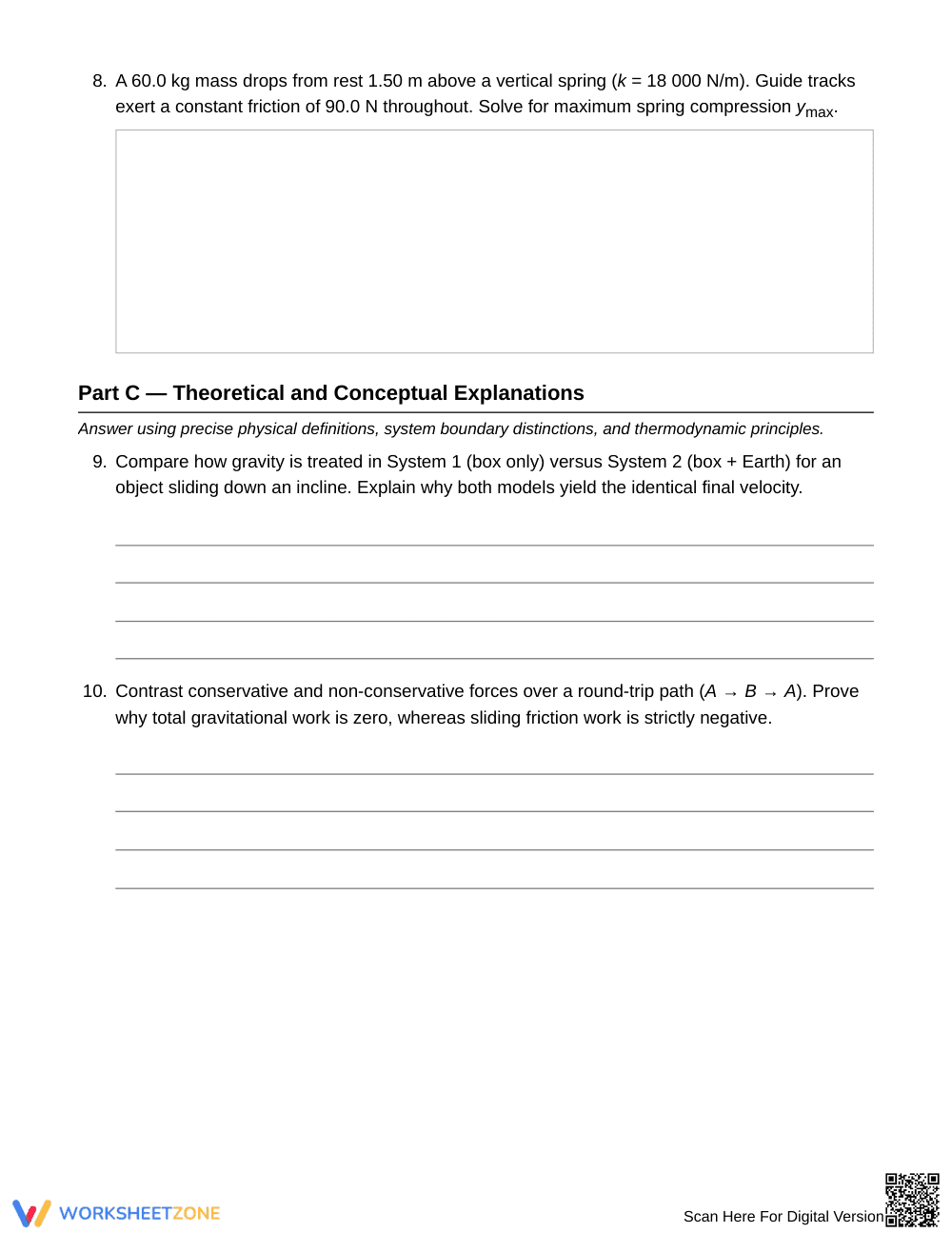
- Supported practice (Tasks 4–8): Five multi-step problems apply the work-energy theorem to car braking, curved chutes, spring dart launchers, and vertical drops with drag.
- Independent practice (Tasks 9–10): Two conceptual prompts require students to contrast conservative versus non-conservative forces over closed loops and compare system boundary definitions.
This sequence implements a gradual-release model transitioning students from structured equation modeling to unguided analysis.
Standards Alignment
This resource aligns with advanced high school physics standards covering work, energy conservation, and thermal dissipation in mechanical systems. Students quantify non-conservative work, analyze energy states, and distinguish system boundaries. Both standard codes can be copied directly into lesson plans, IEP goals, or district curriculum mapping tools.
How to Use It
Use this worksheet after direct instruction on non-conservative forces. Assign Part A for paired collaboration following initial lecture notes, then have students complete Part B independently. For formative assessment, check whether students isolate normal force correctly on the 35.0° incline in Task 7 before computing friction. Expected completion time is 45 to 60 minutes.
Who It's For
This activity is designed for Grade 12 AP, honors, or college-prep physics students mastering mechanics. Differentiate by referencing Model 1 for students needing scaffolded normal force calculations, while directing advanced learners to analyze loop integrals for Task 10. Pair this assignment with an incline-plane friction laboratory or an energy-bar-chart exercise.
According to Fisher & Frey (2014), gradual-release instructional architecture substantially accelerates student mastery in quantitative STEM disciplines by scaffolding the transition from expert modeling to independent problem-solving. This Grade 12 physics worksheet embodies that pedagogical design to help students solve a work-energy balance across complex mechanical systems. By front-loading the governing balance equation and two annotated physical models before introducing multi-step friction scenarios, the resource mitigates cognitive overload during initial schema acquisition. Students systematically trace non-conservative dissipation, determine normal forces on angled surfaces, and evaluate energy distributions within defined system boundaries. Research confirms that structured progressions pairing quantitative calculation with conceptual boundary analysis deepen conceptual retention and analytical agility. Physics educators can rely on this rigorous resource to deliver measurable skill gains, whether reinforcing first-time instruction or conducting targeted review for high-stakes mechanics assessments.


