





























Ready Work, Power & Energy Worksheet | Grades 8-12 Science
Paste this activity's link or code into your existing LMS (Google Classroom, Canvas, Teams, Schoology, Moodle, etc.).
Students can open and work on the activity right away, with no student login required.
You'll still be able to track student progress and results from your teacher account.
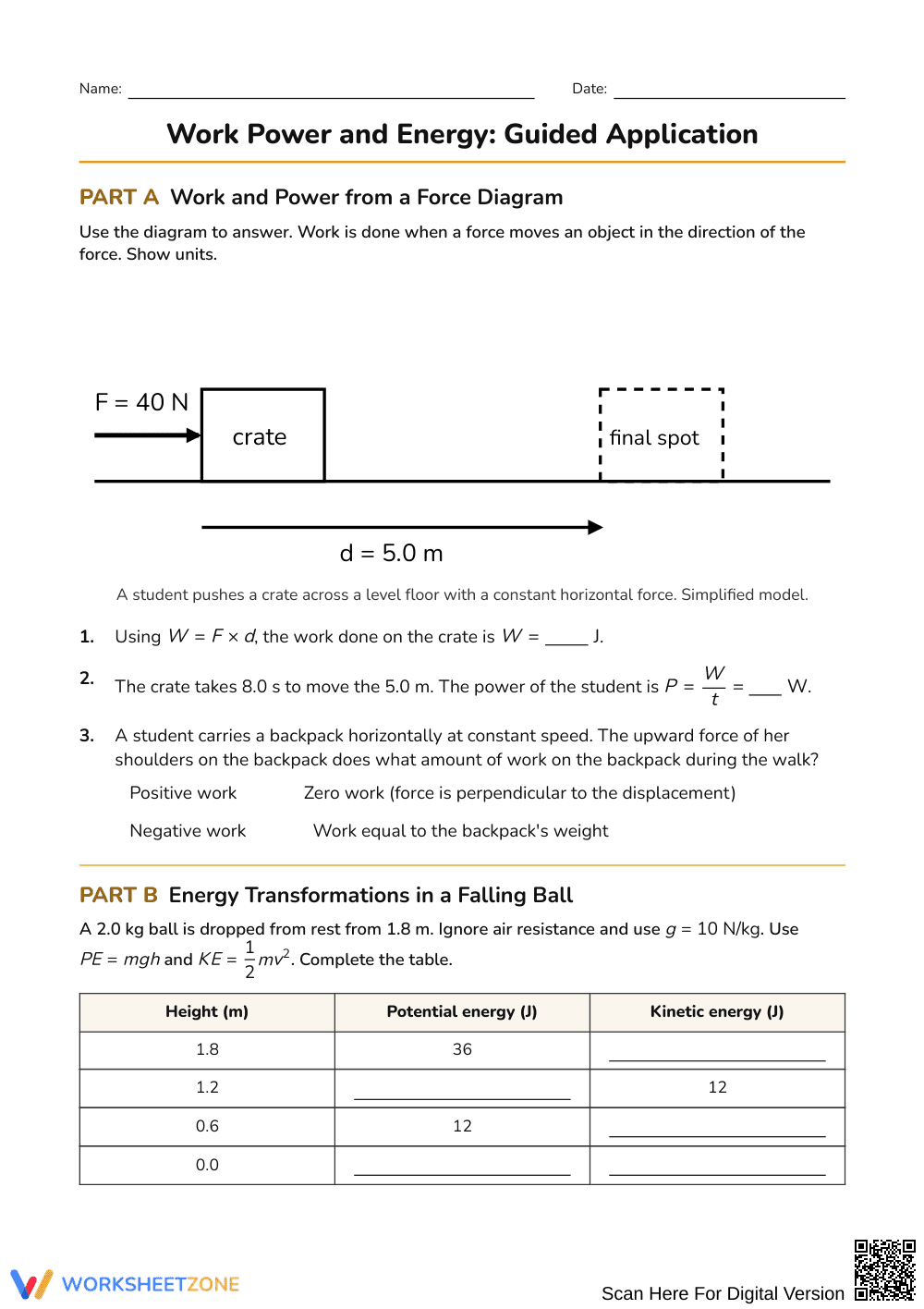
This physical science worksheet guides secondary students through rigorous applications of work, power, and mechanical energy conservation. Students calculate work from forces and graphs, analyze energy transformations, evaluate motor efficiency, and explain power variations across real-world physical systems.
At a Glance
- Grade: Grades 8–12 · Subject: Science (Physics)
- Standard: Scientific Inquiry — Calculate and explain work, kinetic and potential energy transformations, and power
- Skill Focus: Multi-step quantitative problem-solving and qualitative energy explanations
- Format: 4 pages · 29 problems · Answer key included · PDF
- Best For: High school physics practice or review
- Time: 45–60 minutes
The four-page student packet features 29 scaffolded items across five parts. Students interpret force diagrams, complete kinetic and potential energy tables, find work under force-distance curves, calculate machine efficiency, and explain why running stairs demands greater power than walking. A complete four-page teacher answer key provides full solutions.
Skill Progression
- Guided Practice (Part A): Students examine force diagrams and apply W = Fd and P = W/t, solidifying concepts like why perpendicular forces do zero work (4 tasks).
- Supported Practice (Parts B & C): Students complete data tables tracking energy exchanges in a falling mass and calculate work from areas under force-distance graphs (11 tasks).
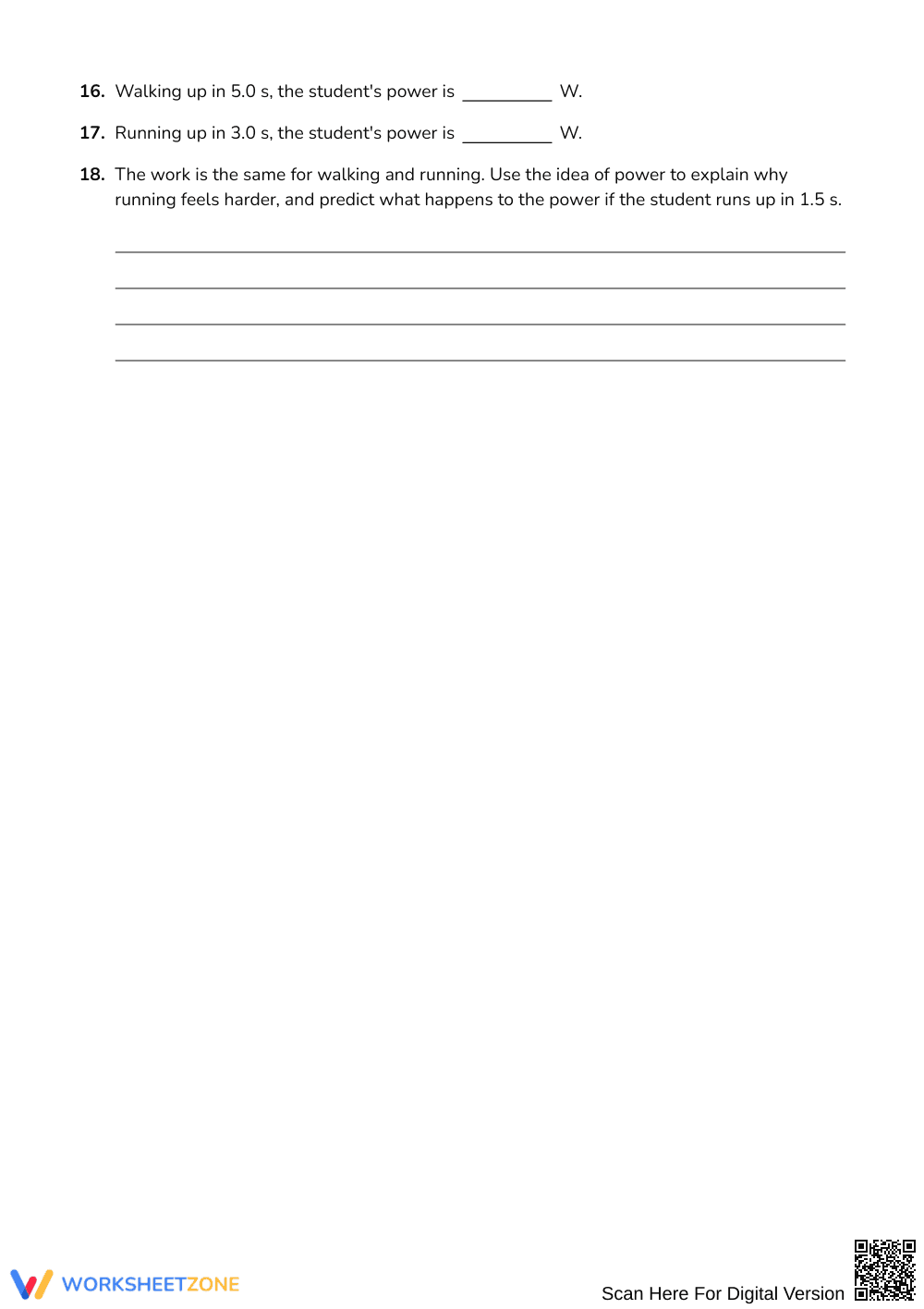
- Independent Application (Parts D & E): Students compare lifting motors, calculate efficiency, account for thermal loss, and predict stair-climbing power changes when time is halved (14 tasks).
This sequence follows a gradual-release model, moving students from guided formula use into independent reasoning and prediction.
Standards Alignment
This resource aligns with secondary physical science standards addressing energy transformations and mechanical work and power calculations in closed systems. Standard statements can be copied directly into lesson plans, IEP goals, or district curriculum mapping tools.
How to Use It
Use this packet during mid-unit practice or review after introducing energy conservation. It works well for paired problem-solving or independent practice. Formative tip: verify that students calculate the area of the triangle and trapezoid in Part C rather than multiplying peak force by distance. Expected completion time is 45 to 60 minutes.
Who It's For
Designed for Grades 8–12 physical science and physics students. Support developing learners with formula reference sheets, and pair this worksheet with an interactive energy skate park simulation or a spring scale lab.
Mastering mechanical work, power, and energy conservation requires students to bridge quantitative calculations with conceptual causal explanations. Educational research by Fisher & Frey (2014) underscores that structured gradual-release frameworks significantly strengthen secondary students' capacity to transfer abstract mathematical models into physical problem-solving contexts. When instructional materials systematically progress from guided computational tasks to independent graphical analyses and open-ended predictions, learners build robust schema regarding force directionality, gravitational potential transformations, and rate-dependent power demands. This resource provides 29 targeted tasks that systematically scaffold mathematical equations alongside verbal justifications, ensuring students understand not merely how to compute mechanical values, but why energy conservation governs thermal dissipation in electrical motors and why reducing transit time doubles power expenditure. Physics educators can utilize these structured scenarios to secure measurable student gains in both quantitative fluency and written scientific reasoning across secondary science curricula.


