



























Ready Work, Power & Energy Worksheet | Grades 8-12 Science
Paste this activity's link or code into your existing LMS (Google Classroom, Canvas, Teams, Schoology, Moodle, etc.).
Students can open and work on the activity right away, with no student login required.
You'll still be able to track student progress and results from your teacher account.
This comprehensive physical science worksheet guides students through foundational mechanics, establishing clear distinctions between work, power, kinetic energy, and gravitational potential energy. Learners evaluate concrete scenarios, calculate physical quantities with standard units, interpret force-distance graphs, and dismantle persistent intuitive misconceptions regarding mechanical power and effort.
At a Glance
- Grade: Grades 8–12 · Subject: Science
- Standard: Core Physical Science — Define and calculate mechanical work, energy transfer, and power rates
- Skill Focus: Foundational work, power, and energy principles
- Format: 4 pages · 33 problems · Answer key included · PDF
- Best For: Physics unit introduction or review
- Time: 45–60 minutes
What's Inside
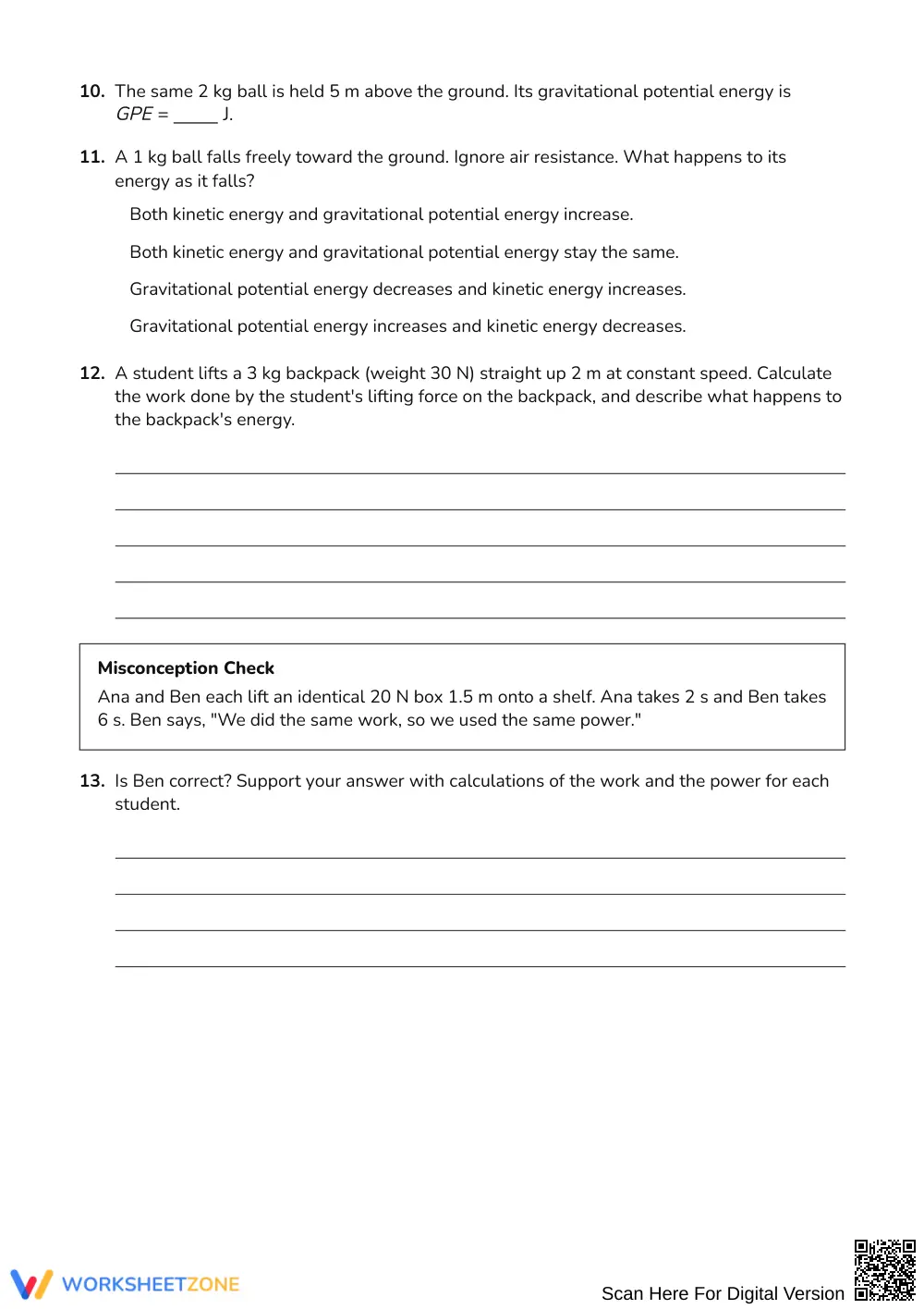
Across four student pages, this resource presents 33 scaffolded items spanning definition matching, example versus non-example classification tables, formula applications, graphical analysis, and structured misconception corrections. A complete four-page teacher answer key provides worked-out arithmetic for formulas like W = F × d and detailed qualitative explanations for force directions.
Skill Progression
- Guided practice (Parts A–B, 11 tasks): Match essential terms to SI units and classify everyday actions as mechanical work or non-work using force-displacement criteria.
- Supported practice (Parts C–D, 14 tasks): Compute work and power from structured comparative tables and determine work done via force-distance graphs.
- Independent practice (Part E, 8 tasks): Solve kinetic and gravitational potential energy problems and resolve a multi-step conceptual misconception between work and power.
This sequence implements gradual-release instruction, bridging initial definitions and autonomous mathematical reasoning.
Standards Alignment
This worksheet aligns directly with middle and high school physical science performance expectations focusing on forces, motion, and energy conservation. It operationalizes foundational criteria requiring students to define work as energy transferred by force over distance and distinguish rate of transfer from total work done. Both standard codes can be copied directly into lesson plans, IEP goals, or district curriculum mapping tools.
How to Use It
Deploy this activity during initial direct instruction on mechanical systems or as a mid-unit diagnostic check before advanced dynamics. While students complete the scenario tables in Part B, circulate to verify that learners recognize perpendicular forces perform zero mechanical work on an object. The entire 4-page sequence requires approximately 45 to 60 minutes of active instructional time.
Who It's For
Designed for introductory physical science and high school physics students, this worksheet supports diverse learners through formula scaffolds and structured tables. Pair this practice with an introductory interactive demonstration on mechanical work or a classroom ramp lab to solidify physical intuition.
Foundational physics instruction requires students to separate everyday linguistic meanings of work and power from rigorous scientific definitions. This worksheet targets that conceptual shift by guiding learners through vocabulary acquisition, directional force analysis, and mathematical computations of mechanical work, power ratings, and kinetic or potential energies. According to Fisher & Frey (2014), structured instructional scaffolds that transition deliberately from guided concept attainment to independent cognitive problem-solving significantly increase student retention in rigorous secondary STEM courses. By coupling tabular comparative analysis with explicit misconception checks, the resource ensures students do not conflate the magnitude of energy transferred with the temporal rate of transfer. Learners synthesize quantitative data with qualitative explanations across 33 focused tasks, creating durable mental models of mechanical energy systems that directly support subsequent coursework in thermodynamics, conservation laws, and advanced kinematics.


