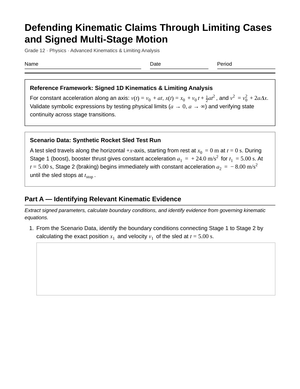
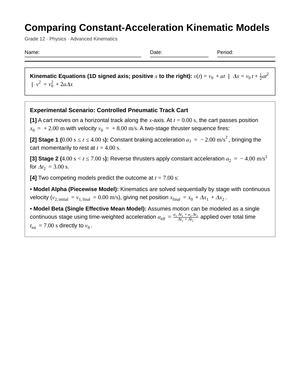
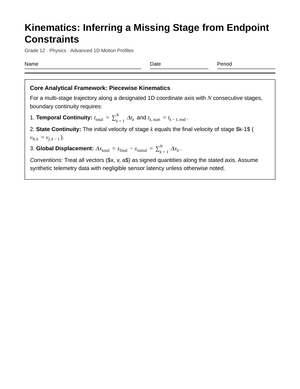
Acceleration shows up the moment students start describing how forces change motion, and that makes it one of the trickiest ideas in a middle or high school physical science sequence. Acceleration worksheets give teachers a low-prep way to move students from watching a cart speed up on a ramp to explaining why it happened in terms of force and mass. Whether you teach sixth-grade physical science or eleventh-grade physics, a well-sequenced set of acceleration worksheets turns an abstract vocabulary word into something students can calculate, graph, and defend with evidence.
How Acceleration Worksheets Support MS-PS2-1 and MS-PS2-2
Middle school force and motion instruction centers on students investigating how an object's change in motion depends on the sum of forces acting on it and its mass, which is the heart of MS-PS2-2. Acceleration worksheets built around this expectation typically ask students to compare scenarios where force or mass changes while everything else stays constant, matching the guidance that assessment tasks should isolate one variable at a time in one-dimensional motion. A companion set of problems can draw on MS-PS2-1, where students apply Newton's Third Law to explain outcomes in a collision, such as two carts colliding and one accelerating away faster than the other.
Middle school assessment guidance for MS-PS2-2 explicitly limits scope to one-dimensional motion and changing only one variable at a time. That single constraint should shape every acceleration worksheet you hand a sixth or seventh grader: hold mass constant while force changes in one set of problems, then hold force constant while mass changes in the next, rather than mixing both variables before students can isolate cause and effect.
Extending to Quantitative Practice with HS-PS2
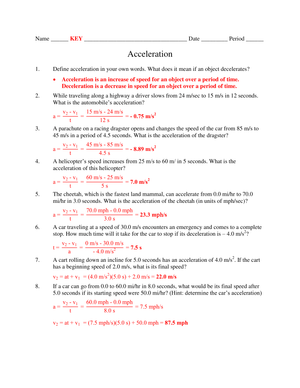
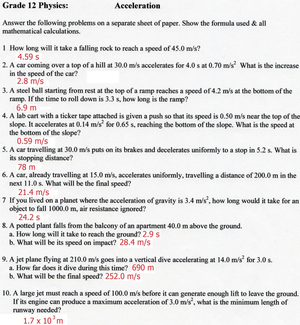
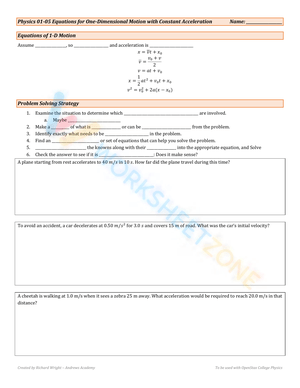
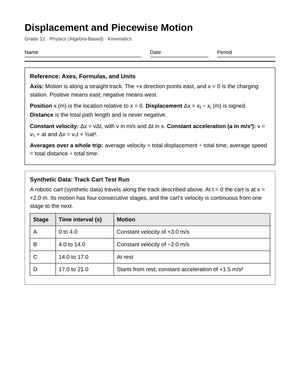
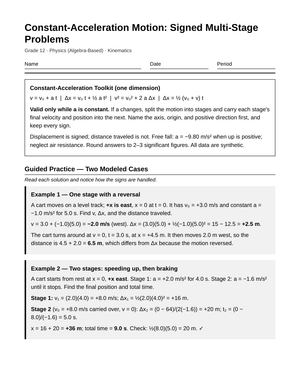
High school physics classrooms push acceleration worksheets further, into the quantitative relationships described under HS-PS2. Once students can state that acceleration measures how quickly velocity changes, worksheets should introduce Newton's Second Law in its formula form, a = F divided by m, and ask students to solve for acceleration, force, or mass given the other two values. Strong high school worksheets layer word problems on top of the bare formula so students practice pulling numbers out of a scenario, choosing the right unit, and checking whether their answer is physically reasonable.
Bundling Speed, Velocity, and Acceleration for Comparison
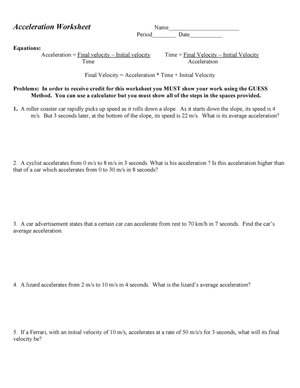
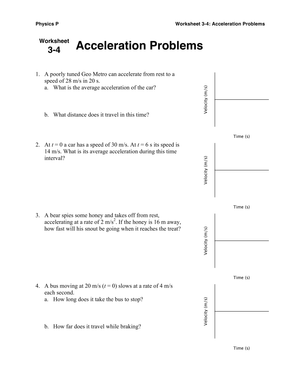
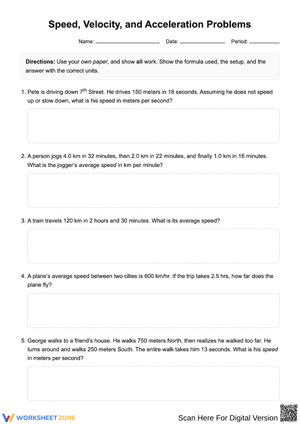
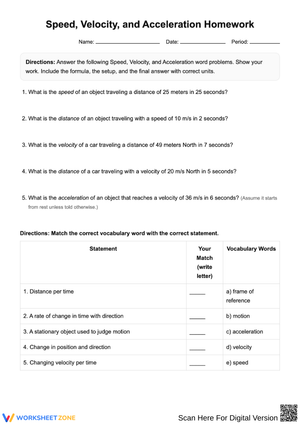
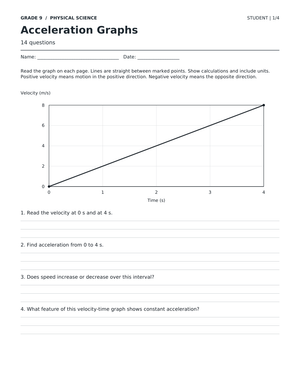
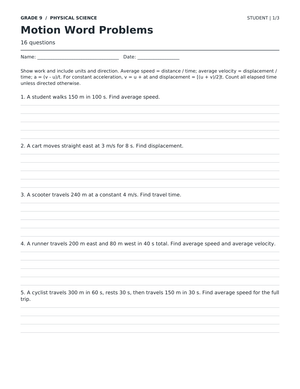
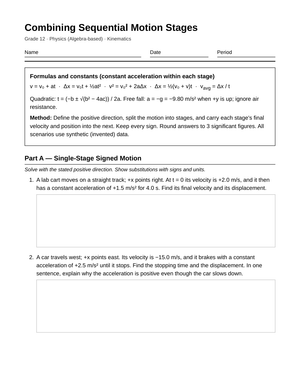
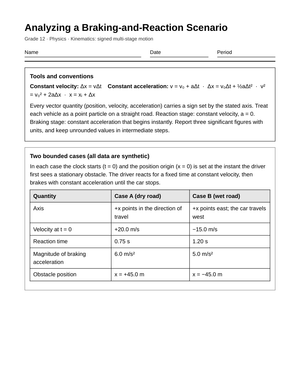
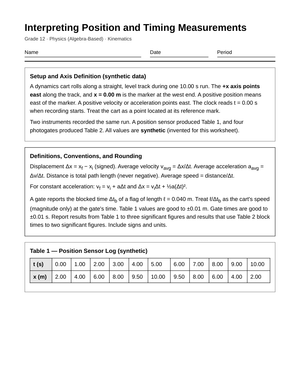
Acceleration rarely gets taught in isolation. Most classrooms introduce it right after speed and velocity, so acceleration worksheets that bundle all three concepts help students see how they build on each other. A single worksheet might ask students to calculate speed from a distance-time table, identify velocity by adding direction, and then use two velocity readings to find acceleration over a time interval. That structure reinforces vocabulary while showing students exactly where acceleration fits in the broader motion unit.
Classroom Implementation
Use acceleration worksheets in short cycles rather than one long assignment. Open a lesson with a two-problem warm-up pulled from a worksheet to activate prior knowledge, use a full worksheet as guided practice right after direct instruction, and save a trimmed version for homework once students have shown independence in class. For small-group intervention, pull students who missed graph-reading questions into a station with only the graph portion of the worksheet, and pair them with a peer who solved it correctly so they can talk through the reasoning together. This cycle keeps acceleration worksheets tied to where students actually are, rather than treating every student the same way.
Frequently Asked Questions
1. What grade level typically studies acceleration and when should worksheets be introduced?
Acceleration is commonly introduced in middle school physical science alongside speed and velocity, then revisited with more quantitative depth in high school physics. Worksheets that start with conceptual comparisons work well for middle school, while formula-based problems suit high school classes working with Newton's Second Law.
2. How do acceleration worksheets align with force and motion standards?
Middle school worksheets can align to MS-PS2-2, which addresses how an object's change in motion depends on the sum of forces and its mass, and to MS-PS2-1, which covers Newton's Third Law in collision scenarios. High school worksheets extend into HS-PS2, where the relationships become quantitative.
3. What is the best way to sequence speed, velocity, and acceleration practice?
Start with speed calculations from distance and time, add direction to introduce velocity, then use changes in velocity over time to teach acceleration. Bundling all three on related worksheets helps students see the progression instead of learning each term in isolation.
4. How can teachers use acceleration worksheets for formative assessment versus homework?
Use a short worksheet segment immediately after a lab or demonstration as a formative check, looking for common errors before moving on. Save longer, mixed-difficulty worksheets for homework once students have demonstrated independent success with the core formula in class.
5. What common errors do students make on acceleration calculation problems?
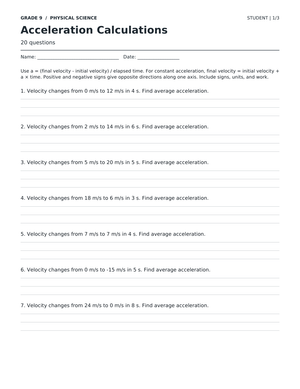
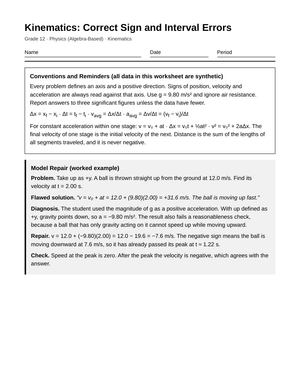
Students often confuse acceleration with speed, forget that slowing down or changing direction both count as acceleration, and mix up which value represents force, mass, or acceleration when rearranging a = F divided by m. Worksheets that include varied scenarios, not just speeding-up examples, help address these errors directly.












 Interactive Worksheet Maker
 Quiz Maker
 Word Search Maker
 Crossword Puzzle Maker
 Word Scramble Generator
 Sentence Scramble Generator
 Handwriting Worksheet Generator
 Name Tracing Generator
 Fill In The Blank Generator