


























Views
Downloads

Complete Work & Energy Signs Worksheet | Grade 12 Physics
Paste this activity's link or code into your existing LMS (Google Classroom, Canvas, Teams, Schoology, Moodle, etc.).
Students can open and work on the activity right away, with no student login required.
You'll still be able to track student progress and results from your teacher account.
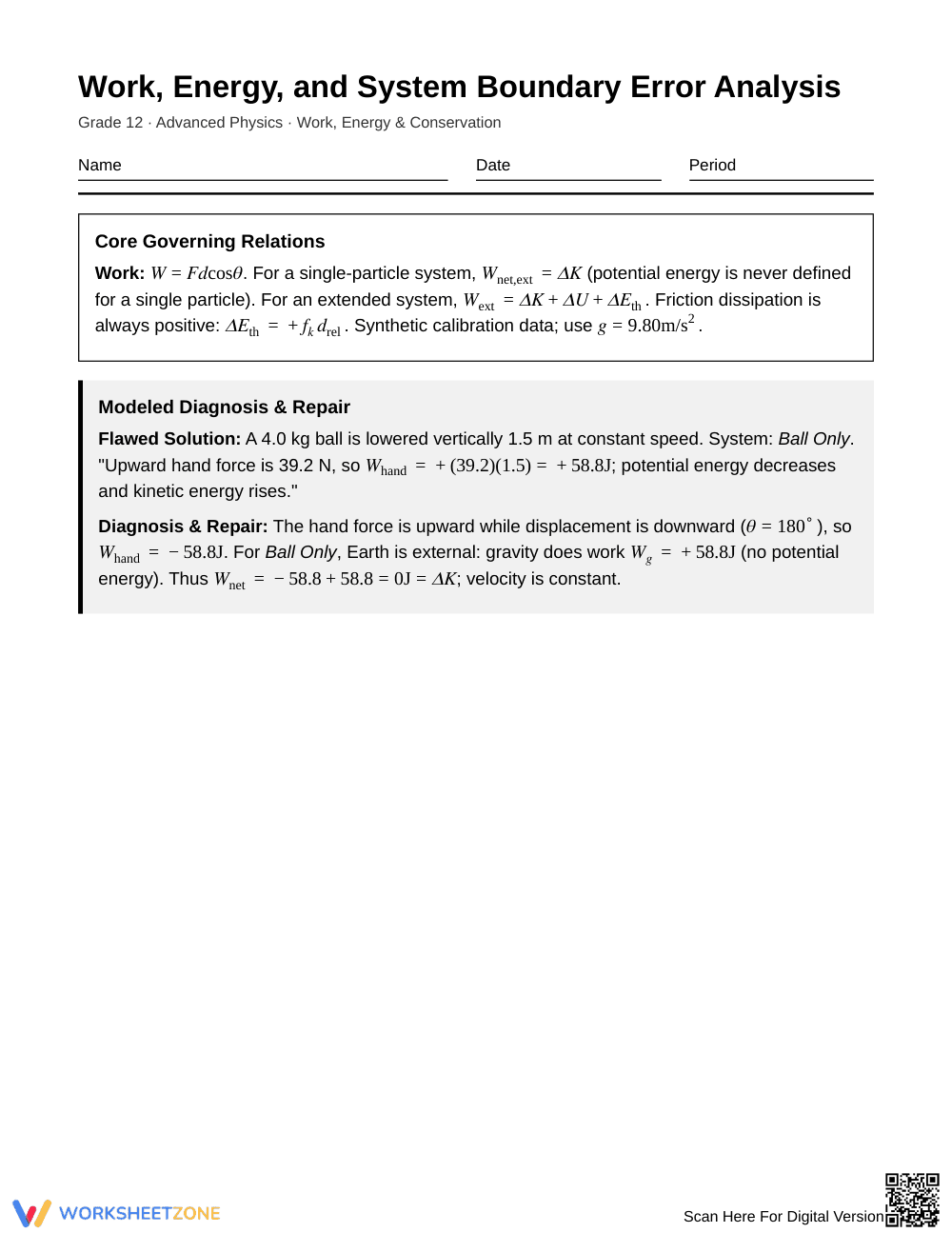
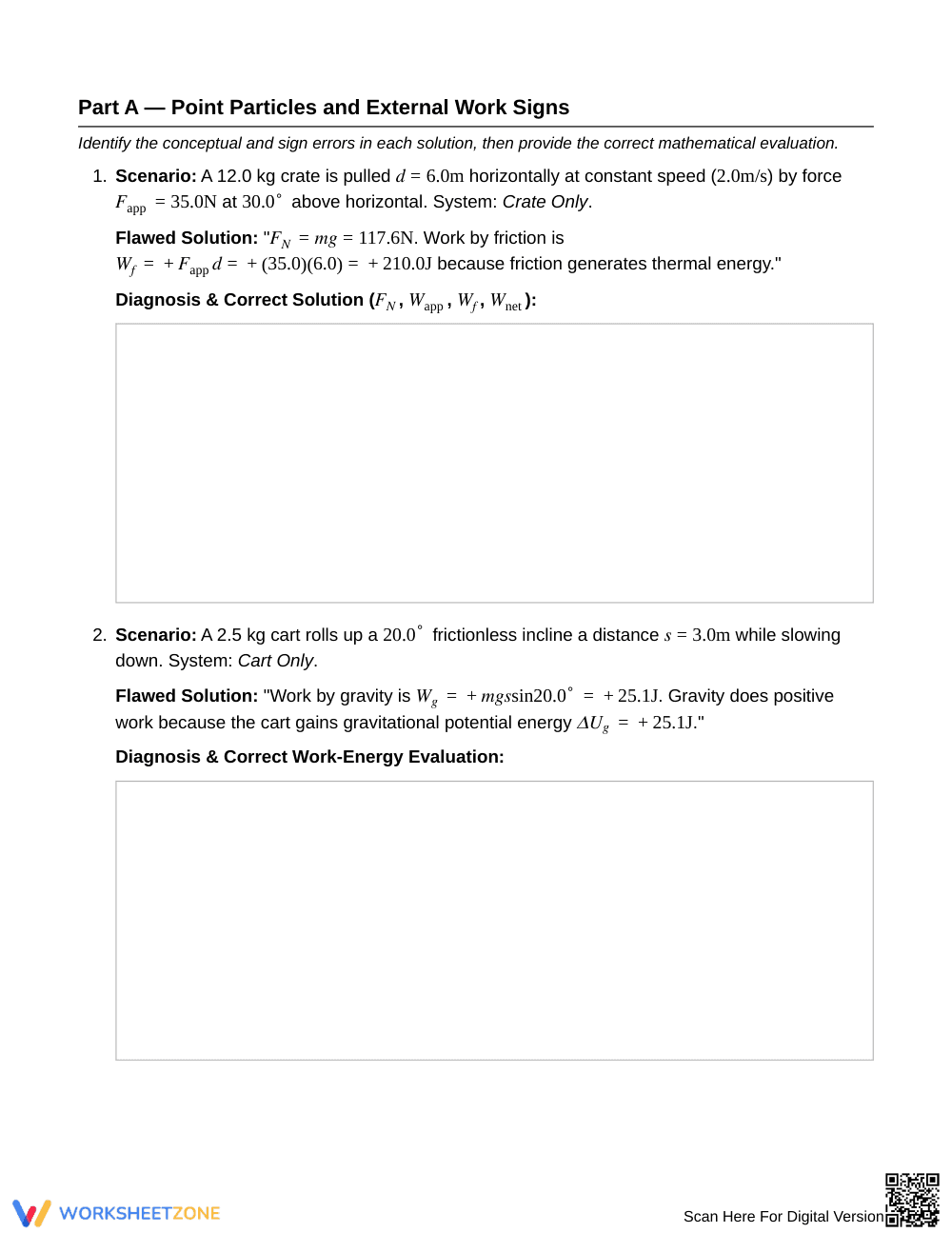
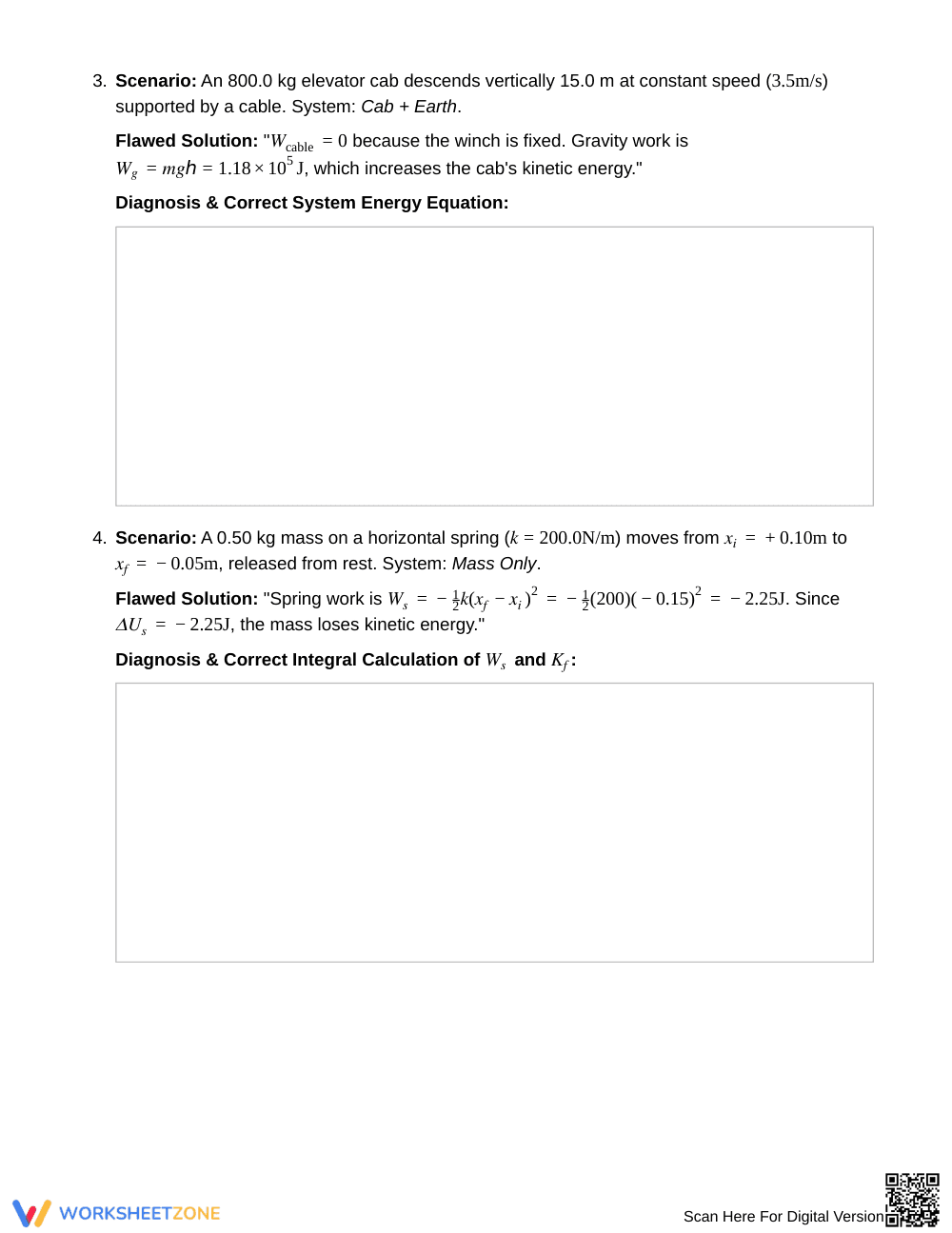
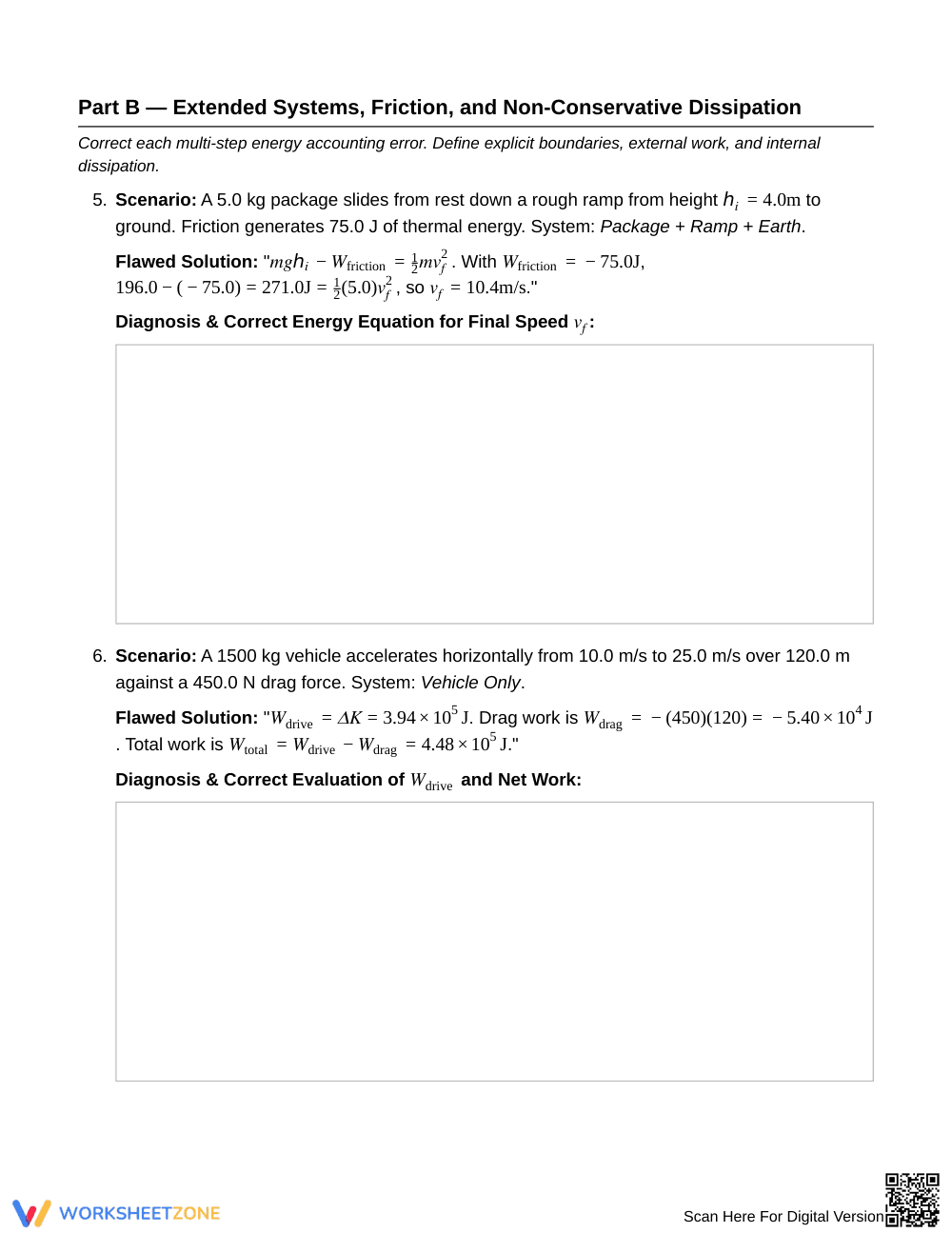
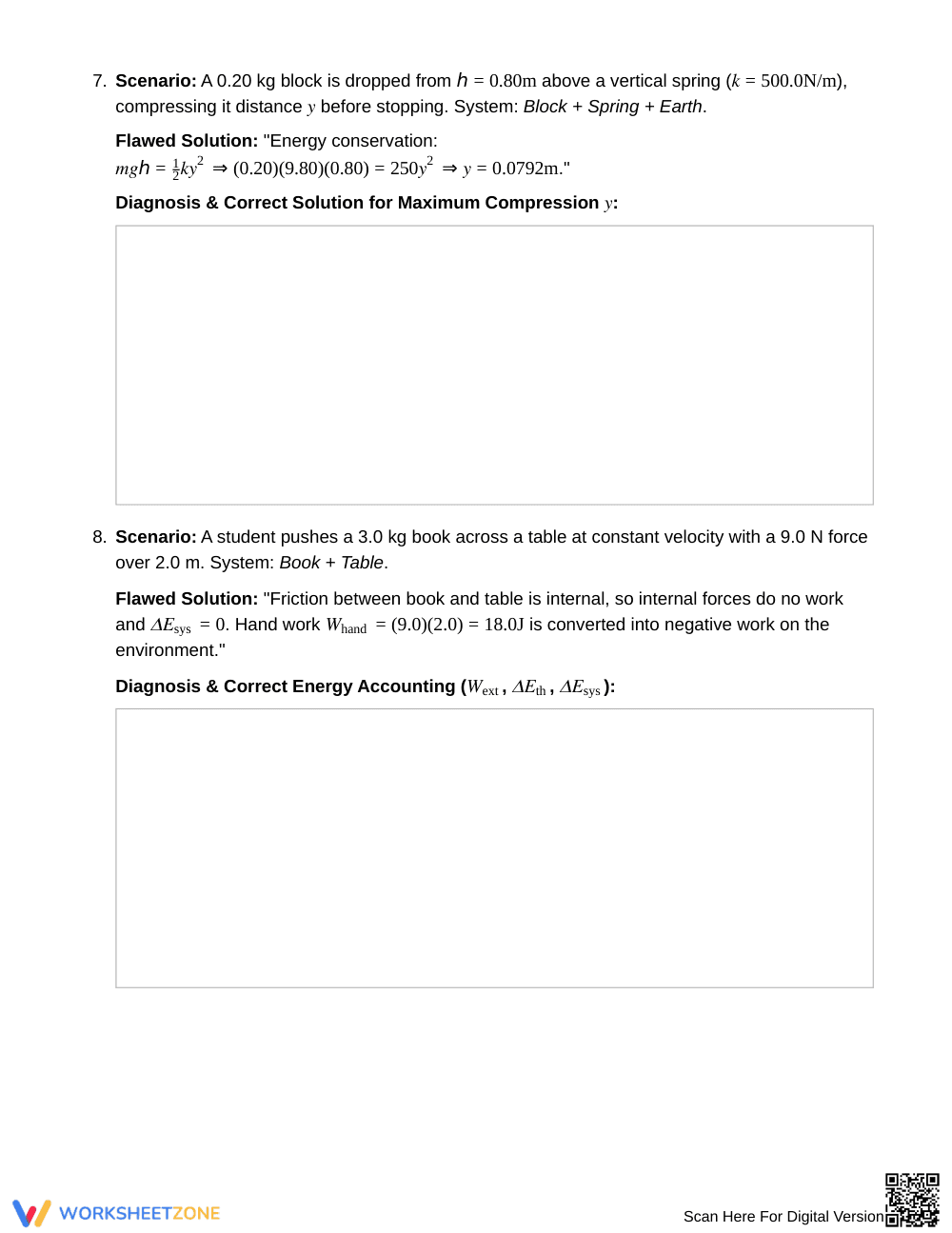
This Grade 12 physics worksheet targets key conceptual and mathematical pitfalls in energy conservation, system boundaries, and work calculations. Students analyze flawed solutions to identify negative work oversights, erroneous single-particle potential energy claims, and improper thermal dissipation signs, converting incorrect statements into mathematically rigorous evaluations.
At a Glance
- Grade: 12 · Subject: Physics
- Standard: Advanced Physics Mechanics — Calculate work and energy transformations across open and closed systems
- Skill Focus: Correct Work-Sign and Energy-Loss Errors
- Format: 5 pages · 8 problems · Answer key included · PDF
- Best For: AP physics error analysis
- Time: 45–60 minutes
What's Inside
This 5-page PDF contains a governing relations summary, a modeled diagnosis and repair example, and 8 multi-step error-analysis tasks. The resource examines point particles and extended systems with friction, supported by a 3-page answer key detailing algebraic derivations, boundary choices, and mathematical repairs.
Skill Progression
- Guided practice: A modeled diagnosis and repair example illustrates how to analyze force vectors, assign correct work signs, and evaluate single-particle systems.
- Supported practice (Part A, Problems 1–4): Four structured point-particle tasks guide students to fix normal force values, gravitational work on inclines, cable work, and spring work integrals.
- Independent practice (Part B, Problems 5–8): Four extended-system problems challenge students to define system boundaries, account for thermal dissipation from friction, and formulate complete energy equations.
This scaffolded progression follows a gradual-release model, moving students from guided error detection to independent energy accounting.
Standards Alignment
This resource aligns with high school physics standards for mechanics and energy conservation. Students calculate external work, track changes in kinetic, potential, and thermal energy, and apply conservation laws to open and closed systems. Both standard codes can be copied directly into lesson plans, IEP goals, or district curriculum mapping tools.
How to Use It
Assign this worksheet after direct instruction on the work-energy theorem and dissipative forces. Use Part A for paired error analysis in class to discuss why single-particle systems lack internal potential energy. Assign Part B as an individual check or AP review. Formatively, observe whether students treat thermal dissipation as positive internal energy. Completion takes 45 to 60 minutes.
Who It's For
This material is designed for Grade 12 physics, AP Physics C, and introductory college mechanics students. It offers targeted remediation for sign conventions and dot product errors. Pair this worksheet with free-body diagrams and energy bar charts (LOL diagrams) for comprehensive instruction.
Research on error analysis by Fisher & Frey (2014) demonstrates that structured diagnosis of non-examples deepens conceptual understanding in advanced science. When physics students systematically identify and repair flawed calculations, they shift from rote formulas to rigorous physical modeling. This 5-page worksheet targets core misconceptions in work and energy, such as confusing vector directions in work integrals, treating friction work as negative system energy rather than positive thermal dissipation, and attributing potential energy to single-particle systems. By evaluating 8 authentic flawed scenarios across single-particle and extended-system boundaries, Grade 12 learners develop robust metacognitive monitoring and precise algebraic reasoning. Implementing structured error correction directly supports mastery of the work-energy theorem, equipping students to justify physical claims, evaluate dot products, and analyze thermodynamic transformations across complex mechanical systems.


