


























Views
Downloads


Essential Force-Displacement Worksheet | Grade 12 Physics
Paste this activity's link or code into your existing LMS (Google Classroom, Canvas, Teams, Schoology, Moodle, etc.).
Students can open and work on the activity right away, with no student login required.
You'll still be able to track student progress and results from your teacher account.
This physics worksheet trains high school students to calculate work, kinetic energy, and velocity from numerical force-displacement tables using the trapezoidal rule and Work-Energy Theorem. Through 10 rigorous problems, learners evaluate variable towing dynamics, arrestor deceleration profiles, and calculus-based modeling assumptions.
At a Glance
- Grade: 12 · Subject: Physics
- Standard:
Mechanics: Work-Energy— Apply the work-energy theorem to variable force data using numerical integration- Skill Focus: Interpret Force-Displacement Data
- Format: 4 pages · 10 problems · Answer key included · PDF
- Best For: AP or Advanced Physics practice
- Time: 45–60 minutes
This 4-page worksheet features 10 quantitative and conceptual tasks arranged around two distinct empirical data sets. Students work with a linear towing scenario under constant friction and a non-linear arrestor buffer deceleration test. The resource includes explicit formula references for trapezoidal approximations and work-energy relations, structured data tables, and a complete 2-page answer key with step-by-step calculations.
Skill Progression
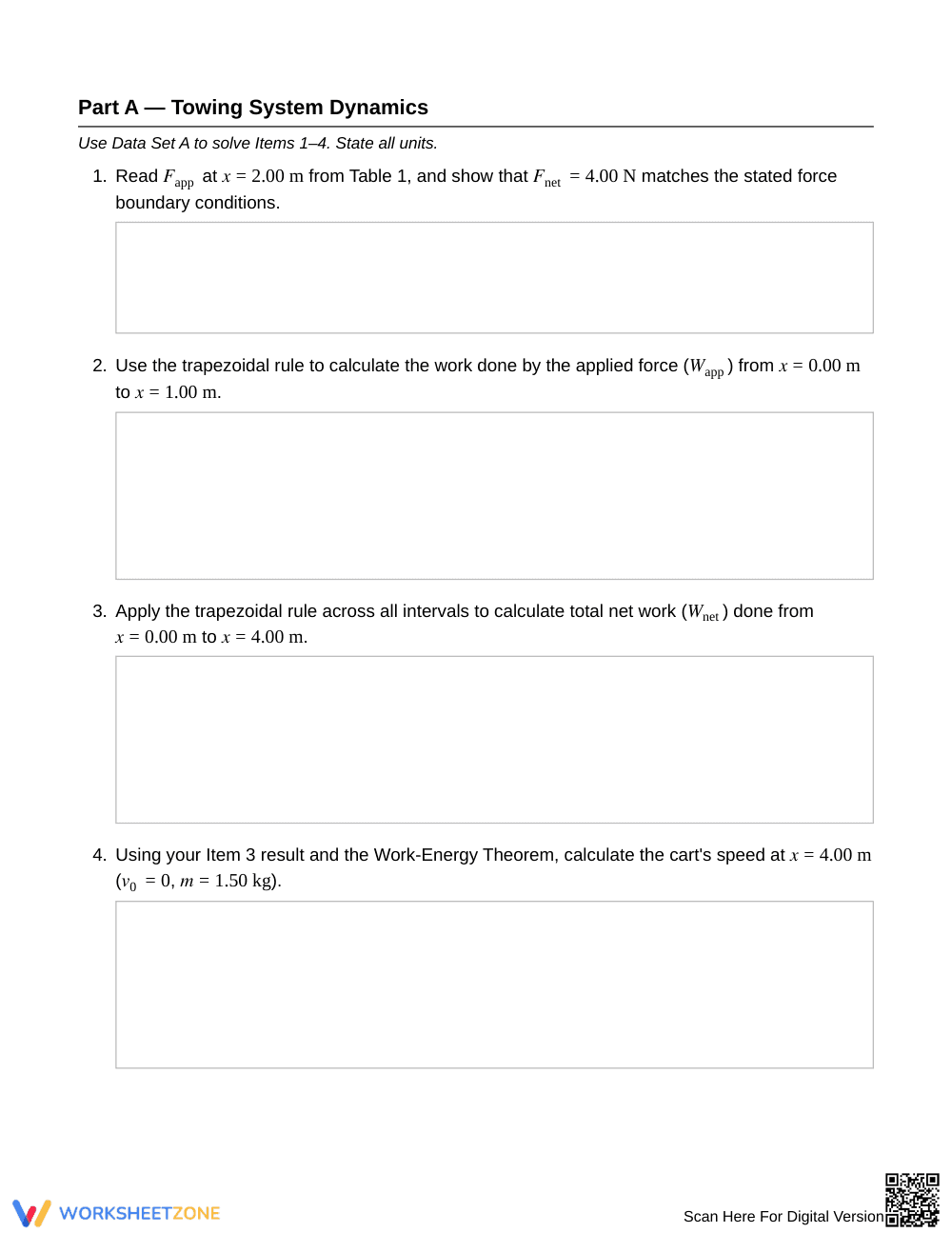
- Guided practice (Items 1–4): Students analyze a tabular towing system with friction, verifying force boundary conditions and applying the trapezoidal rule across discrete intervals to calculate net work and final speed.
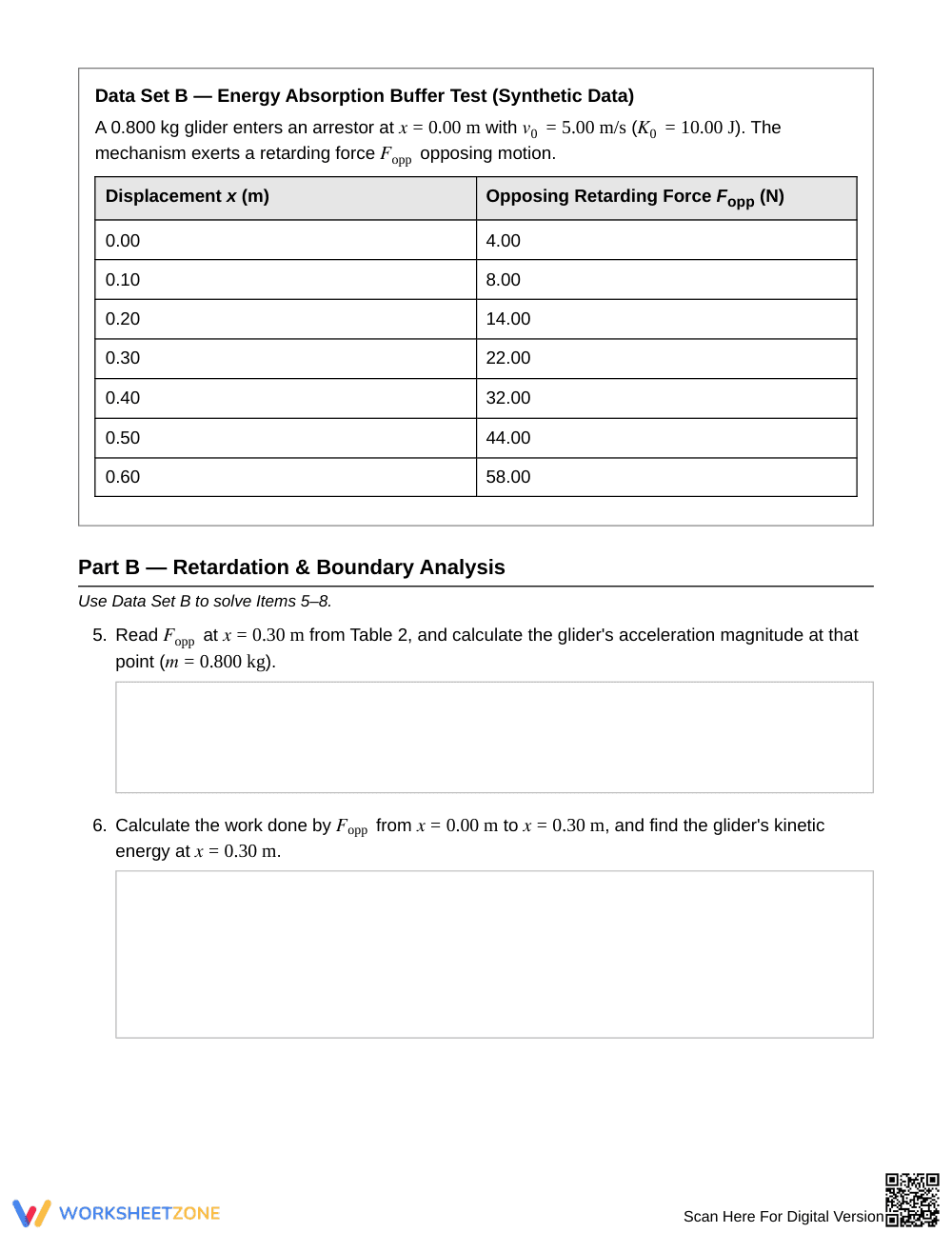
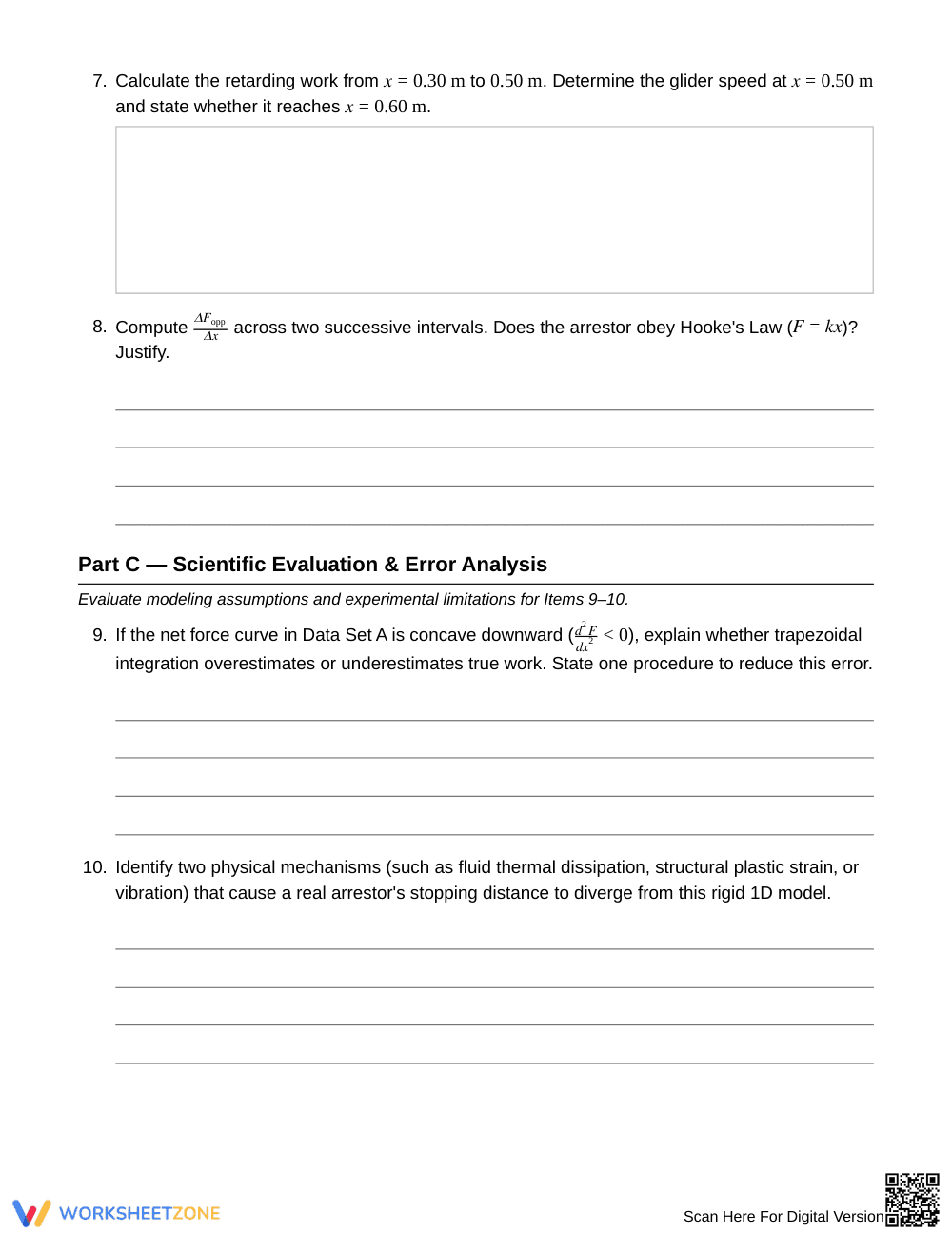
- Supported practice (Items 5–8): Learners evaluate non-linear arrestor buffer data to calculate localized acceleration, total retarding work, residual kinetic energy, and check elasticity against Hooke's Law.
- Independent practice (Items 9–10): Students perform scientific error analysis by evaluating geometric concavity effects on trapezoidal integration and identifying physical mechanisms causing real-world divergence from 1D models.
This progression leverages a gradual-release instructional model, transitioning students from structured tabular computations to advanced calculus-based modeling and physical reasoning.
Standards Alignment
This resource aligns with advanced high school and introductory college physics mechanics standards for work, energy, and numerical integration. Students calculate the area under variable force-displacement curves to determine mechanical energy changes. Both standard codes can be copied directly into lesson plans, IEP goals, or district curriculum mapping tools.
How to Use It
Deploy this worksheet after direct instruction on variable forces and numerical integration. Use it as an in-class problem lab where student pairs compute trapezoidal intervals, or assign it as an advanced homework set. For formative assessment, inspect student work on Item 3 to ensure learners average adjacent force values rather than multiplying endpoint forces directly. Completion takes 45 to 60 minutes.
Who It's For
This activity is designed for Grade 12 physics, AP Physics C: Mechanics, and introductory calculus-based physics students. Advanced learners benefit from the concavity analysis in Part C, while students needing support can use the embedded formulas and structured data tables. Pair this worksheet with an interactive air-track or force-sensor motion lab.
According to research by Fisher & Frey (2014), structured instructional sequences that move intentionally from guided data interpretation to independent evaluative tasks build deep conceptual mastery in STEM disciplines. This Grade 12 physics resource embodies that design across 10 targeted problems centered on interpreting force-displacement data. Students develop quantitative fluency by calculating mechanical work through step-by-step trapezoidal numerical integration, applying the Work-Energy Theorem to determine particle velocity, and investigating non-linear elastic boundaries. Moving beyond rote calculation, the concluding scientific evaluation challenges learners to examine how mathematical modeling assumptions—such as curve concavity in numerical integration—impact physical predictions. By anchoring rigorous mathematical computation to authentic experimental contexts like arrestor buffer deceleration and linear friction dynamics, this resource provides an effective balance of procedural scaffolding and higher-order analytical reasoning for advanced mechanics classrooms.


