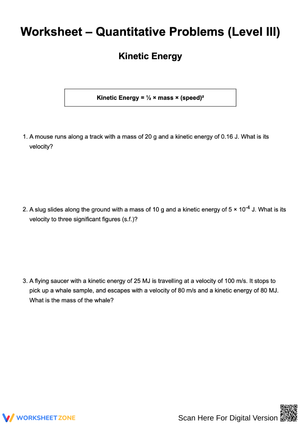
What escape velocity worksheets teach
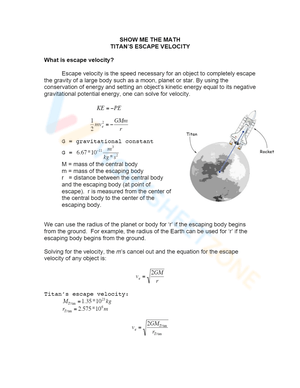
Escape velocity worksheets give your students structured practice with one of the most concrete applications of gravity in a physical science unit: the minimum speed an object needs to break free from a planet without any further push. Instead of treating gravity as an abstract force, students calculate a real number they can picture, the speed a rocket has to reach to leave Earth behind. These pages work well as homework after a gravity lesson, as small-group review before a quiz, or as an anchor task when you first introduce orbital motion.
A strong worksheet set moves from qualitative reasoning to quantitative problem solving, so you can assign the same topic across a mixed-readiness class. Middle schoolers argue about which planet holds onto its atmosphere more tightly, while high schoolers substitute values into v = √(2GM/R) and defend their answer with evidence. Because the topic connects to spaceflight, it tends to hold attention better than a generic force diagram, and that engagement pays off when the algebra gets harder.
Where escape velocity fits your NGSS standards
Escape velocity sits inside the forces and gravity strand, and it maps cleanly onto two NGSS performance expectations depending on your grade band. In middle school, MS-PS2-4 asks students to construct an evidence-based argument that gravitational interactions are attractive and depend on the masses of the objects involved, with no formula required. Escape velocity scenarios let students reason qualitatively: a more massive planet pulls harder, so leaving it demands more speed.
In high school, HS-PS2-4 raises the bar by asking students to use mathematical representations of Newton's Law of Gravitation to predict gravitational forces between objects. Escape velocity worksheets are a natural bridge here, because the formula for escape speed comes directly from that gravitational relationship and rewards the algebra your students have been building all year.
The math students actually use
The formula looks intimidating, but it needs only a square root, not calculus. Students substitute the gravitational constant, the planet's mass, and its radius, then solve for the speed. For most middle and high school courses, teachers hand students the constant and the planet's data, so the workflow is simple: read the values, plug them in, and evaluate. The bigger payoff is conceptual, because escape speed depends only on the mass and radius of the attracting body, never on the mass or the launch direction of the object trying to leave.
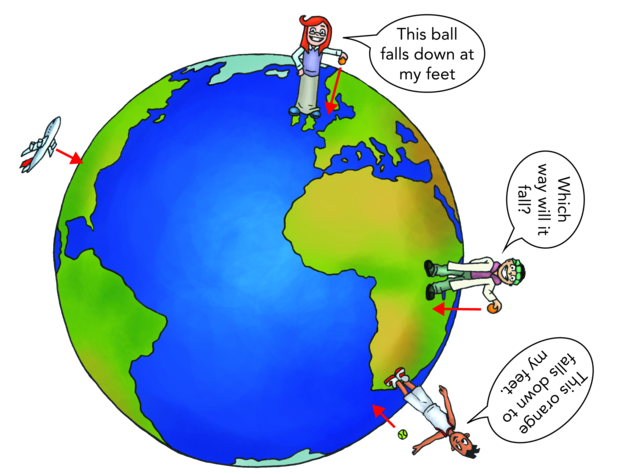
That last point is where the deepest learning happens. Many students assume a heavy rocket needs a higher escape velocity than a light satellite, but the math says otherwise: a marble and a moon-sized spacecraft leaving Earth both need the same 11.2 km/s. When students watch the launching object's mass cancel out of the energy equation, they have touched a genuine insight about how conservation of mechanical energy governs the problem, and they retain it far longer than a memorized figure.
Comparing planets to build proportional reasoning
The most engaging escape velocity worksheets ask students to compute and compare values across different bodies. Earth's escape velocity is about 11.2 km/s, the Moon's is only about 2.4 km/s, and a gas giant like Jupiter is far higher. Lining these numbers up turns a single calculation into a reasoning task: why does the Moon, with far less mass, let objects escape so much more easily than Earth does?
NASA's Space Math collection frames these comparisons with authentic mission data, which helps students see that escape velocity is not a textbook abstraction but a design constraint every rocket engineer has to respect. A few prompts that push proportional thinking:
- Rank Earth, the Moon, and Mars by escape speed and justify the order.
- Predict how doubling a planet's radius changes its escape velocity.
- Explain why gas giants can hold light gases that smaller worlds lose to space.
Using These Worksheets In Real Science Classes
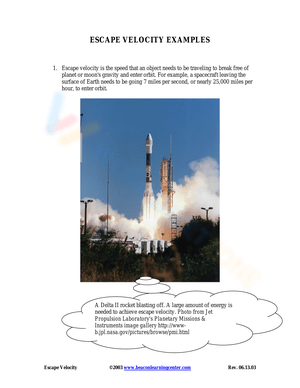
Start with a five-minute hook before any worksheet lands on a desk. Show a rocket launch clip and ask students what speed the vehicle needs so it never falls back to the ground. Then hand out the qualitative page so students commit to a prediction on paper. Only after that discussion do you introduce the formula, so the algebra answers a question the class already cares about instead of arriving cold.
For differentiation, offer tiered versions of the same escape velocity worksheets. Give developing students the formula with the constants already substituted so they can focus on the square root, and give advanced students blank scenarios where they locate the mass and radius themselves. Pair the pages with a quick exit ticket that asks students to explain, in one sentence, why the escaping object's mass does not change the answer.
- Use qualitative pages for MS-PS2-4 argumentation and formula pages for HS-PS2-4 modeling.
- Assign planet-comparison problems as homework ahead of an orbital-motion lab.
- Close each lesson with an exit ticket that targets the mass misconception.
Frequently Asked Questions
1. What grade level teaches escape velocity?
It appears in both middle and high school. Middle school physical science introduces the idea qualitatively within a gravity and forces unit, while high school physics or Earth and space science adds the formula. Sixth through twelfth grade classrooms can each use a version of these worksheets matched to their level.
2. Do students need calculus for these worksheets?
No. Escape velocity worksheet problems require only substitution and a square root. Any student who can evaluate v = √(2GM/R) with a calculator can complete them. The concept comes from conservation of energy, but the arithmetic itself stays at an Algebra 1 level.
3. How do these worksheets align with NGSS?
Qualitative pages support MS-PS2-4, where students argue that gravity depends on mass. Quantitative pages support HS-PS2-4, where students use mathematical representations of Newton's Law of Gravitation to predict gravitational forces. You can assign either strand depending on your course and grade band.
4. How can I differentiate for students still building proportional reasoning?
Pre-substitute the constants so students focus on a single operation, and pair each calculation with a sentence frame that links a larger mass to a higher escape speed. Ranking tasks let students reason about proportion qualitatively before they ever compute an exact value.
5. What real-world example introduces escape velocity best?
A rocket launch is the clearest hook. Ask students what speed a spacecraft needs so it never falls back to Earth, then reveal the 11.2 km/s answer. Comparing that to the Moon's much lower 2.4 km/s makes the role of planetary mass immediately visible to the whole class.












 Interactive Worksheet Maker
 Quiz Maker
 Word Search Maker
 Crossword Puzzle Maker
 Word Scramble Generator
 Sentence Scramble Generator
 Handwriting Worksheet Generator
 Name Tracing Generator
 Fill In The Blank Generator