


























Views
Downloads
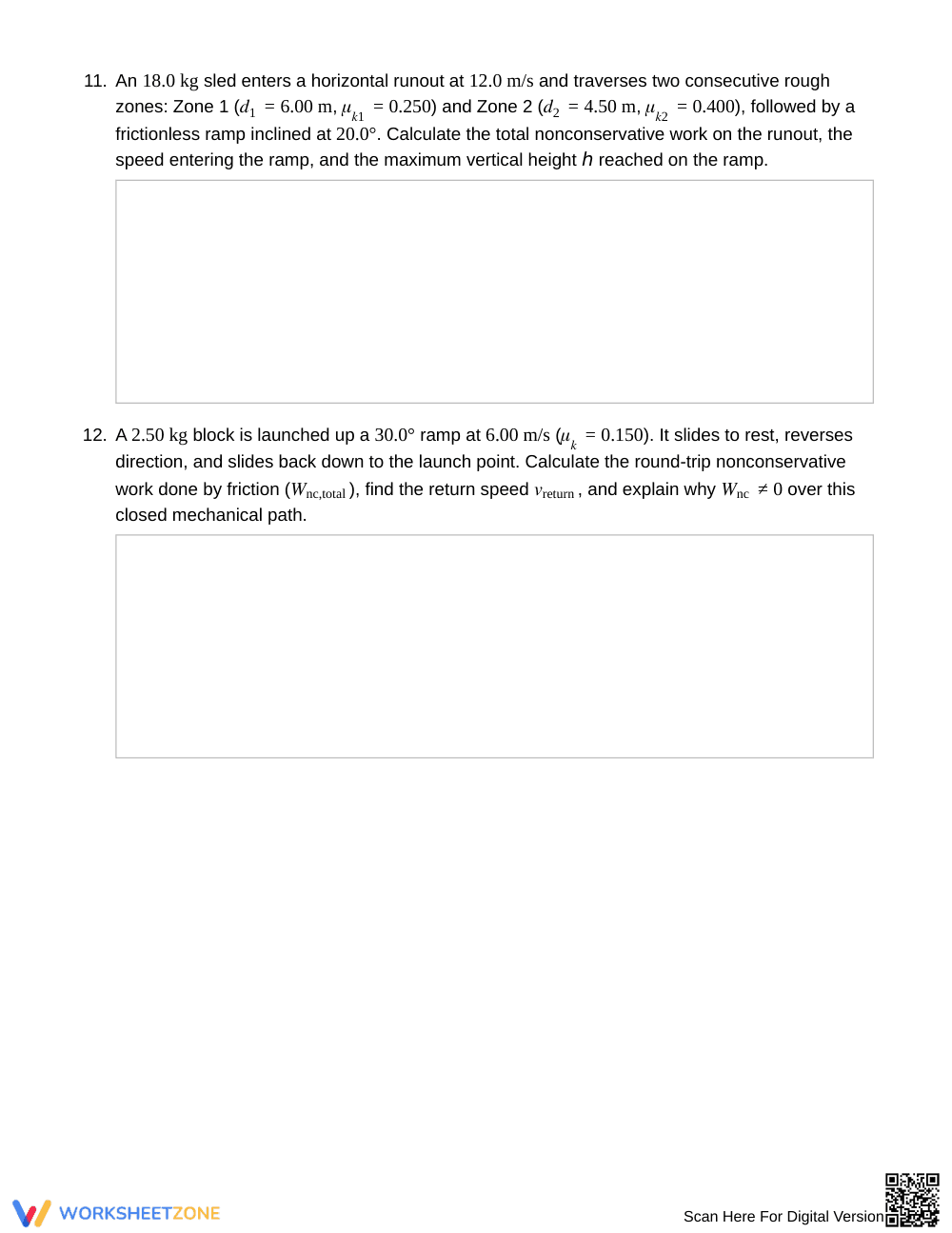

Complete Nonconservative Work Worksheet | Grade 12 Physics
Paste this activity's link or code into your existing LMS (Google Classroom, Canvas, Teams, Schoology, Moodle, etc.).
Students can open and work on the activity right away, with no student login required.
You'll still be able to track student progress and results from your teacher account.
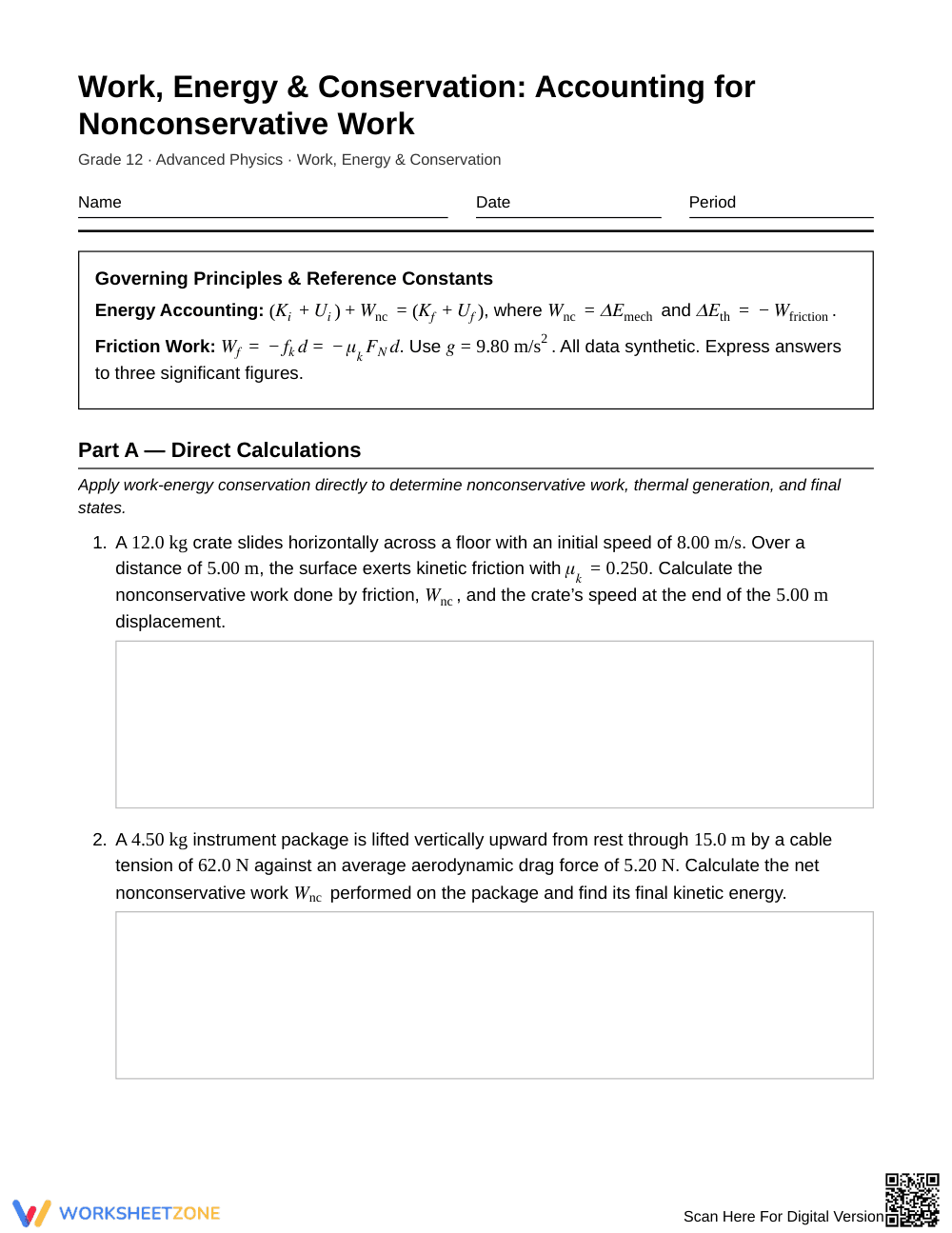
This advanced physics worksheet develops student mastery in calculating nonconservative work, thermal energy dissipation, and mechanical energy changes across complex multi-step systems. Students solve rigorous quantitative scenarios involving kinetic friction, aerodynamic drag, and spring compression to connect work-energy theorems with thermodynamic energy conservation.
At a Glance
- Grade: 12 · Subject: Physics
- Standard: Advanced Physics — Calculate nonconservative work, mechanical energy changes, and thermal energy dissipation in multi-stage systems
- Skill Focus: Nonconservative work equations and system energy accounting
- Format: 5 pages · 12 problems · Answer key included · PDF
- Best For: AP Physics practice and unit review
- Time: 45–60 minutes
What's Inside
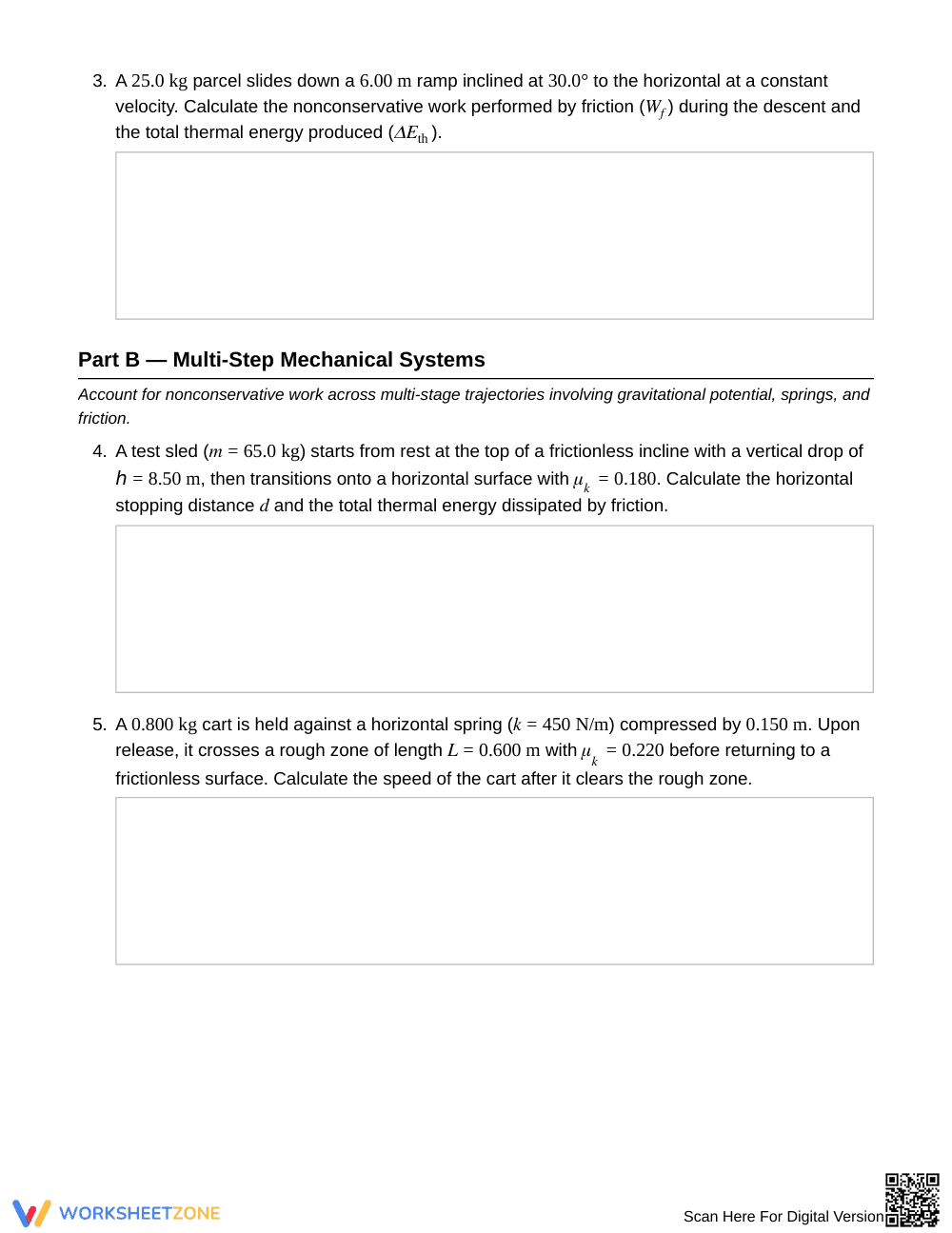
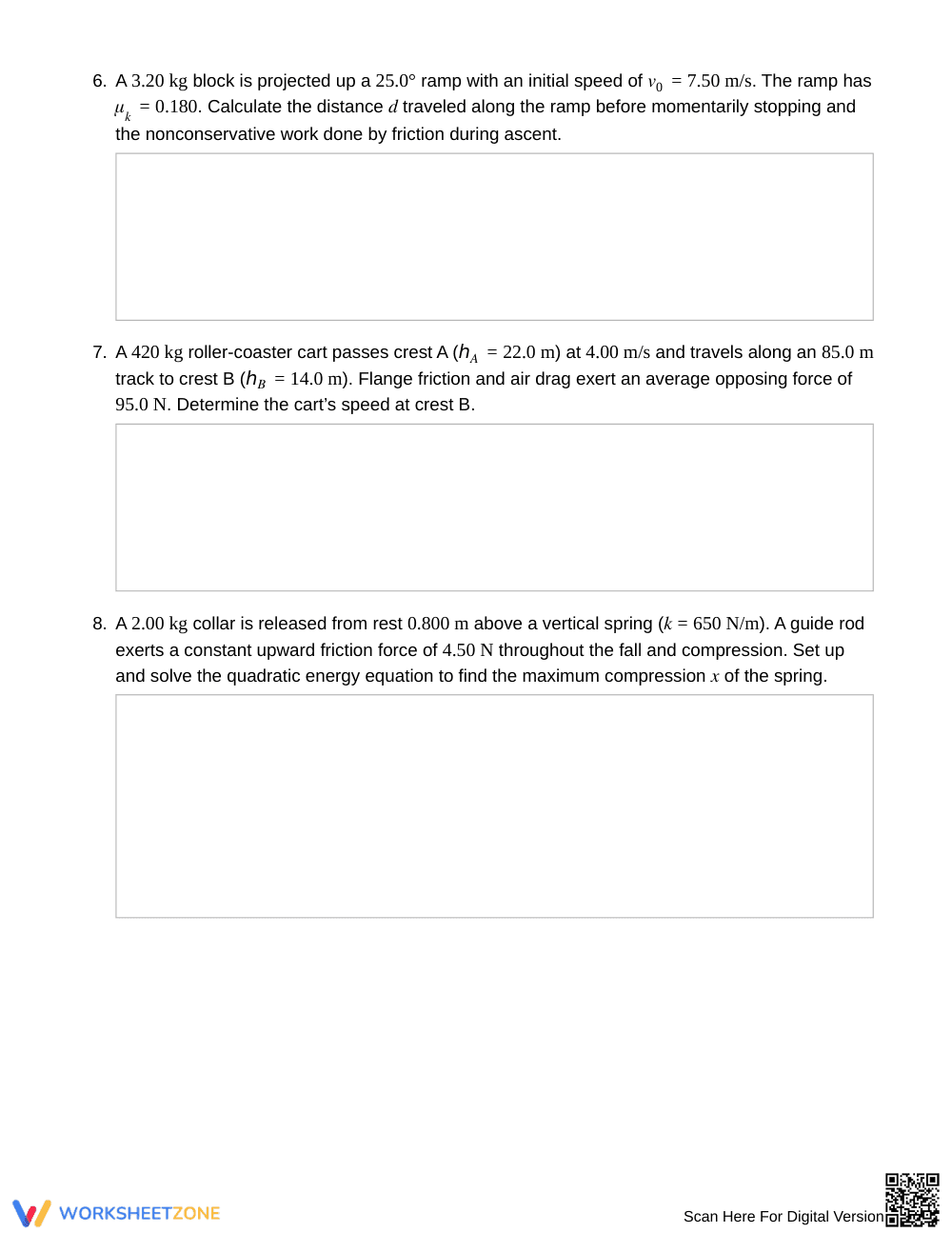
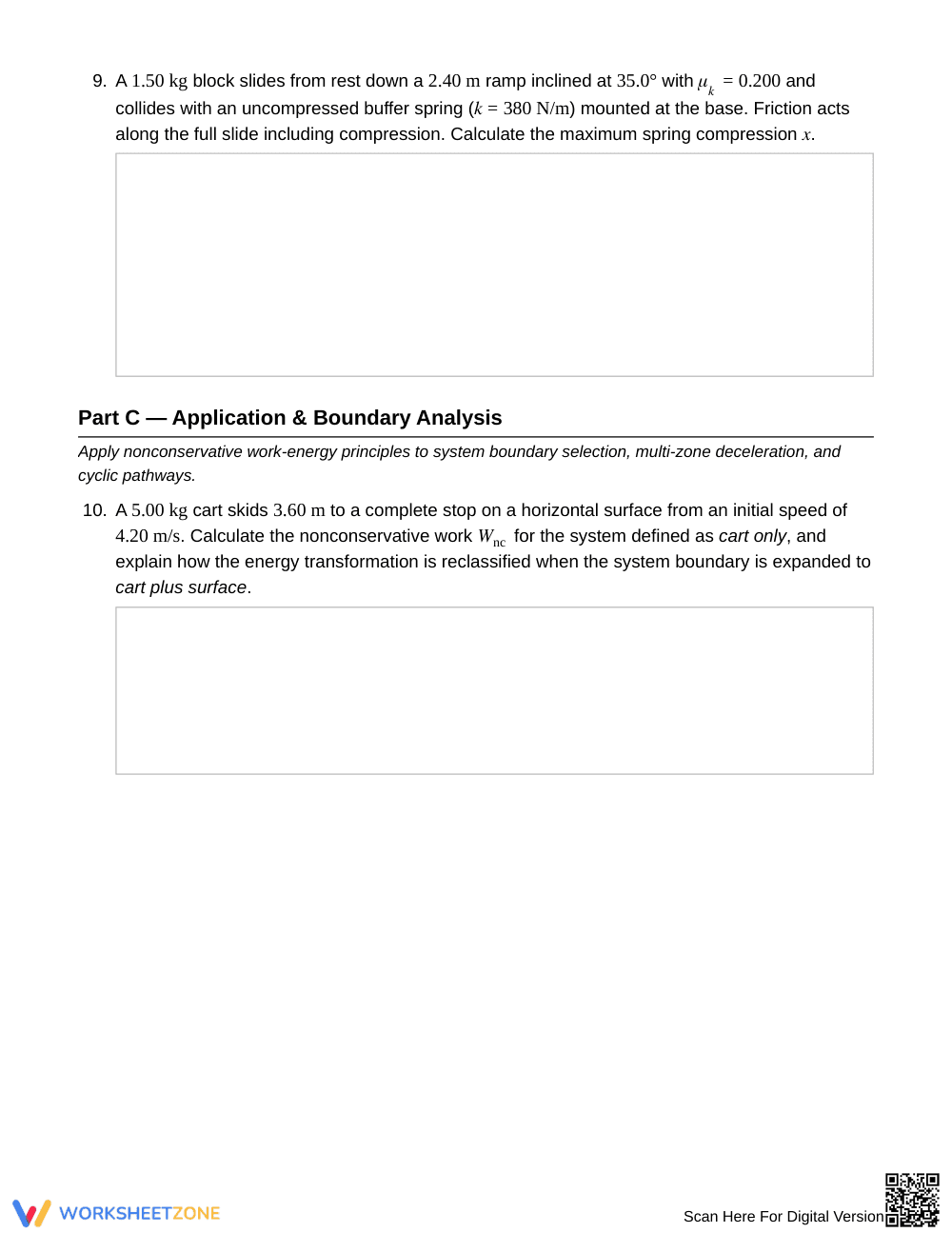
The 5-page resource provides 12 challenging quantitative physics problems divided into three structured parts. A governing principles reference header establishes standard equations for mechanical energy, nonconservative work, and friction formulas. The included 3-page comprehensive answer key outlines complete algebraic setups, intermediate substitutions, and numerical solutions expressed to three significant figures.
Skill Progression
- Guided Practice (Part A — Direct Calculations): 3 single-stage problems focusing on direct application of work-energy formulas for horizontal friction, vertical cable tension with drag, and constant-velocity inclined descents.
- Supported Practice (Part B — Multi-Step Mechanical Systems): 6 multi-stage problems requiring students to link energy conservation across frictionless inclines, rough patches, and vertical or inclined spring collisions involving quadratic equations.
- Independent Practice (Part C — Application & Boundary Analysis): 3 sophisticated analytical problems demanding system boundary identification, multi-zone friction deceleration, and path-dependent round-trip work calculations.
This structure follows an intentional gradual-release model that transitions students from formula substitution to conceptual boundary analysis.
Standards Alignment
This worksheet aligns with advanced high school physics and introductory college physics curricula covering work, kinetic and potential energy, and the work-energy theorem. Students apply the principle that the work done by nonconservative forces equals the change in total mechanical energy of a defined system. These problems can be integrated directly into lesson plans, AP Physics review modules, or district physics curriculum mapping tools.
How to Use It
Deploy this worksheet after direct instruction on the work-energy theorem and conservative versus nonconservative forces. For structured classwork, allocate 45 to 60 minutes for student pairs to work through Parts A and B before completing Part C individually. For formative assessment, examine student work on Part B spring compression problems to quickly identify whether learners correctly maintain energy signs when setting up quadratic conservation equations.
Who It's For
Designed for Grade 12 students in Honors Physics, AP Physics 1, or AP Physics C mechanics courses. It offers targeted practice for students preparing for collegiate STEM coursework and pairs effectively with laboratory investigations measuring friction coefficients on inclined planes.
According to research by Fisher & Frey (2014) on purposeful instructional design, structured problem sets that systematically increase cognitive complexity accelerate mastery of abstract physical principles. This Grade 12 physics worksheet operationalizes nonconservative work calculations across 12 targeted multi-step problems, moving from direct single-stage work equations to multi-zone deceleration and closed-path round trips. Students learn to systematically define system boundaries, evaluate mechanical energy dissipation, and account for thermal generation caused by nonconservative forces like friction and drag. The included complete answer key provides worked algebraic steps and final values rounded to three significant figures, giving educators a dependable resource for AP Physics exam preparation and rigorous mechanical physics instruction.


