




























Complete Work and Power Worksheet | Grades 8-12 Science
Paste this activity's link or code into your existing LMS (Google Classroom, Canvas, Teams, Schoology, Moodle, etc.).
Students can open and work on the activity right away, with no student login required.
You'll still be able to track student progress and results from your teacher account.
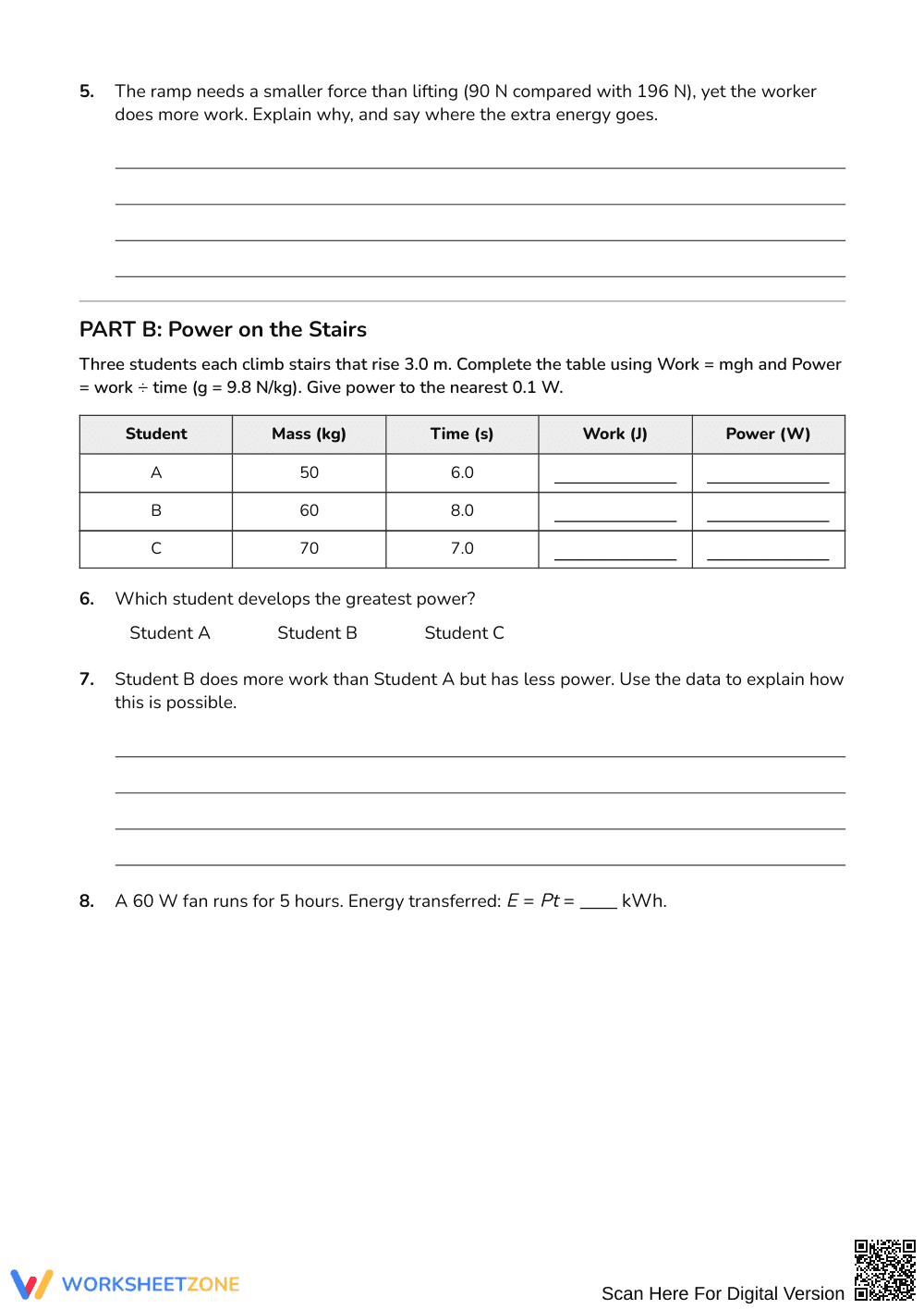
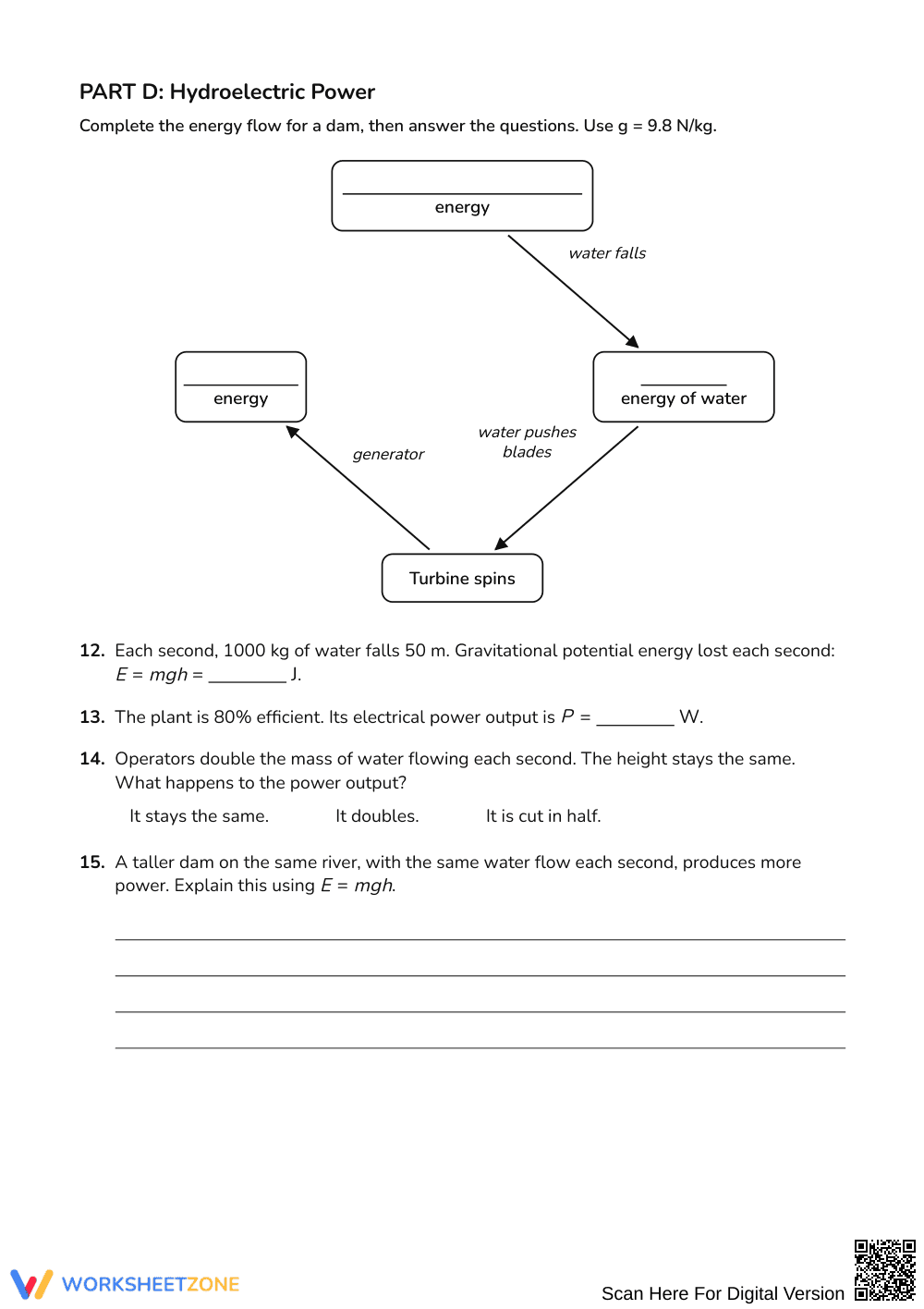
This physical science worksheet equips secondary students to analyze real-world mechanical systems by calculating work, power, mechanical advantage, and efficiency across multi-step scenarios. Learners examine loading ramps, stair-climbing power outputs, elastic energy in drawn bows, and hydroelectric generation to build durable quantitative reasoning skills across 24 targeted tasks.
At a Glance
- Grade: Grades 8–12 · Subject: Science
- Standard: High School Physical Science — Apply work, power, and energy conservation equations to real mechanical systems
- Skill Focus: Real-world multi-step work, power, and energy transfer
- Format: 4 pages · 24 problems · Answer key included · PDF
- Best For: Independent practice after direct energy instruction
- Time: 45–60 minutes
What's Inside: The 4-page student packet guides learners through four real-world problem sets: ramp mechanics, human power output on stairs, elastic potential energy and projectile speed, and hydroelectric generation. Tasks combine quantitative formulas (W = Fd, P = W/t, and KE = 1/2mv²) with qualitative explanations of energy dissipation and friction. A complete 4-page answer key provides step-by-step mathematical solutions and conceptual explanations.
Skill Progression
- Guided Practice (Part A): Students examine ramp efficiency and work tradeoffs using provided formulas, comparing direct lifting against an inclined plane to isolate frictional losses (6 tasks).
- Supported Practice (Parts B & C): Learners complete comparative data tables measuring power output across multiple subjects and interpret force-distance graphs to calculate kinetic launch speeds (10 tasks).
- Independent Application (Part D): Students independently track energy transformations through hydroelectric dams and determine how changing flow rates alter power generation without step-by-step prompts (8 tasks).
This structure reflects the gradual release of responsibility model, shifting students from guided mechanical calculations to independent system-level energy analysis.
Standards Alignment
This worksheet aligns with core physical science standards requiring students to develop and use models to illustrate that energy at the macroscopic scale can be accounted for as a combination of energy associated with the motions of particles and energy associated with the relative positions of particles. In addition, it supports standards requiring mathematical representations to calculate changes in kinetic and potential energy. Both standard codes can be copied directly into lesson plans, IEP goals, or district curriculum mapping tools.
How to Use It
Assign this resource immediately after direct instruction on work, power, and conservation of energy. It serves effectively as paired collaborative problem-solving or as an independent summative assignment across two class periods. When circulating, check whether students account for work done against friction in Part A before they calculate ramp efficiency. Expected completion time is 45 to 60 minutes.
Who It's For
This activity is designed for middle and high school physical science or introductory physics students mastering computational physics. For students needing support, provide formula reference cards showing isolated target variables. Pair this worksheet directly with an interactive energy conservation laboratory or inclined plane demonstration.
Secondary physical science education demands that students connect abstract mathematical equations to authentic mechanical systems. Fisher & Frey (2014) emphasize that structured gradual-release frameworks enable students to bridge the gap between guided formula application and independent system analysis. By moving methodically from ramp friction to stair-climbing rates, bow mechanics, and hydroelectric turbines, this resource ensures learners do not merely plug numbers into isolated formulas. Instead, students confront energy dissipation, calculate efficiency rates, and evaluate how time intervals govern power output. Grounding multi-step calculations in authentic physical scenarios prepares learners for advanced physics coursework, state science assessments, and engineering coursework.


