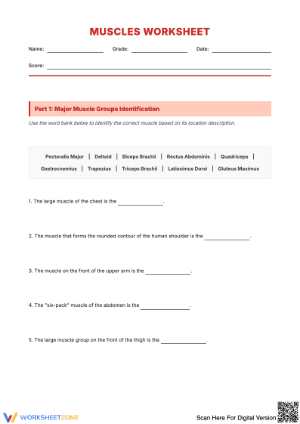
Human body systems printable worksheets for 9th grade give biology teachers something genuinely difficult to find at this level: activities that move past organ labeling into the analytical work the 9th-grade curriculum actually demands. This set covers all eleven major organ systems—circulatory, respiratory, nervous, digestive, endocrine, skeletal, muscular, excretory, integumentary, immune, and reproductive—with consistent emphasis on system interactions and homeostatic regulation rather than isolated anatomy. Each worksheet targets labeling, flowchart completion, cross-system comparison, or case study analysis, and teachers can drop them into an existing unit without restructuring their pacing guide.
The Analytical Work Students Do Across the Set
Each worksheet targets a specific type of thinking, which matters more than format variety for building real biology understanding. The skills across the set include:
- Biological organization diagrams: Students trace a specialized cell type—a skeletal muscle fiber, a red blood cell—upward through tissue, organ, and system levels, annotating each transition with a functional explanation rather than just a label.
- Feedback loop flowcharts: Partially completed diagrams walk students through negative and positive feedback mechanisms. One worksheet traces thermoregulation across the nervous and integumentary systems; another maps insulin and glucagon responses across the pancreas, liver, and circulatory system.
- Cross-system interaction matrices: Students fill comparison charts showing how two or three systems collaborate on one function—oxygen delivery, nutrient absorption, immune response—requiring them to hold multiple systems in mind simultaneously.
- Case study analysis: Students read short clinical scenarios, then identify which organs are likely affected and explain the physiological chain of events. A typical scenario describes a patient with elevated heart rate, low oxygen saturation, and fatigue, and asks students to reason backward through the cardiovascular and respiratory systems.
- Vocabulary in context: Key terms appear embedded in diagrams and response prompts rather than in matching lists, requiring students to demonstrate meaning through application rather than recognition.
Errors That Show Up Consistently When Students Hit This Material
The dominant error at this level is not anatomical confusion—it's false isolation. Students who can correctly label a diagram of the nephron will still write "the kidneys filter blood" in an open response without mentioning the circulatory system delivering that blood, the endocrine system regulating filtration rate, or the nervous system responding to fluid imbalance. They treat each system as a sealed unit. The cross-system worksheets address this directly by structuring questions so that a complete answer is impossible without referencing at least two systems. Students who resist that requirement are almost always the ones who relied on system-by-system memorization rather than developing any picture of how the body integrates those systems.
A second consistent pattern: students confuse negative and positive feedback on first encounter. The terminology defeats them—"negative" reads as inhibition or failure rather than regulation, so they reach for examples of one system stopping another. The flowchart format makes directionality concrete in a way prose explanations often can't, because the visual loop shows the relationship between stimulus, response, and return to set point without requiring students to hold all three steps in working memory at once.
Standard Alignment
These worksheets align with NGSS HS-LS1-2, which asks students to develop and use a model to illustrate the hierarchical organization of interacting systems that provide specific functions within multicellular organisms. That standard sits at 9th grade deliberately—it requires the cell biology foundation students build in middle school, and without it, system interaction is an abstraction with nothing to attach to. Teachers looking for human body systems printable worksheets for 9th grade that document cleanly against this standard will find the hierarchy diagrams, feedback loop flowcharts, and cross-system matrices most directly citable. Each of those formats is a modeling exercise in the sense NGSS intends: students aren't filling blanks from memory, they're constructing a functional representation of how parts relate to each other and to the whole.
Fitting These Worksheets Into Your Unit Structure
The most effective placement is as formative work running alongside your instructional sequence, not as end-of-unit assessments. Introduce a system through direct instruction, then assign the corresponding worksheet as a warm-up the following class period. That 10-to-15-minute window before new content starts is where these worksheets work best—you can circulate, catch misconceptions before they settle in, and get a quick read on who understood yesterday's lesson before you move forward.
The case study worksheets lend themselves to a jigsaw format. Assign small groups one system each using the single-system worksheet and give them 12 to 15 minutes to become the room's experts on that system. Then regroup students into mixed teams to work through a shared homeostasis scenario together. Each student has to explain their assigned system's role to peers who haven't studied it—that act of articulation does more for retention than re-reading notes ever does, because retrieval and translation are harder cognitive work than recognition. The case study questions are open enough to require genuine synthesis, which is what makes the jigsaw format click with this material rather than collapsing into one student doing all the work.
Adjusting the Worksheets for a Range of Learners
For students still consolidating basic anatomy, the hierarchy and single-system labeling worksheets belong first. Asking a student who cannot yet locate the alveoli to trace oxygen exchange across the respiratory and circulatory systems simultaneously puts too much on working memory before any of it is automatic. Use those foundational worksheets to stabilize vocabulary and structural knowledge; move to the cross-system comparison materials once students can retrieve single-system content without friction.
Students who move through the standard worksheets quickly benefit most from the case study format as an extension, particularly when the scenario is deliberately ambiguous—where two different system failures could plausibly explain the same symptoms. Asking those students to construct a written argument for which system is the primary cause, citing physiological evidence rather than general reasoning, mirrors the kind of thinking that appears on AP Biology and IB Biology assessments later in high school. It keeps advanced students genuinely challenged rather than just doing more of the same work faster.
Frequently Asked Questions
Do all eleven body systems need to be covered to use this set?
No. The human body systems printable worksheets for 9th grade in this set are standalone—each covers a specific system or interaction without depending on prior worksheets in the collection. Teachers whose curriculum prioritizes circulatory, respiratory, and nervous systems can pull exactly those worksheets without working through the rest. Sequencing is entirely the teacher's call.
How long does a typical worksheet take to complete?
Single-system labeling and hierarchy worksheets generally run 10 to 15 minutes of independent work. The feedback loop and cross-system comparison worksheets typically take closer to 20 minutes because students are reasoning across systems rather than recalling isolated facts. Case study worksheets, when discussion is included, usually fill a full 45-to-50-minute period.
What if my district sequences body systems differently than these worksheets do?
Human body systems printable worksheets for 9th grade built around NGSS HS-LS1-2 rather than textbook chapters travel across curriculum materials without modification. The content doesn't depend on any particular chapter order. The only adjustment most teachers make is sequencing—using a feedback loop or cross-system worksheet earlier or later in the unit depending on when their textbook introduces the relevant vocabulary.
Which worksheets transfer most directly to standardized assessment performance?
The cross-system matrices and case study worksheets. State-level and NGSS-aligned biology assessments at this grade rarely ask for recall—they present unfamiliar scenarios and ask students to apply system knowledge to something they haven't seen before. Students who have practiced that kind of transfer outperform students who relied on diagram memorization, and the gap shows up most sharply on any item that gives a patient scenario and asks for physiological reasoning rather than organ identification.