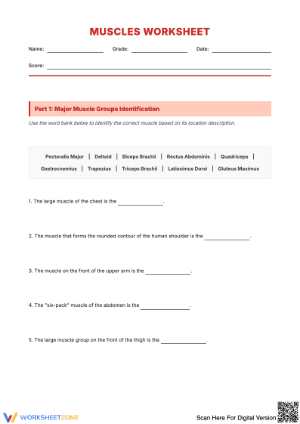
These 9th grade biology worksheets give teachers printable, topic-sorted resources for every major unit in a standard freshman course — cell structure, genetics, ecology, and evolution — as PDF files that hold their formatting whether you run them through a school copier or drop them into Google Classroom. The same worksheet you print for Thursday distributes cleanly as a digital file to absent students, which matters more than it sounds when you are managing 90 students across three sections.
What These Worksheets Cover, Unit by Unit
The set addresses the four units that anchor most state-level biology curricula for freshmen. Within each unit, the worksheets move from vocabulary and identification toward application and analysis — students label before they explain, and they explain before they interpret data.
Cell structure and function worksheets ask students to label plant and animal cell organelles, distinguish the roles of the cell membrane and cell wall, and sequence the stages of mitosis and meiosis. Several worksheets connect photosynthesis and cellular respiration by having students trace reactants and products to specific organelles — a step many textbooks skip that predictably produces errors on unit exams.
Genetics and molecular biology resources cover monohybrid and dihybrid Punnett squares, incomplete dominance, codominance, and sex-linked traits. Separate worksheets address DNA structure, replication, RNA transcription, and translation. Because protein synthesis involves three sequential processes that freshmen routinely conflate, those worksheets present each stage in isolation before a final one asks students to sequence the full pathway from gene to protein.
Evolution and ecology worksheets have students interpret cladograms, apply natural selection to specific scenarios, and trace energy flow through food webs and pyramids. Biogeochemical cycles — nitrogen, carbon, and water — each receive a dedicated diagram-labeling worksheet rather than being bundled onto one task, giving teachers flexibility to pace that unit independently of the others.
Fitting These Worksheets Into Your Teaching Week
The format that sees the most consistent use in actual biology classrooms is the entry-ticket model. Before students handle microscopes or reagents, require them to complete a brief diagram-labeling or vocabulary-matching exercise at their seats. This takes 6 to 8 minutes and does something a verbal review cannot: it produces written evidence showing which students cannot yet name a cell structure before they are asked to find one under a slide. Teachers who run this routine consistently report fewer off-task moments during lab time because students arrive at the bench with baseline vocabulary already active rather than trying to recall it mid-experiment.
For end-of-unit review, spread several worksheets across stations around the room — each table covering a different topic — and let students move to where their gaps are. This works better than a cumulative review sheet because students who already understand genetics do not need 20 minutes on Punnett squares; they can move directly to ecology materials. The written work students leave at each station tells you exactly which concepts still need reteaching before the exam, which is more precise than exit tickets that ask for a self-rating on a scale of one to five.
A third use worth building into your routine: pull a worksheet from your 9th grade biology worksheets collection as a Monday warm-up on the first day back from a break or a long weekend. Students who completed the previous unit retain more when they encounter the material again within 48 hours — a straightforward application of spaced retrieval — and a targeted worksheet requires zero additional prep time to implement.
Student Mistakes That Surface Repeatedly in These Units
Genetics produces the densest cluster of predictable freshman errors. Students who correctly set up a Punnett square and arrive at a 3:1 ratio still frequently write "3 dominant and 1 recessive" rather than describing phenotypic proportions — conflating the count of boxes with actual offspring ratios. A separate pattern appears with incomplete dominance: students who can define it in writing still revert to complete dominance notation under a cross, writing "Rr = red" when the heterozygote should produce a pink flower. Both errors show up clearly on the genetics worksheets and are easier to address there than after a unit exam.
In the molecular biology unit, a reliable fraction of freshmen confuse transcription and translation — partly because both terms start with "tr" and partly because diagrams in most textbooks show them on the same page without a clear visual break between them. Students will describe ribosomes as located in the nucleus or explain that mRNA serves as a template for new DNA. These errors surface on the worksheet that asks students to sequence the steps of protein synthesis, which is exactly the right moment to catch them.
Osmosis produces a misconception worth addressing before students ever see the term: students apply diffusion reasoning to water movement, saying water flows "from high to low concentration" and meaning solute concentration. When asked why water enters a cell placed in a hypotonic solution, they explain it backward. Worksheets that display solute and solvent concentrations side by side — with arrows for students to draw and label — surface this error faster than any multiple-choice format, and that kind of diagnostic task is what separates a solid 9th grade biology worksheets from a review sheet that only confirms what students already know.
Standard Alignment
These worksheets address several NGSS High School Life Sciences performance expectations. HS-LS1-1 and HS-LS1-2 anchor the cell structure and function materials — students construct explanations of how organelle structures support cell-level functions. HS-LS1-6 and HS-LS1-7 appear in the cellular respiration and photosynthesis worksheets, which ask students to use mathematical representations of matter and energy transfer rather than reciting equations from memory. The genetics unit connects to HS-LS3-1 and HS-LS3-3, and the evolution worksheets support HS-LS4-2 and HS-LS4-4 through natural selection scenario analysis and data interpretation.
In classroom terms, HS-LS3-1 asks students to make and defend predictions about trait inheritance — the two-step move from probability to phenotype that appears in a well-structured 9th grade biology worksheets set when students complete a dihybrid cross and then explain what the resulting ratios mean for offspring appearance. Teachers in states that have adopted or adapted NGSS can map each worksheet directly to the standard it addresses without auditing activities from scratch.
Adjusting the Set for a Mixed-Ability Classroom
The most practical modification for students still building academic vocabulary is a word bank added to any diagram-labeling worksheet. This reduces retrieval pressure enough that ELL students and students reading below grade level can focus on understanding the structure rather than searching for terminology they haven't yet consolidated. Word banks do not make the task easier in terms of biological understanding — students still match term to structure — but they remove the blank-page paralysis that causes some students to submit an untouched worksheet rather than attempt it at all.
For students working above grade level, two adjustments do the most work: remove the word bank and add one open-ended question requiring a written explanation rather than a label. After a student identifies the mitochondria on a diagram, ask them to explain in two sentences why a cardiac muscle cell contains more mitochondria than an epidermal cell. That question requires application rather than recall and generates writing that gives you a clearer picture of actual conceptual understanding than any fill-in response can.
Students who freeze on open-ended diagram work — a pattern that shows up regularly with students who have processing difficulties or a history of assessment anxiety — respond better when one label is already filled in as a reference point. Providing a single completed anchor on the diagram gives those students a foothold without removing the intellectual work of the remaining items.
Frequently Asked Questions
Do these worksheets include answer keys?
Each worksheet in the set comes with a corresponding answer key. For diagram-labeling activities, the key shows the fully labeled diagram. For genetics and molecular biology worksheets, worked examples accompany the answers so teachers can trace the reasoning path — not just check the final answer — which makes it faster to pinpoint exactly where a student's work went wrong.
Can these be assigned digitally, or are they print-only?
The PDF format means the worksheets display consistently across devices and inside any LMS, including Google Classroom, Canvas, and Schoology. For digital submissions, students can annotate inside Adobe Acrobat or Google Drive's PDF viewer. Diagram-labeling worksheets work better as printed materials because precise arrow placement is easier on paper; vocabulary and genetics worksheets work fine as typed digital submissions.
How long does a typical worksheet take to complete?
Most run 15 to 25 minutes for an average-paced freshman working independently. Diagram-labeling worksheets tend toward the shorter end; genetics and protein synthesis worksheets with multi-step problems take closer to 25 minutes. That range fits comfortably within a single class period alongside direct instruction, or as a homework assignment that does not consume an entire evening.
Are these appropriate for AP Biology or only standard-level courses?
The set targets standard freshman biology. AP Biology introduces depth — enzyme kinetics, the electron transport chain, Hardy-Weinberg equilibrium — that these worksheets do not address. They are useful for AP students who need to consolidate foundational knowledge before moving into college-level content, particularly students who completed standard biology more than a year before enrolling in AP and need to reactivate what they covered as freshmen.















 Interactive Worksheet Maker
 Quiz Maker
 Word Search Maker
 Crossword Puzzle Maker
 Word Scramble Generator
 Sentence Scramble Generator
 Handwriting Worksheet Generator
 Name Tracing Generator
 Fill In The Blank Generator