


























0
Views
0
Downloads

0.0
0
Save
0 Likes
Share
Trophic Levels: Food Web to Energy Pyramid
0 Views
0 Downloads
Paste this activity's link or code into your existing LMS (Google Classroom, Canvas, Teams, Schoology, Moodle, etc.).
Students can open and work on the activity right away, with no student login required.
You'll still be able to track student progress and results from your teacher account.
Information
Description
What It Is:
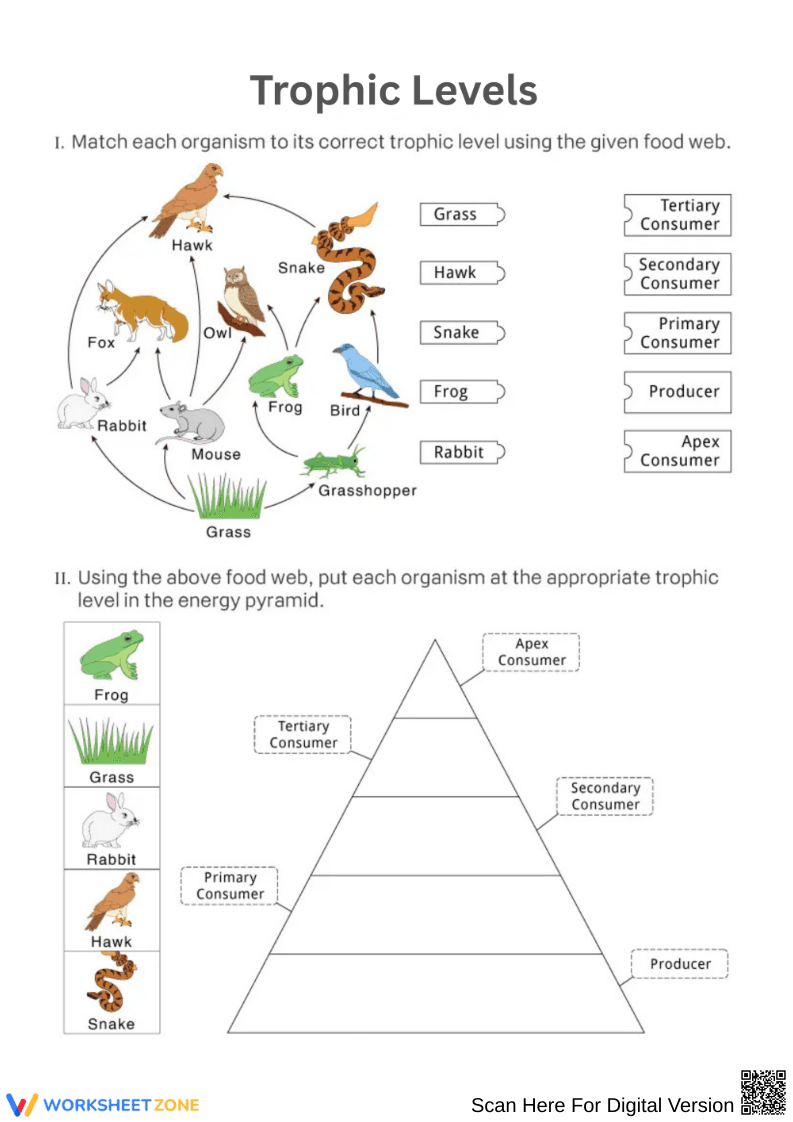
This worksheet guides students through analyzing a food web and assigning organisms to their correct trophic levels. Students first match organisms to roles such as producer, primary consumer, secondary consumer, tertiary consumer, and apex consumer, then place those organisms into the correct levels of an energy pyramid.
Why Use It:
This activity strengthens systems thinking by helping students connect food webs to energy pyramids. It reinforces how feeding relationships determine trophic position and supports a deeper understanding of energy transfer within ecosystems.
How to Use It:
• Have students study the food web and identify feeding relationships.
• Ask students to match each organism to its correct trophic level.
• In Part II, have students place the organisms into the appropriate level of the energy pyramid.
• Review answers to discuss energy loss and apex consumer roles.
Grade Suitability:
Best suited for Grade 7 to Grade 9.
• Grade 7: Practicing identification of trophic roles using visual food webs.
• Grade 8–9: Applying trophic concepts to energy pyramids and ecosystem models.
Target Users:
Designed for middle school science teachers, homeschool educators, and students studying ecosystems, food webs, energy flow, and trophic structures.
This worksheet guides students through analyzing a food web and assigning organisms to their correct trophic levels. Students first match organisms to roles such as producer, primary consumer, secondary consumer, tertiary consumer, and apex consumer, then place those organisms into the correct levels of an energy pyramid.
Why Use It:
This activity strengthens systems thinking by helping students connect food webs to energy pyramids. It reinforces how feeding relationships determine trophic position and supports a deeper understanding of energy transfer within ecosystems.
How to Use It:
• Have students study the food web and identify feeding relationships.
• Ask students to match each organism to its correct trophic level.
• In Part II, have students place the organisms into the appropriate level of the energy pyramid.
• Review answers to discuss energy loss and apex consumer roles.
Grade Suitability:
Best suited for Grade 7 to Grade 9.
• Grade 7: Practicing identification of trophic roles using visual food webs.
• Grade 8–9: Applying trophic concepts to energy pyramids and ecosystem models.
Target Users:
Designed for middle school science teachers, homeschool educators, and students studying ecosystems, food webs, energy flow, and trophic structures.


