


























Views
Downloads

Essential Natural Selection Worksheet | Grade 9-12
Paste this activity's link or code into your existing LMS (Google Classroom, Canvas, Teams, Schoology, Moodle, etc.).
Students can open and work on the activity right away, with no student login required.
You'll still be able to track student progress and results from your teacher account.
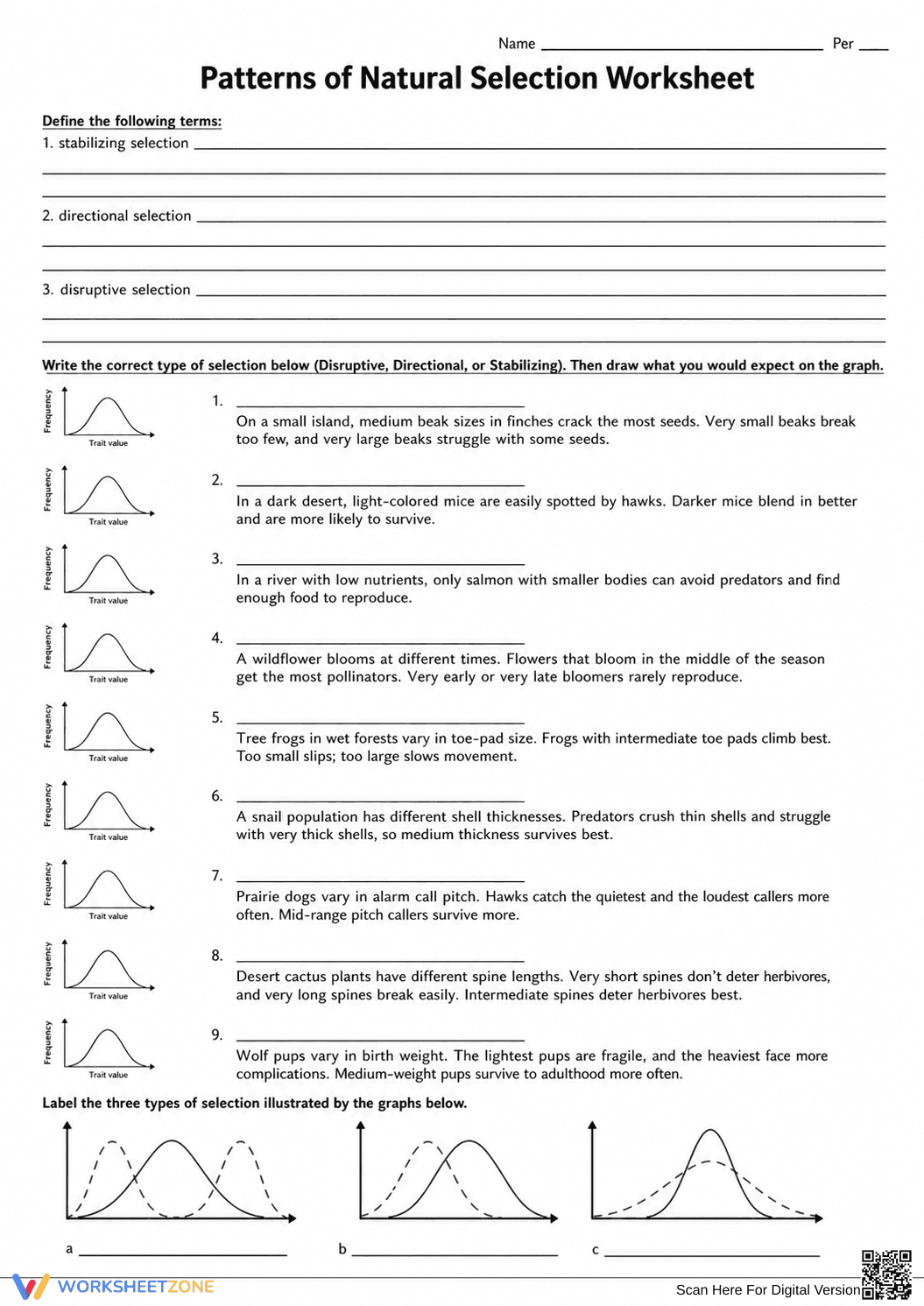
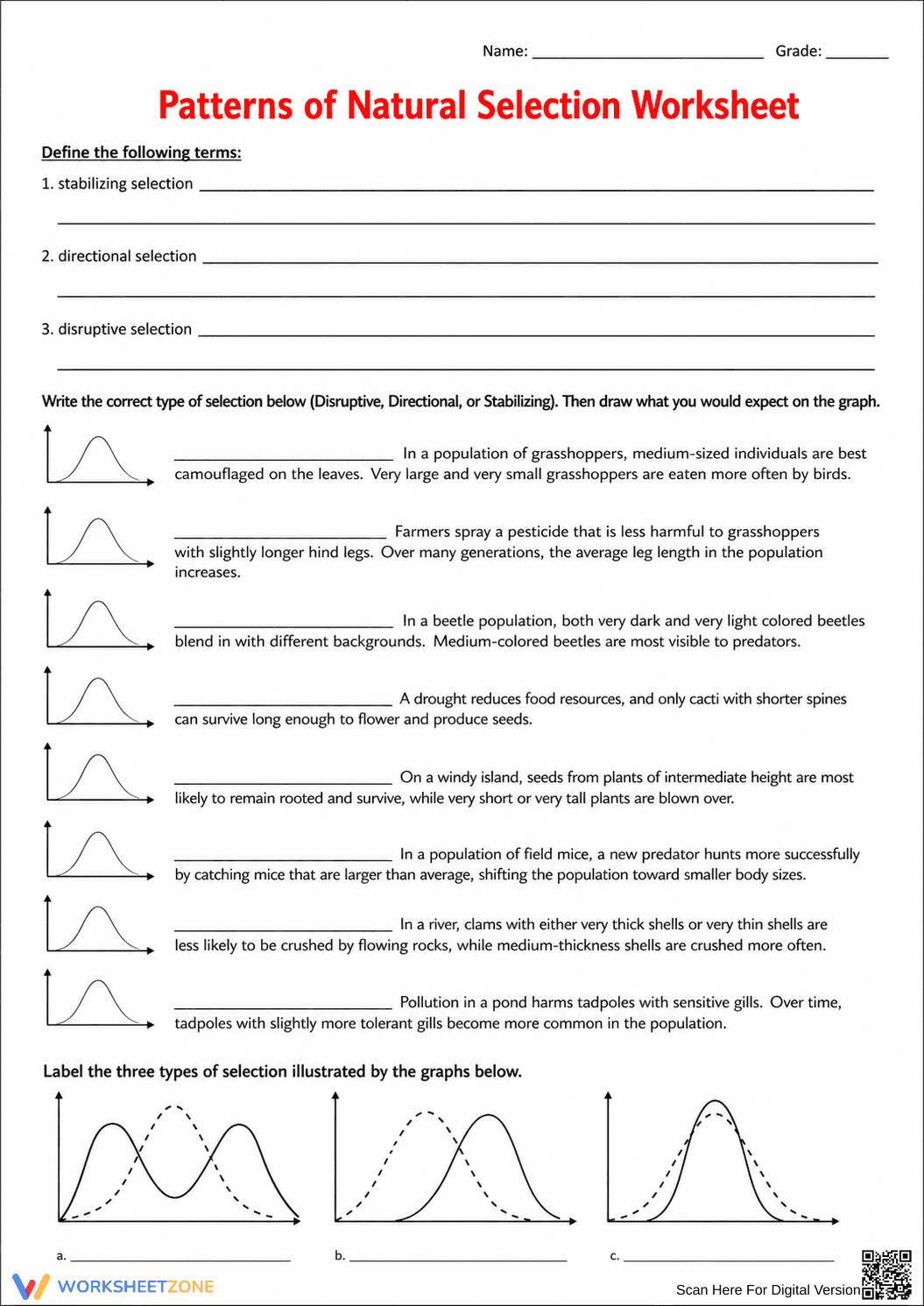
This high school biology resource provides a comprehensive framework for analyzing how populations change over time. Students identify, define, and graph the three primary modes of natural selection. By connecting theoretical definitions to real-world biological scenarios, learners develop a concrete understanding of evolutionary mechanisms and population dynamics.
At a Glance
- Grade: 9-12 · Subject: Biology
- Standard:
HS-LS4-3— Use statistics to explain how advantageous traits increase in populations- Skill Focus: Identifying and graphing selection patterns
- Format: 2 pages · 13 problems · Answer key included · PDF
- Best For: Independent practice or sub plans
- Time: 35–45 minutes
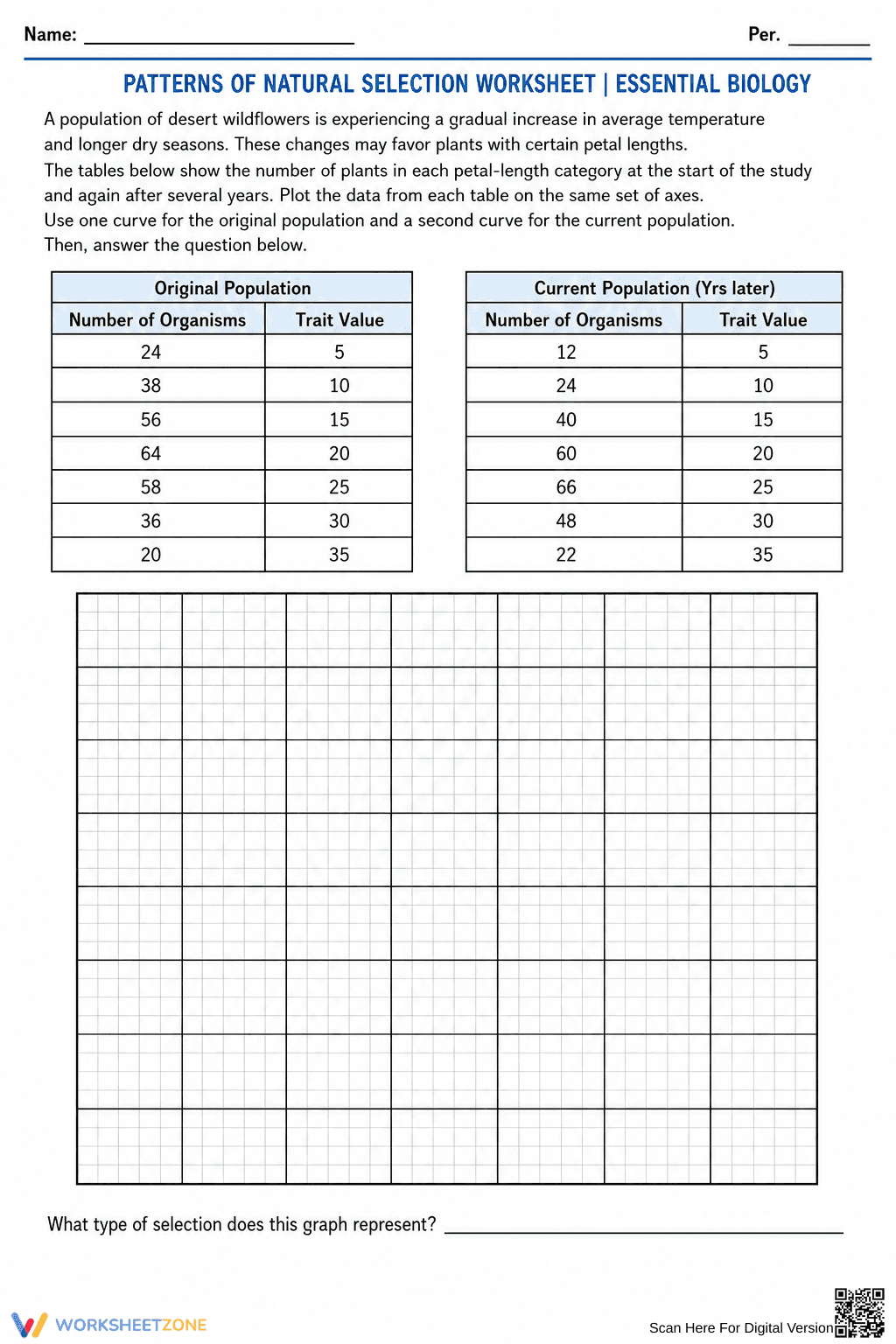
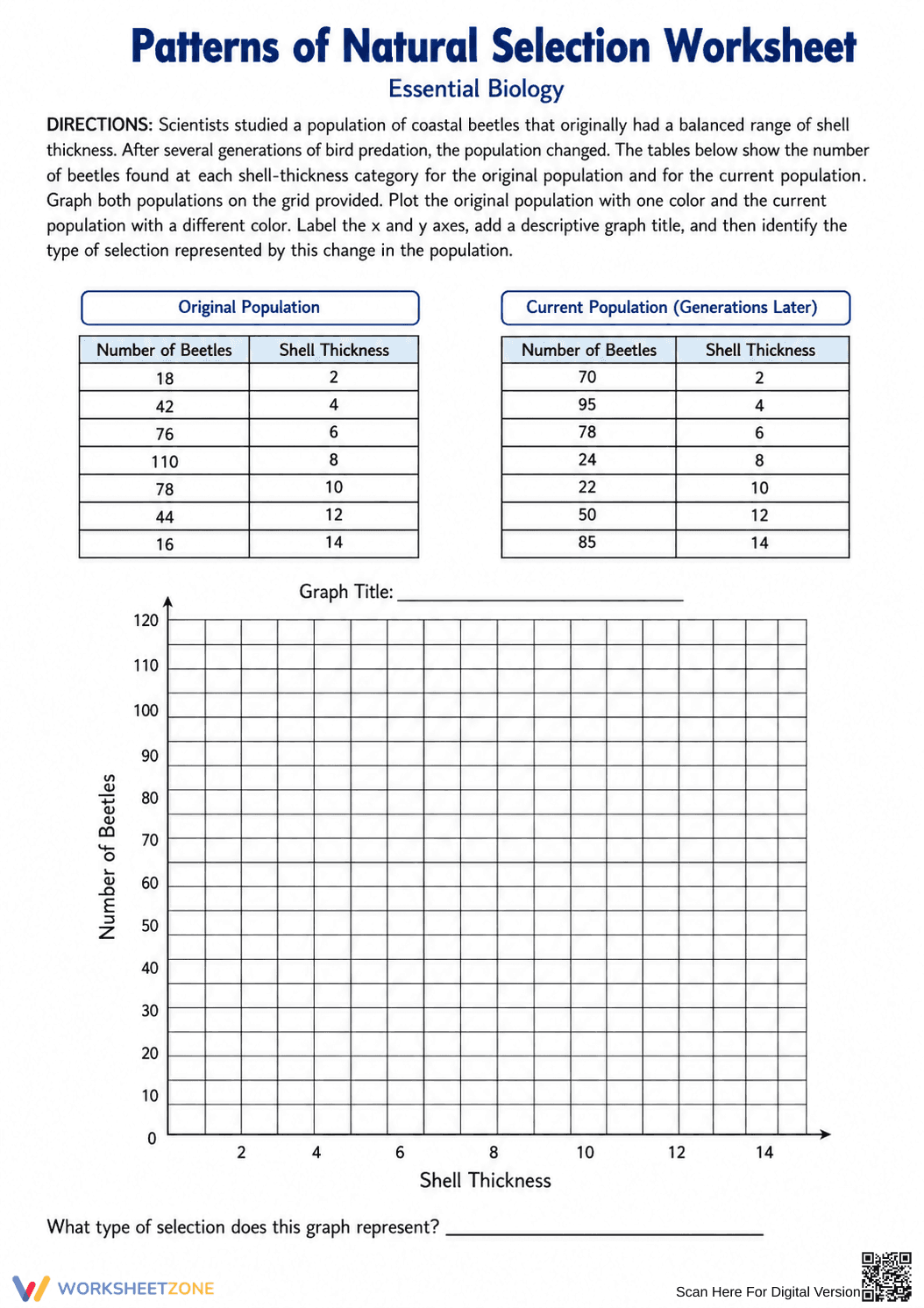
The packet contains two distinct student pages designed for maximum clarity. Page one features three vocabulary definitions followed by nine unique scenarios involving starlings, lizards, and oak trees. Each scenario requires students to name the selection type and sketch the resulting bell curve. Page two transitions to quantitative analysis, providing two data tables for a spiny cactus population. Students must plot these data points on a provided grid to visualize the shift in traits over time.
Zero-Prep Workflow
- Print: Generate the double-sided PDF in under 2 minutes for the entire class.
- Distribute: Hand out the materials in seconds; the self-explanatory instructions allow for immediate student engagement.
- Review: Use the included 2-page color-coded answer key to grade or review results in less than 5 minutes.
This streamlined process makes the resource an ideal solution for emergency sub plans or reinforcement during a busy unit.
This worksheet aligns directly with HS-LS4-3. This standard requires students to apply concepts of statistics and probability to support explanations that organisms with advantageous heritable traits tend to increase in proportion. The graphing component specifically addresses the mathematical modeling required by NGSS. Both standard codes can be copied directly into lesson plans, IEP goals, or district curriculum mapping tools.
Use this as a formative assessment after an introductory lecture on evolution. It works well as a middle-of-unit check to ensure students can distinguish between disruptive and stabilizing selection before moving to speciation. Teachers should observe students during the graphing phase to ensure they are correctly labeling the axes. Completion typically takes 40 minutes, making it a perfect fit for a standard high school period.
This is designed for general biology students in grades 9 through 12. It is particularly effective for visual learners who benefit from drawing the shifts in population curves. It pairs naturally with a digital simulation of natural selection or a textbook chapter on microevolution. The scenarios provided offer enough variety to keep students engaged while reinforcing the core mathematical concepts of biology.
According to Fisher & Frey (2014), the use of scaffolds like the scenario-based identification tasks in this worksheet supports the gradual release of responsibility, moving students from conceptual definitions to complex data interpretation. The HS-LS4-3 alignment ensures that students are not merely memorizing terms but are engaging in the scientific practice of data analysis. By requiring students to graph two distinct populations—the original and the current—the worksheet mirrors the evidence-based reasoning found in modern biological research. This dual-graphing approach helps students visualize the fitness of specific phenotypes within a changing environment. Research indicates that such visual-quantitative tasks significantly improve long-term retention of evolutionary concepts compared to rote memorization. This resource provides the necessary structure for students to master the statistical foundations of natural selection while maintaining high engagement through diverse biological examples.


