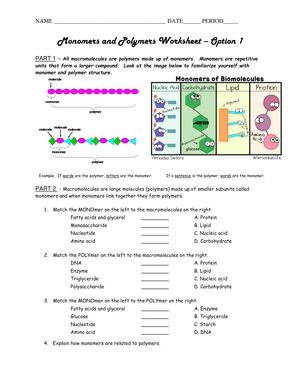
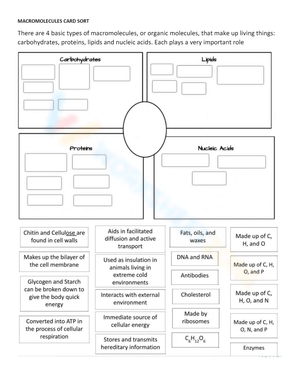
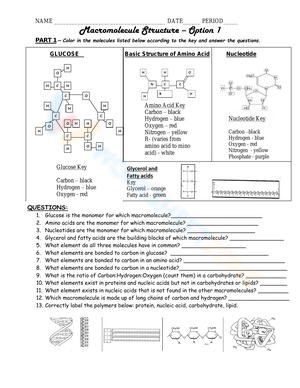
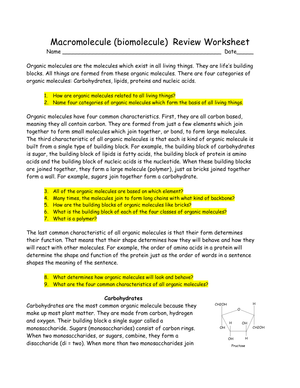
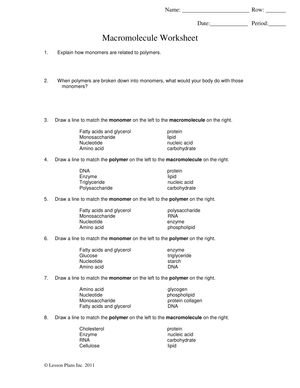
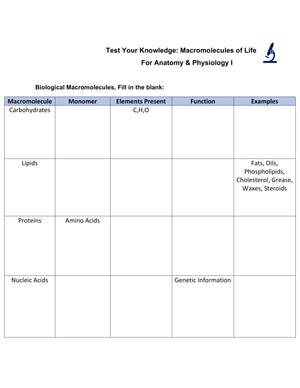
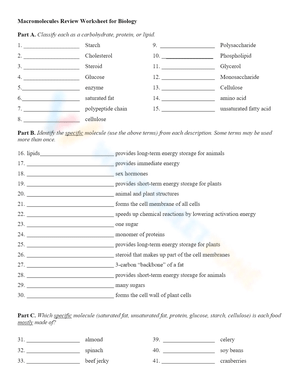
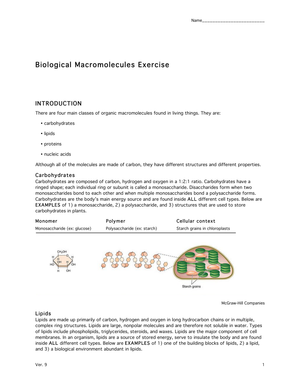
These 8th grade macromolecule worksheets resources give life science teachers a set of standalone, printable practice tools built around the four major biological macromolecule groups — carbohydrates, lipids, proteins, and nucleic acids. Each worksheet moves students from identifying the groups toward explaining what those molecules actually do in living systems, which is a different cognitive task than vocabulary recall alone. Teachers working through a food, growth, or organisms unit will find the set useful whether they need a Monday bell ringer, a Tuesday guided-practice activity, or a Friday formative check before a unit test.
The Specific Skills These Worksheets Target
A well-designed 8th grade macromolecule worksheets set addresses five overlapping skill areas that reflect what grade 8 life science expects students to be able to do with this content. The tasks move from concrete to abstract: students start with familiar examples — pasta, cooking oil, muscle fiber, a strand of DNA — before naming the molecule type, and only after that do they explain the function. That sequence reduces cognitive load for students who are still building science vocabulary because each answer is anchored in something observable before students are asked to reason about biology.
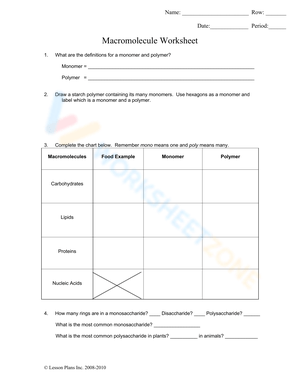
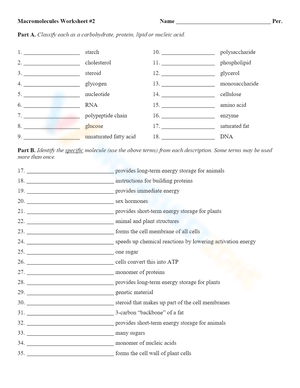
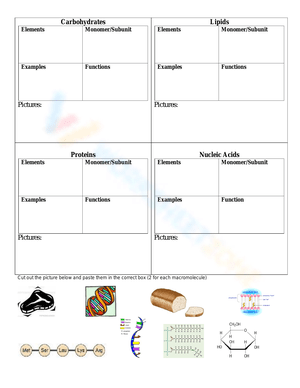
- Identification from examples: Students sort everyday foods, body structures, and biological molecules into the four macromolecule categories.
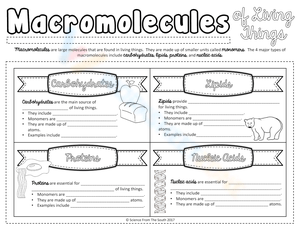
- Function matching: Each worksheet asks students to connect carbohydrates, lipids, proteins, and nucleic acids to their primary roles — quick energy, long-term storage, structural repair and enzyme activity, and genetic information storage.
- Monomer and polymer recognition: Students compare how carbohydrates, proteins, and nucleic acids are assembled from smaller subunits, and note that lipids don't follow the same polymer pattern — a distinction that rewards careful reading and gives stronger students an extra layer to work with.
- Evidence-based reasoning: Several prompts give students a short scenario about an organism's behavior or diet and ask them to identify the most relevant macromolecule and explain why.
- Written explanation: Students write one- to two-sentence responses connecting structure to function, giving teachers more useful evidence than circled answers alone.
Common Misconceptions to Watch For and Correct
The most persistent confusion at this level is the energy overlap between carbohydrates and lipids. Students learn early that carbohydrates provide energy, and many conclude from that fact that lipids do not — or that lipids are simply "bad for you," which reflects what many of them hear at home or in health class. When asked to assign a function to lipids, a significant portion of students will write "insulation" or "cell membranes" but leave the energy-storage function blank entirely. Each worksheet includes prompts that surface this gap directly by asking students to distinguish between short-term and long-term energy sources, which forces them to deal with the distinction rather than skip past it.
A second recurring problem involves enzymes. Most 8th graders do not automatically categorize enzymes as proteins. They treat enzymes as a separate, somewhat mysterious category — something the teacher mentioned once in the context of digestion. A worksheet prompt that reads "a molecule speeds up a chemical reaction in the small intestine — what macromolecule group does it belong to?" reliably reveals whether students have connected enzymes to the protein group or are simply pattern-matching on vocabulary they half-remember. That kind of scenario-based question exposes the gap where a matching task would not.
Students also lose precision when writing about nucleic acids. They know DNA is important, but they frequently describe nucleic acids as "controlling the body" or "telling cells what to do" rather than storing and transmitting genetic information. That vague phrasing appears often in short-answer responses and makes it difficult to know whether a student understands the concept or is relying on loose recall. Annotation tasks — where students underline key terms in a short passage before writing their answers — help push thinking toward more specific language.
How to Build These Worksheets Into Your Lesson Plans
The most effective approach is to distribute worksheets across the unit rather than assign them all at once. On the first day students encounter the four groups, one worksheet used as a sorting activity gives you a quick snapshot of prior knowledge in under ten minutes. That same worksheet, revisited later in the week with a written-explanation prompt added, becomes a different task because the students' instructional context has shifted — they've seen examples, had discussion, and now need to consolidate rather than guess.
For a 45- to 55-minute class period, a workable sequence: open with a food-example sort on one worksheet (eight to ten minutes), model one or two tricky cases as a class, release students to partner-complete the identification items, then close with one or two written responses students hand in at the door. That structure fits a single period and produces enough student writing to inform tomorrow's instruction. The worksheets also hold up well in station rotations — one station for identification, one for function comparison, one for extended writing — without the lesson falling apart if groups finish at different rates.
Standard Alignment
The closest NGSS anchor is MS-LS1-7, which calls on students to construct explanations for how food molecules are rearranged through chemical reactions that release energy and produce waste materials. Macromolecule identification and function analysis are the conceptual foundation for that standard — students can't reason about how food is rearranged for energy without knowing what those food molecules are. The broader disciplinary core ideas in the MS-LS1 cluster also position macromolecules as necessary background for understanding growth, repair, and matter flow in organisms. Teachers who work through macromolecule worksheets before a body-systems or matter-and-energy unit are setting up the vocabulary and conceptual structure that more complex NGSS performance tasks will draw on later in the year.
Adjusting the Worksheets for a Range of Learners
Grade 8 science classes almost always span a wide readiness range. Some students have encountered macromolecule vocabulary in 7th grade health; others are genuinely seeing these terms for the first time. The same worksheet handles both groups effectively when teachers adjust how students access the task rather than assigning entirely different materials.
For students who need more support, pre-teaching four to five key function words — energy, storage, structure, enzyme, genetic information — before they begin lowers the barrier without removing the cognitive work. Assigning those students a partner for the identification section lets them talk through reasoning before committing answers in writing. For students ready to push further, the monomer-polymer distinction is a natural extension point: ask them to explain in writing why lipids are grouped with macromolecules even though they don't follow the polymer assembly pattern. That question has no clean one-sentence answer at the middle school level, which makes it genuinely stretching rather than just more of the same.
Because each worksheet is printable, teachers can mark up separate copies for different groups — circling items one group will complete, adding sentence frames on another copy — without rebuilding the lesson from scratch. During intervention blocks or make-up sessions, that consistency is practical in ways that differentiated digital tasks sometimes aren't.
Frequently Asked Questions
What prior knowledge do 8th graders typically bring to a macromolecule unit?
Most students arrive with a general sense that food provides energy and that DNA is connected to genetics, but the four-group classification is usually new. Some students have heard "protein" in a nutrition context and conflate muscle-building with the molecule's structural and enzymatic roles. Very few walk in knowing that enzymes are proteins. These worksheets are effective partly because they start with examples students already recognize from daily life — bread, cooking oil, chicken, a cell diagram — before asking them to apply scientific terminology to those examples.
Can these worksheets function as a pre-assessment at the start of the unit?
Yes. The identification and function-matching tasks on the first worksheets in the set reveal exactly what background knowledge students have before instruction begins. Assigning one on day one — telling students to complete it without looking anything up — takes less than fifteen minutes and produces a clear map of where vocabulary instruction needs to start. Comparing those day-one responses to the same student's work at the end of the unit gives a concrete before-and-after picture that is useful for instructional planning and parent conferences alike.
How do these worksheets connect to later life science topics?
Macromolecule vocabulary shows up again when students study digestion, cell structure, heredity, and matter-and-energy flow in ecosystems. Students who can name and explain the four groups carry that language into discussions about how enzymes break down food, why the cell membrane is made of lipids, and how DNA stores the instructions for building proteins. These 8th grade macromolecule worksheets resources are worth keeping in the rotation year after year because the conceptual foundation they build doesn't stay confined to the macromolecule unit — it keeps showing up in later conversations.
Are these appropriate for students who need extension work beyond standard unit pacing?
The written-explanation prompts and monomer-polymer comparison tasks toward the end of the set work well as extension activities. Students who have mastered the four groups can use those prompts to reason about edge cases — why cellulose counts as a carbohydrate, why some proteins function as hormones rather than structural components. Those questions fall outside the standard grade 8 curriculum, but they're natural next steps for students who need a more demanding task without leaving the topic entirely. Whether that turns into additional written work or a brief class discussion is a teacher call, but the 8th grade macromolecule worksheets set gives enough material to support either path without requiring additional preparation.