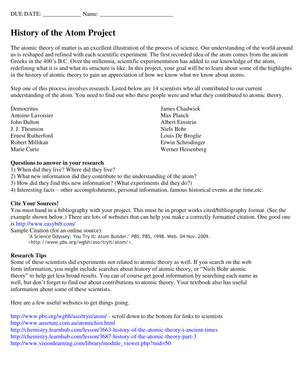
These 8th grade history of an atom printable worksheets resources center on one instructional goal: helping students understand that atomic models changed because experiments produced evidence the current model could not explain. The set covers the progression from Democritus through Bohr using timeline ordering, scientist-to-model matching, diagram labeling, and short written comparison prompts. Teachers get materials that hold up as unit openers, guided practice tools, or focused review before an assessment on atomic structure.
Concepts Covered Across the Set
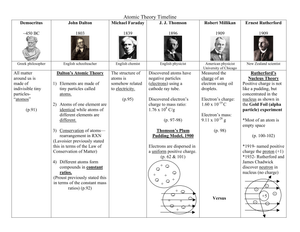
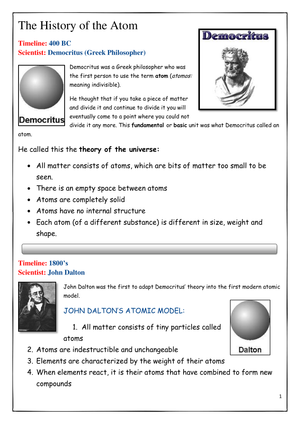
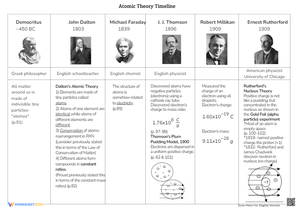
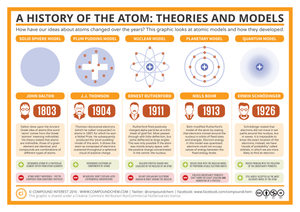
Each worksheet moves students through a clear sequence of thinkers and model shifts. Democritus opens the progression as the early source of the idea that matter consists of indivisible particles. Dalton follows as the scientist who formalized that idea into working atomic theory — atoms as solid, indivisible spheres that cannot be created or destroyed. Thomson, Rutherford, and Bohr each then appear as model-changers rather than simply names to recall.
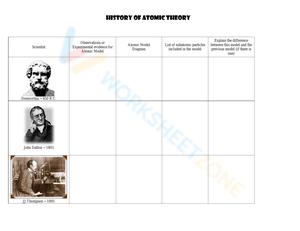
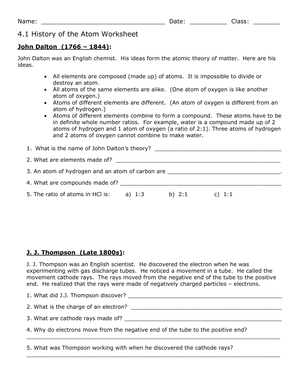
The tasks build around evidence-to-model connections. A timeline worksheet asks students to order the sequence and label what each model proposed. A scientist-match worksheet pairs an experiment or discovery with the model it produced. Diagram-labeling tasks make the structural differences between models visible — students mark where electrons, the nucleus, and energy levels appear in each representation. Short written prompts ask students to explain why a specific model was revised, not just what it was replaced by.
Frequent Student Errors Worth Watching For
The most consistent error pattern is treating the history of the atom as a list rather than a story. Students who study by memorizing names in order will place Rutherford before Thomson without recognizing that Thomson's electron discovery was precisely what made Dalton's indivisible-particle model incomplete. On a matching worksheet, that confusion shows up as a student correctly writing "Thomson → electron" but then placing Thomson after Rutherford in a timeline — because the student knows the names but not the logic connecting them. Reteaching should target the evidence chain, not the sequence of names.
Bohr creates a separate problem. Many 8th graders leave an atom-history unit believing Bohr's model is the accurate and final description of atomic structure. A comparison prompt — "What does Bohr's model help explain, and what does it leave out?" — addresses this without requiring any quantum mechanics. Students can engage with the idea that models are tools, which is the more durable lesson at this grade.
A third error: students often describe Dalton's model as simply "wrong." That framing misrepresents how science progresses. The better claim — and one these worksheets explicitly prompt — is that Dalton's model explained what early chemists could observe but could not account for the behavior of electrons that Thomson's cathode ray work later revealed.
How to Build These Worksheets Into Your Lesson Plans
The most practical entry point is using one worksheet as a pre-unit activator. Before formal instruction on atomic structure begins, a short timeline task surfaces what students already believe — and what they confidently believe that is out of order. That diagnostic picture is more actionable than a verbal class poll.
- Bell ringer: a four-item scientist-to-discovery matching task in the first eight minutes of class, before launching direct instruction on Rutherford's gold foil experiment
- Guided practice: a diagram-labeling worksheet completed alongside teacher-led notes, so students encode structure while hearing the explanation
- Station rotation on review day: one worksheet per station, with partners discussing reasoning before writing their answers
- Exit ticket: a compare-and-contrast prompt asking how Thomson's model improved on Dalton's — collected at the door before students move on
Sub plans are also a genuine fit here. The 8th grade history of an atom printable worksheets resources are self-contained enough that a substitute can manage the lesson without running a simulation or lab. Each worksheet includes its own directions, and students who finish early can extend by sketching the progression of models from memory. For teachers who want a digital follow-up, the PhET Build an Atom simulation pairs well after the printed work — students move from historical models into direct interaction with atomic structure.
Standard Alignment
These worksheets connect to the NGSS MS-PS1 cluster, which anchors middle school physical science in developing and using atomic models. The performance expectations in that cluster ask students to build model-based explanations of matter's behavior — and students do that work far more accurately when they first understand how the atomic model developed and why each revision happened. The crosscutting concept of Patterns and the science and engineering practice of Developing and Using Models are both directly activated when students explain, in a written response prompt, what experimental evidence made an older model insufficient. That connection makes these materials a defensible instructional choice, not just a review activity.
Adjusting the Set for Mixed-Ability Classrooms
For students who need more structure, the timeline and matching formats are the natural starting points. Both provide the scientist names and require students to arrange or connect information rather than generate it from memory. Adding a brief word bank or a partially completed timeline reduces the retrieval demand without changing the core reasoning task.
Students working above grade level benefit most from the written response prompts. Moving those students past "Bohr's model included energy levels" toward "explain what limitation of Thomson's model Rutherford's experiment actually addressed" shifts the task into genuine analytical reasoning. A strong extension is asking them to argue which single experiment changed the atomic model most significantly and defend that claim with specific evidence from the sequence.
For intervention groups, the most effective approach is narrowing the sequence before expanding it. Using 8th grade history of an atom printable worksheets materials with only three scientists — Dalton, Thomson, Rutherford — lets students internalize the evidence-to-model logic before Bohr is added. That narrowing keeps the instructional focus on reasoning rather than on memorizing an expanding roster of names.
Frequently Asked Questions
What should 8th graders know about the history of the atom?
Students should know the progression from Democritus through Dalton, Thomson, Rutherford, and Bohr, and they should understand why each model replaced the one before it. Name recall matters less than the reasoning chain — new experimental evidence, not just new thinking, drove each revision. That understanding is what makes the topic meaningful at this grade level rather than just another list to memorize.
Which scientists are typically included in a middle school atomic theory timeline?
Democritus, Dalton, Thomson, Rutherford, and Bohr are the five most commonly included. That group gives students a complete enough arc to trace the atom from an early philosophical concept to a model that accounts for nuclear structure and electron energy levels. Some teachers add Chadwick when covering neutron discovery, though that addition is more common in high school chemistry than in grade 8 physical science.
How are these worksheets useful before the unit begins, not just as review?
A timeline or matching worksheet given at the start of the unit reveals exactly which model transitions students already misunderstand. That information guides which parts of instruction need the most time. These 8th grade history of an atom printable worksheets materials are also clear enough in their directions that many students can work through them during initial instruction — alongside teacher input — rather than saving them only for end-of-unit review.
What is the practical difference between Dalton's, Thomson's, Rutherford's, and Bohr's models?
Dalton described atoms as solid, indivisible particles. Thomson showed that atoms contain electrons, meaning they are not indivisible after all. Rutherford demonstrated that the atom is mostly empty space surrounding a small, dense, positively charged nucleus. Bohr refined that further by proposing that electrons occupy specific energy levels around the nucleus — a simplified model that still helps 8th graders reason about electron arrangement, even though later science has added considerably more detail to that picture.