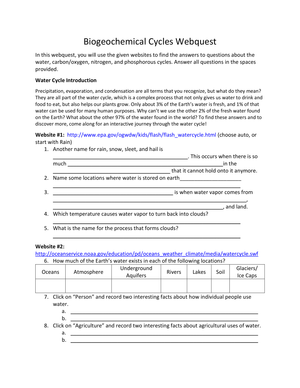
These 8th grade biogeochemical cycles worksheets give science teachers a printable set covering the water, carbon, nitrogen, and phosphorus cycles — with task variety across diagram labeling, comparison charts, and written explanation that carries students from first instruction through review without requiring extra materials. The worksheets are built around modeling and comparison, not vocabulary recall, which is where 8th grade instruction needs to go.
Biogeochemical cycles land in the 8th grade sequence because students at this level are expected to shift from naming parts of a system to explaining how matter moves through it. That distinction drives what a useful worksheet set has to do: push past labeling and ask students to reason about direction, mechanism, and the role of living things in keeping matter in motion.
The Specific Skills Targeted
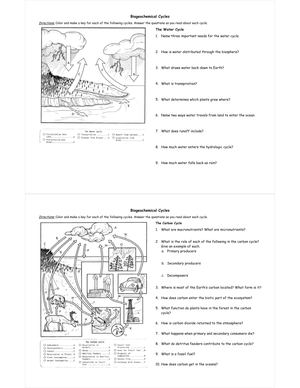
Each worksheet focuses on a distinct skill rather than repeating the same task format across all four cycles. The progression moves from identification to comparison to explanation:
- Reservoir identification — students mark where matter is stored in each cycle, including the notable distinction that phosphorus has no significant atmospheric stage while carbon and nitrogen both move through the atmosphere
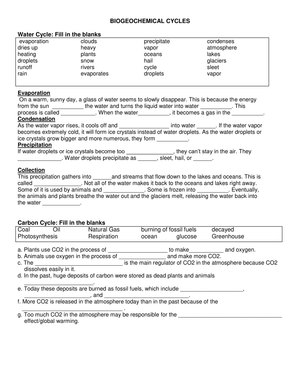
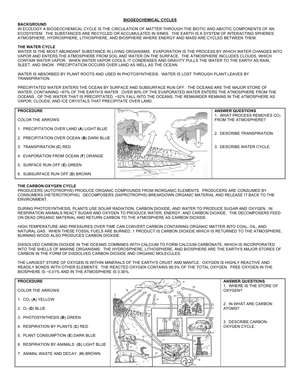
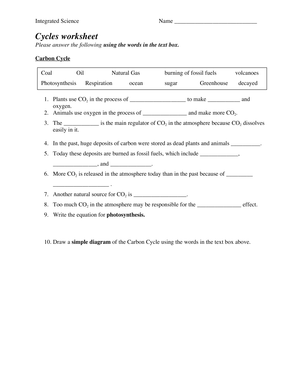
- Process labeling — evaporation, condensation, transpiration, photosynthesis, respiration, decomposition, combustion, nitrogen fixation, denitrification, and weathering appear in context, not in a vocabulary list
- Direction of matter flow — students trace arrow pathways on diagrams and write brief explanations of why matter moves from one reservoir to another
- Cross-cycle comparison — a dedicated comparison worksheet asks students to identify shared features across all four cycles and explain what makes phosphorus movement different from the other three
- Model revision — students receive an incomplete or partially incorrect ecosystem diagram and correct it using evidence from earlier work in the set
The model-revision task matters more than it might appear. Students who can label a correct diagram sometimes cannot identify what is wrong with an incorrect one — and that task is also the closest analog to what MS-LS2-3 actually requires.
Student Error Patterns Worth Anticipating Before the Lesson
The most persistent error in biogeochemical cycle instruction is treating each cycle as an isolated, closed loop. A student will draw the nitrogen cycle from atmosphere to plant to decomposer and back to atmosphere — plausible on the surface, but erasing the nitrogen-fixing and denitrifying bacteria that make nitrogen accessible to plants in the first place. When those bacteria don't appear on the diagram, nitrogen availability to plants becomes unexplained and the cycle looks far simpler than it is.
Carbon brings a different problem. Students routinely treat combustion as a minor, optional pathway rather than as a large-scale process that returns carbon to the atmosphere. That framing matters because the carbon cycle connects directly to energy transfer and human impact discussions later in the unit, and students who've minimized combustion from the start carry that misunderstanding into both topics.
With phosphorus, a third pattern appears: students assume their diagram is incomplete because there's no atmospheric reservoir. A worksheet that explicitly names this feature — and asks students to explain why phosphorus moves primarily through rocks, soil, water, and organisms — turns that moment of confusion into a productive comparison point rather than a dead end.
Standard Alignment
These worksheets address MS-LS2-3 (Ecosystems: Interactions, Energy, and Dynamics), which asks students to develop a model describing the cycling of matter and flow of energy among living and nonliving parts of an ecosystem. In classroom terms, that performance expectation means diagram labeling alone won't satisfy the standard — students also need to build, critique, and revise models. The comparison charts and model-revision tasks are what move instruction to that level. When selecting an 8th grade biogeochemical cycles worksheets for an NGSS classroom, teachers should confirm that at least some tasks require explanation or revision, not only identification.
MS-LS2-3 also connects naturally to MS-ESS2 (Earth's Systems), since all four cycles cross the biosphere, hydrosphere, lithosphere, and atmosphere. That crosscutting structure makes the phosphorus-versus-nitrogen comparison more than cycle-specific content — it becomes a practical anchor for systems thinking that carries across units.
Lesson-Planning Moves That Get the Most From This Set
The water cycle worksheet works best as the entry point because students already hold partial mental models of it from earlier grades. On day one, use it as a bell ringer with one direction: label what you already know, then put a question mark next to anything you're uncertain about. That takes eight minutes and immediately surfaces what the class brings to the lesson before any direct instruction starts.
A three-day sequence from there holds up well. Day two moves into carbon and nitrogen with the comparison chart as paired work — two students, one cycle each, tasked with finding three shared processes and one process unique to their cycle. Day three gives students the model-revision worksheet and asks them to correct a flawed diagram using what they've built across earlier worksheets. That final task also functions as a pre-assessment: it tells you where understanding breaks down before the unit test, not after.
For planned absences or homework assignments, the 8th grade biogeochemical cycles worksheets print cleanly and include enough context in the directions that students can work independently — which makes them practical for sub days in a way that discussion-dependent resources simply aren't.
Adjusting These Worksheets for Students at Different Readiness Levels
Students who need more support work best with the diagram-labeling worksheets when a word bank is provided. Rather than pulling terminology from memory, they focus on placing terms correctly in context — which still builds understanding of reservoir location and matter movement while reducing the retrieval demand that causes some students to stop working before they've started.
Students who are ready to move further can complete the blank model worksheet with no pre-filled labels, then write a short explanation connecting two cycles. Asking a student to explain how water movement through soil affects phosphorus availability pushes toward cross-system reasoning that stronger 8th graders are capable of but rarely asked to do in any structured format.
One honest limitation: the comparison tasks assume students can hold two cycle diagrams in mind simultaneously. For students with higher working memory demands, breaking the task into two discrete steps — complete one full cycle diagram, then return to it for comparison — manages that load without reducing the content expectation. Students who skip that step tend to copy rather than reason.
Frequently Asked Questions
What cycles does this set cover?
The set covers the water, carbon, nitrogen, and phosphorus cycles. Each cycle has dedicated diagram and analysis work, and several worksheets ask students to compare multiple cycles within one task.
How does this set align to NGSS?
The worksheets address MS-LS2-3, which asks students to develop and use models to explain matter cycling and energy flow in ecosystems. The model-revision and written-explanation tasks are what that performance expectation specifically calls for — not just vocabulary identification.
Can these work for review before a unit test?
Teachers often use the 8th grade biogeochemical cycles worksheets as a targeted review the day before an assessment, assigning students two or three worksheets based on which cycles they feel least confident about. The comparison charts are especially useful here because they surface gaps across multiple cycles at once.
How long does each worksheet take to complete?
Diagram and labeling worksheets typically take 10–15 minutes during guided practice. Comparison charts with written response prompts run closer to 20–25 minutes for students still building content fluency. The model-revision worksheet can fill a full 30-minute block when students work through it with partner discussion built in.