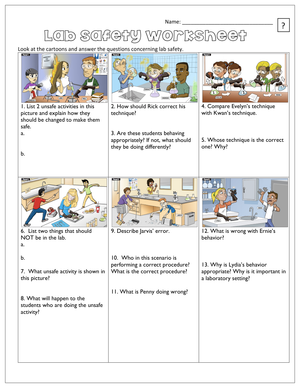
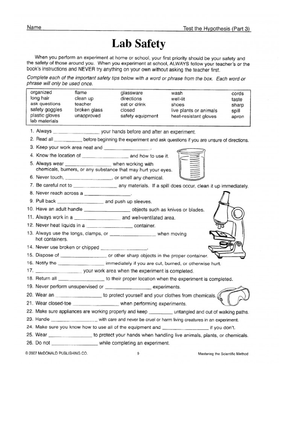
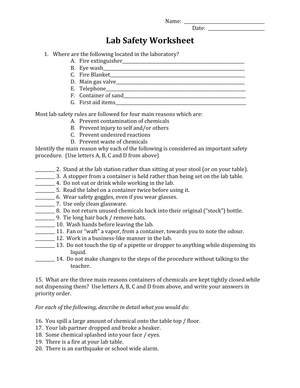
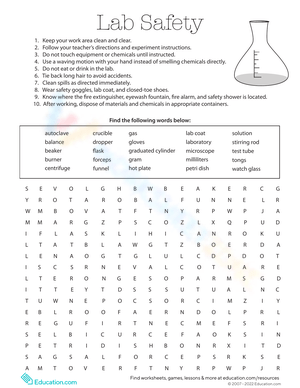
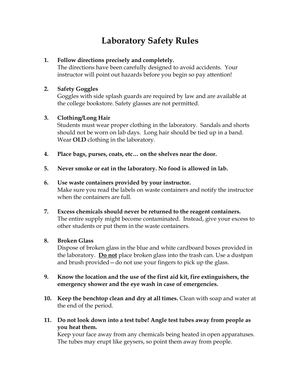
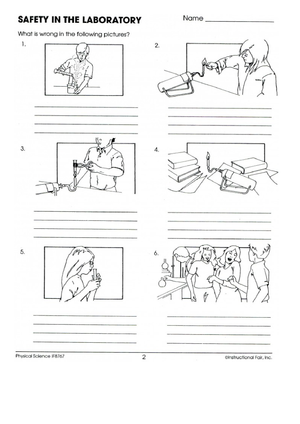
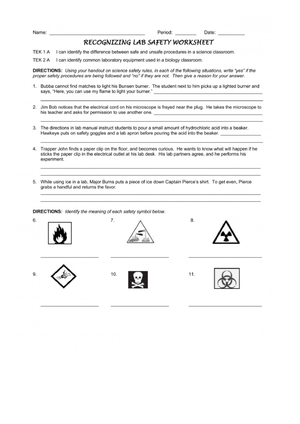
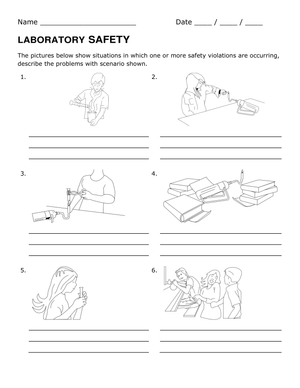
The 8th grade lab safety printable worksheets in this set give science teachers a concrete, markable resource to use before students ever handle a graduated cylinder, a reagent bottle, or an open heat source. Each worksheet asks students to do more than recall a rule — they identify safe and unsafe choices, connect PPE decisions to specific lab conditions, and explain in writing why a procedure matters. That moves safety practice from poster-reading into something that shows up in actual lab behavior.
What Each Worksheet Targets
The set focuses on the situations eighth graders actually encounter in middle school science — not abstract chemical theory, but the specific judgment calls that arise the moment a student reaches for a container or leans over a flame. Skills covered across the worksheets include:
- Core lab rules: no food or drinks at work areas, following teacher directions before touching materials, and keeping workspaces organized so spills are visible and contained.
- PPE use: when chemical splash goggles are required, why they stay on until the teacher clears the room, and why standard eyeglasses are not adequate substitutes for splash protection.
- Safe handling techniques: wafting instead of smelling chemicals directly, transporting glassware with two hands, and keeping hands away from the face throughout lab work.
- Emergency protocols: what to do first when there is a spill, a broken container, or a potential chemical exposure — including notifying the teacher before attempting any cleanup independently.
- Hazard symbols and lab layout: matching common warning symbols to the appropriate student response and identifying which areas of the room call for different levels of care.
Several worksheets include short scenario prompts rather than rule lists — a classmate removes goggles before the teacher signals clearance, or a student smells an unknown liquid directly. Students write or circle the correct intervention and explain the reasoning behind it. That format produces actual evidence of understanding rather than a completed checklist, which matters when you need to decide who is ready to receive lab materials and who needs a follow-up conversation first.
Error Patterns That Surface Before Students Touch Materials
The most consistent error in eighth-grade safety work is not forgetting a rule — it's misunderstanding the scope of one. Students who know "keep goggles on during lab" will still write, on a scenario worksheet, that removing goggles once they've finished their own step is acceptable. They haven't registered that shared lab space means neighboring students are still working with materials that pose a splash risk. ACS middle school chemistry safety guidance and NSTA's eye protection framework both name chemical splash goggles as the appropriate standard for activities involving chemical hazards — specifically because goggles seal around the eye socket in a way that safety glasses do not. A scenario that asks students to choose between "remove goggles when done with my steps" and "keep goggles on until teacher clearance" surfaces that misunderstanding on paper, before lab day.
Wafting is a persistent second problem. Many students can define the term correctly but, when presented with a scenario describing a clear, odorless liquid, choose direct smelling — reasoning that if it looks like water, it probably is. That logic becomes explicit when students write it out, which gives you something specific to address in the debrief rather than a vague sense that some students still aren't sure about the rule.
A third pattern involves spill reporting. Students consistently rank "report spills immediately" as important in rule-recall tasks, but will write in a scenario that they'd clean up a small spill quietly to avoid disrupting the class. That instinct toward social caution is developmentally normal in early adolescence and directly at odds with safe lab procedure. Seeing it in student writing gives you the opening to address it directly before it shows up mid-investigation.
How to Fit These Worksheets Into the Days Before a Lab
The 8th grade lab safety printable worksheets in this set work best when used as a gate, not a formality. Start with a short direct-instruction block — ten minutes at most — where you model the three or four rules students most consistently misapply: correct goggle fit, wafting technique, spill protocol, and the no-food-or-drinks line. Then distribute the worksheet and let students work through it independently or in pairs before materials ever appear on the tables.
After students finish, build in a brief talk step. Ask pairs to explain one answer aloud using a sentence frame like, I chose this action because... Students who fill in correct answers during individual work frequently cannot articulate the reasoning when pressed — which reveals that they're recalling a phrase rather than understanding the principle. Hearing the reasoning out loud identifies that gap before lab day, not during it.
NSTA safety guidance notes that science activities become harder to supervise when enrollment exceeds 24 students. In a section of 28 or 30, a completed worksheet functions as a practical management layer: it lets you identify who needs a reteach before you're monitoring four tables simultaneously. Many teachers treat the worksheet as the ticket to receive materials — strong responses move ahead, and incomplete or incorrect answers on key items trigger a five-minute reteach before that student handles anything. The consequence stays instructional and immediate rather than reactive.
Meeting Different Learners Without Lowering the Bar
Safety expectations stay consistent across all students; what changes is the path to demonstrating them. For multilingual learners or students who need reading support, choose worksheets that pair scenario text with visual cues — a labeled diagram of correct goggle placement, or an image sequence showing wafting technique — so vocabulary load doesn't block access to the content. For students ready to go deeper, look for response items that ask them to compare two student choices and explain which is safer and why. That requires a more complex chain of reasoning than recognizing a correct answer from a list.
Timing adjustments are underused and straightforward. Sending a worksheet home the evening before a lab, or assigning it during the period prior, lets students review procedures without competing for attention with materials already on the table. That low-pressure pre-exposure tends to make lab starts noticeably cleaner. For intervention groups, planned repetition around the five habits that prevent the most serious middle school lab injuries — listening before touching, keeping goggles on throughout, reporting problems immediately, wafting correctly, and keeping workspaces clear — is appropriate across the full year. These habits transfer to every lab setup students encounter in eighth grade, not just one unit.
Reading Student Work for What It Actually Reveals
The 8th grade lab safety printable worksheets in this set are most useful when you read student responses before the lab begins, not after. Three things to look for: Can the student name the correct action? Can they explain the reason in plain language? And can they apply the rule to a scenario they haven't seen before — not just reproduce the phrasing from the worksheet prompt?
Students who hit all three have moved past compliance-level recall. Students who can only answer the first question need a short targeted conversation before receiving materials. That distinction turns the worksheet into a formative check with a clear instructional next step, rather than a task run out of habit before labs begin.
Frequently Asked Questions
What should an 8th grade lab safety worksheet include beyond a list of rules?
Scenario-based prompts are the most important addition. Rule-list tasks let students restate what they've read; scenario prompts require applying a rule when a wrong option is visible and plausible. Items that ask students to explain why a procedure exists — rather than just identify it — produce much stronger evidence of actual readiness. Symbol recognition and PPE-matching items are also worth including, since students encounter hazard labels across most 8th grade chemistry and physical science work.
Are chemical splash goggles required for all 8th grade labs?
NSTA's position is that eye protection is required whenever chemical, physical, or biological hazards are present, which covers the majority of hands-on 8th grade science work. ACS middle school chemistry safety materials specifically reference chemical splash goggles rather than standard safety glasses, because goggles provide a sealed barrier around the eye socket that glasses cannot replicate. For any lab involving liquids, heat, or breakable materials, splash goggles are the appropriate standard — not an optional addition.
How do these worksheets fit into a lab safety contract routine?
Use them before the contract signing, not after. A worksheet completed and discussed first means students have thought through the expectations before signing, rather than skimming a contract and adding a name at the bottom. The 8th grade lab safety printable worksheets in this set work well as a pre-contract discussion tool: students complete the worksheet, talk through answers in pairs, and then sign the contract with a firmer understanding of what they're committing to follow. That sequence takes an extra fifteen minutes and produces noticeably better retention through the first several labs of the year.
How often should lab safety be reviewed after the first week?
Before any lab involving new materials, new equipment, or a setup students haven't seen before. Most middle school science teachers build a brief safety review into the start of any investigation that introduces something unfamiliar. A focused worksheet review also makes sense after a long break, after a substitute day when procedures may have drifted, or when a specific moment in class signals that expectations need to be stated explicitly again. Safety instruction in eighth grade runs alongside content across the full year — it isn't a box to check once at the start of September.