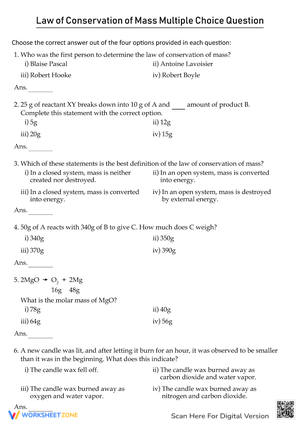
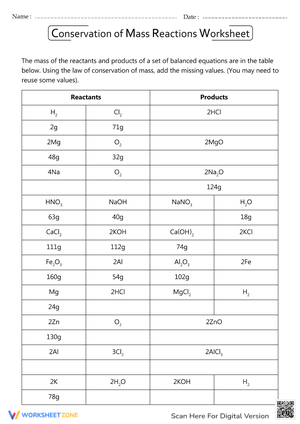
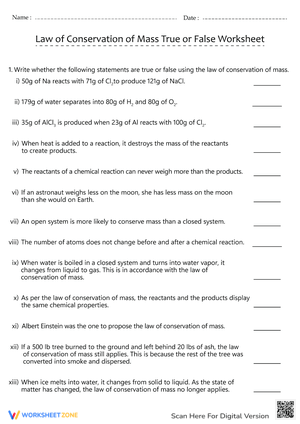
The best 8th grade conservation of mass worksheets resources do one specific job well: they make students account for matter they can no longer see. At this grade level, most eighth graders know the phrase "conservation of mass," but that knowledge collapses when gas escapes a reaction or ash weighs less than the wood that burned — students conclude matter was destroyed because they can't locate it. These worksheets are built to interrupt that reasoning before it hardens.
The Specific Work Each Worksheet Asks Students to Do
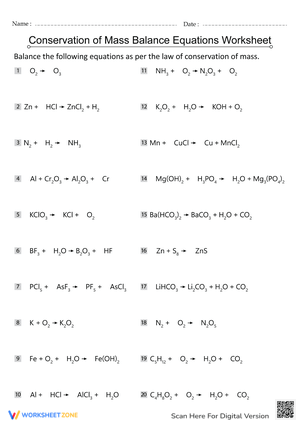
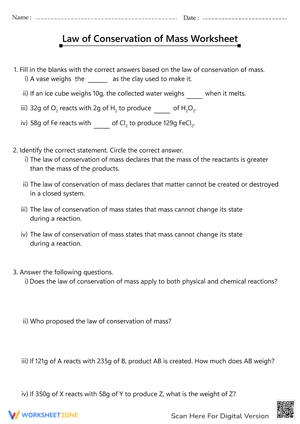
The most productive 8th grade practice connects three levels of representation: observable data, particle-level models, and simple reaction descriptions. Each worksheet in this set moves across at least two of those levels, so students can't rely on a single strategy to get through the work.
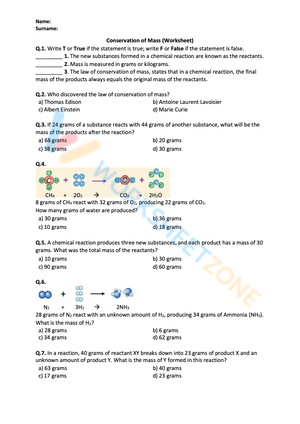
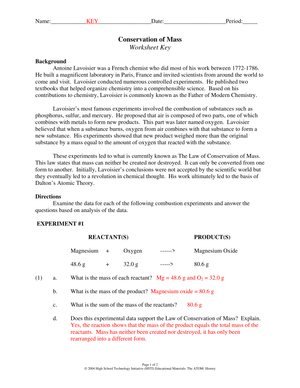
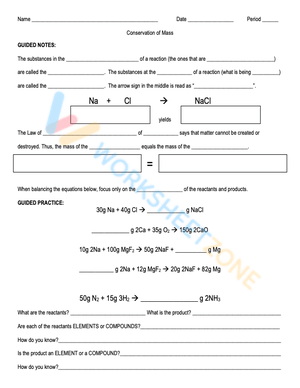
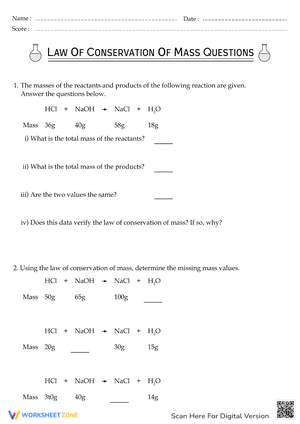
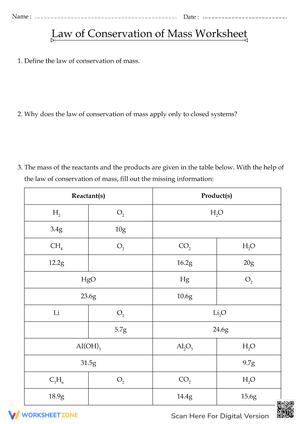
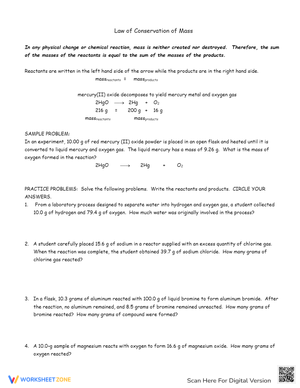
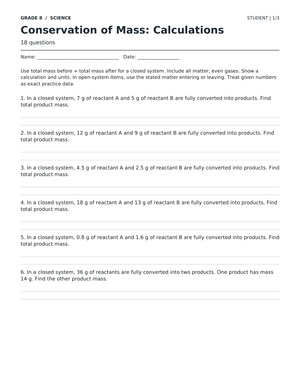
- Before-and-after mass tables: Students compare measured masses and decide whether the data confirm conservation — including explaining any discrepancy caused by an open versus closed system.
- Particle diagram prompts: Students draw or interpret particle arrangements before and after dissolving, melting, mixing, or reacting. The goal is tracking atoms, not artistic accuracy.
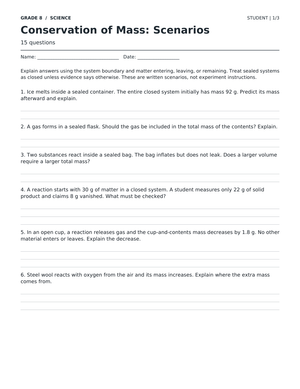
- Open-system and closed-system comparisons: A sealed bag and an open beaker produce different mass readings from the same reaction. Students explain what each setup tells them about where the matter went.
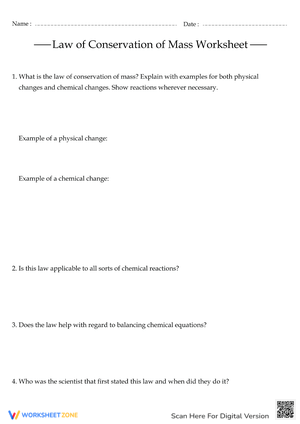
- CER writing prompts: Claim-evidence-reasoning frames ask students to use data to defend why total mass stays constant — or to explain why measured mass appears to change in an open setup.
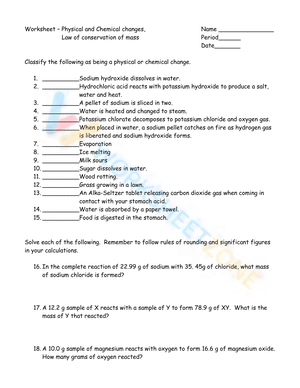
- Mixed physical and chemical changes: Students apply the same conservation principle to dissolving, freezing, and burning, because the law holds in all three cases even though the type of change differs.
That range matters in practice. Students who can read a data table often struggle with particle diagrams. Students who can sketch particles sometimes can't get their reasoning onto paper in a CER format. The CER prompts in particular work better mid-unit — after students have practiced the format at least once in a group setting — than as an early independent activity. That's one honest tradeoff worth planning around before assigning them cold.
Student Errors Worth Catching Before They Solidify
Three misconceptions appear reliably in 8th grade work on this topic. The first is the disappearing gas problem: a student sees mass decrease in an open container after a fizzing tablet dissolves and concludes that mass was lost. They're not tracking the carbon dioxide that left the system. A well-placed worksheet prompt asks them to circle every place matter can be found after the reaction — including the air above the beaker — which forces them to account for escaped gases rather than ignore them.
The second misconception shows up with burning. Ash weighs less than the original material, so students often conclude that burning destroys matter. They're not accounting for water vapor and carbon dioxide released during combustion. A worksheet that places a sealed combustion setup alongside an open one, with mass data for both, makes the comparison concrete. Students who see that the sealed container registers no mass change — even while the candle burns — shift their reasoning faster than they do from a lecture explanation alone.
The third error is subtler and shows up most often in dissolving scenarios. When a solid disappears into water and the solution looks clear, some students say the solid "became water" or "turned into liquid," confusing invisibility with destruction of matter. Particle diagram prompts that show solute particles distributed throughout the solvent — still present, just spaced out — address this directly and in a way that verbal explanations typically don't reach.
Fitting These Worksheets Into the Week Without Losing Momentum
These resources work across multiple moments in a unit cycle, not just as independent practice after direct instruction. A useful entry point: open the unit with a worksheet that surfaces prior thinking — ask students to predict what happens to mass when a candle burns or a tablet fizzes in water, then write a brief explanation. Their written answers reveal exactly which misconceptions to address before moving into particle-level content.
In the middle of the unit, paired with a sealed-bag lab or a dissolving demonstration, each worksheet becomes a bridge between observation and explanation. Students record what they measured, sketch what happened at the particle level, then write one sentence justifying why total mass didn't change. That three-step sequence — doable in roughly twelve minutes of independent work time — builds more durable understanding than three separate activities spread across different days.
A set of 8th grade conservation of mass worksheets resources also holds up well for reteach situations. For the last week of a unit or for small intervention groups before a test, a mixed-review worksheet covering physical changes, chemical changes, open systems, and closed systems gives teachers a fast read on who still needs targeted follow-up — without requiring a separate assessment.
Standard Alignment
NGSS MS-PS1-5 asks students to develop and use a model showing that the total number of atoms does not change in a chemical reaction and thus mass is conserved. That performance expectation places particle diagrams at the center of 8th grade instruction — not equation balancing, not isolated vocabulary matching. Each worksheet treats particle models as the primary reasoning tool, with mass data and written explanation as connected supports. Teachers working toward this standard will find the set addresses the actual performance demand rather than a simpler procedural version of it.
Adjusting the Set for a Range of Learners
For students who need more support, the data-table worksheets — where mass values are provided and students interpret rather than calculate — reduce arithmetic demand so thinking stays focused on the conservation concept itself. Those worksheets also work as a strong entry point for English learners, since labeled diagrams carry meaning without depending heavily on academic vocabulary. Starting with physical changes (dissolving, melting, freezing) before moving to chemical reactions keeps the core idea accessible for students still building background knowledge in chemistry.
For students ready for more challenge, the open-versus-closed system comparisons and CER writing prompts push into genuine scientific argumentation. Rather than asking whether mass was conserved, those prompts ask students to explain why a specific experimental setup produced apparently contradictory data and what a better-controlled procedure would look like. That's a real intellectual step up from identification-level work, and it sits close to the kind of reasoning assessed on state science exams.
In a mixed-ability class, the same 8th grade conservation of mass worksheets set works across a full period: assign the particle diagram and table questions to one group, add the open-system comparison and written reasoning prompts to another. Both groups work on the same science idea with the same materials in front of them, which simplifies classroom management without flattening the intellectual demand for students who are ready for something harder.
Frequently Asked Questions
What does conservation of mass mean in 8th grade science?
Students learn that the total amount of matter before a physical change or chemical reaction equals the total amount of matter after. Atoms rearrange into new substances during a chemical reaction, or substances shift state during a physical change, but none of that matter is created or destroyed in the process.
Why do students think mass disappears when gas forms or something burns?
Students anchor their understanding to what they can still see. When gas escapes a container or smoke disperses into the air, those products become invisible, and students treat invisible as gone. Worksheet prompts that require students to locate all products — including gases — interrupt that incomplete accounting before it becomes a fixed belief that's harder to correct later.
How are these worksheets different from equation-balancing practice?
Equation balancing is a symbolic skill. These worksheets build the underlying conceptual understanding: that atoms physically persist through a reaction and that mass is measurable evidence of that persistence. Students who work through a set of 8th grade conservation of mass worksheets resources and can explain where the matter in a burning candle actually goes are far better prepared to understand why balancing an equation matters — rather than treating it as a pure arithmetic exercise with no physical meaning.
Can these worksheets reach students who are significantly behind grade level?
Yes. The data-table and particle-diagram worksheets give students a concrete entry point that doesn't require prior chemistry vocabulary. Pairing a worksheet with a brief class discussion of one physical change — ice melting into water, for example — before students work independently gives struggling learners enough context to engage with the central question: where did the matter go?