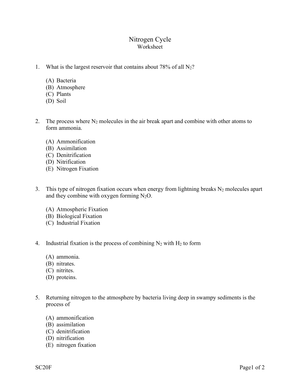
These 8th grade on nitrogen cycle pdf worksheets give science teachers targeted practice materials covering all five major processes — fixation, nitrification, assimilation, ammonification, and denitrification — in formats that push students from label-and-match recognition to genuine explanation. The set is built around the ecosystem framing middle school science requires: nitrogen moving through soil, organisms, and atmosphere as matter cycling through a system, not a vocabulary list to memorize.
What Each Worksheet Covers
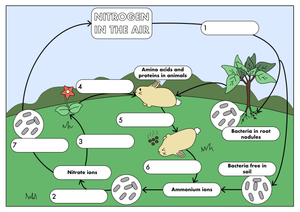
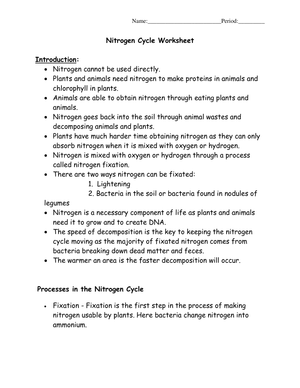
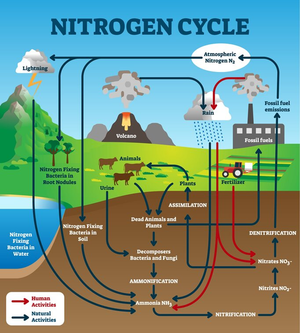
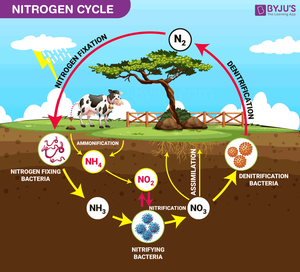
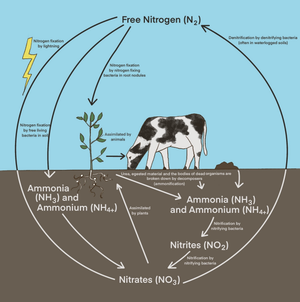
Students trace nitrogen through the cycle in a deliberate progression. Diagram tasks require them to identify where fixation introduces usable nitrogen into the soil, how bacteria convert ammonium to nitrate through nitrification, where plants absorb those compounds through assimilation, how decomposers release nitrogen from dead tissue through ammonification, and how denitrification returns nitrogen gas to the atmosphere. Each process appears in multiple item formats across the set so students encounter every step in more than one context before the end-of-unit assessment.
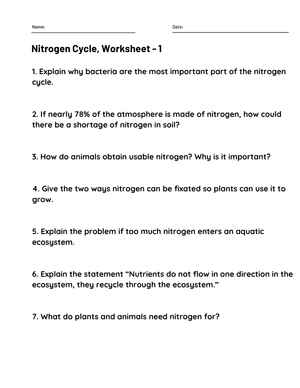
Beyond the five process steps, the worksheets include ecosystem-level questions: why plants cannot draw nitrogen directly from air, what would happen to a food web if soil bacteria disappeared, and how fertilizer runoff throws the nitrogen balance in waterways off course. Those questions connect the cycle to human impact without turning any worksheet into a research task.
Where Students Reliably Get the Cycle Wrong
The most persistent error is conflating fixation with how plants absorb light during photosynthesis. Students who correctly place sunlight on a food-web diagram will sometimes draw nitrogen entering a plant the same way — directly from the atmosphere through the leaf. When you see that arrow in student work, it signals the fixation misconception: they know nitrogen matters to plants, but they have not yet internalized that the conversion happens in the soil through bacteria, not inside the plant through gas exchange. The labeling tasks in this set surface that specific confusion quickly, usually before a quiz reveals it at the wrong moment.
A second pattern involves ammonification. Many eighth graders understand that decomposers break things down, but they write "decomposers make soil" rather than explaining the chemical result — the release of ammonium compounds that bacteria then convert into plant-available forms. Short written-response items force students to make that distinction explicit, and that distinction shows up on end-of-unit tests more often than most teachers expect.
Standard Alignment
Next Generation Science Standards MS-LS2-3 asks students to develop a model describing how matter cycles and energy flows among living and nonliving parts of an ecosystem. A nitrogen cycle worksheet earns its place in an MS-LS2-3 sequence when it pushes students to trace matter across at least three system components in a single response — from atmosphere to soil to plant tissue, for example — rather than identify each component in isolation. That cross-system trace reflects the systems thinking the standard targets. Each worksheet in this set includes at least one item requiring that kind of multi-component explanation, which makes the resources appropriate for formative work mid-unit, not just end-of-unit review.
Fitting the Set Into Your Actual Week
The most reliable entry point is the lesson immediately after the first round of direct instruction, not before it. Students benefit from a short teacher-modeled walkthrough of one or two cycle steps — fixation and nitrification work well because the bacteria connection surprises most eighth graders — and then can complete the diagram labeling and vocabulary items independently. That brief modeling reduces the number of students who stall mid-worksheet asking what "nitrification" means again.
Within a week-long ecosystem unit, the 8th grade on nitrogen cycle pdf worksheets in this set fit naturally at three points: mid-lesson guided practice after the initial model is introduced, overnight homework review before class discussion, and a focused review session the day before the summative. The formatting stays consistent enough across the set that students do not lose time figuring out new directions each time they pick up a new worksheet.
The resources also work well for sub days. The diagram-plus-short-response structure gives a substitute clear tasks and predictable student work. Writing "label the diagram, then answer questions 1 through 4" on the board is enough direction for the class to stay on task.
Adjusting Each Worksheet for Different Levels of Readiness
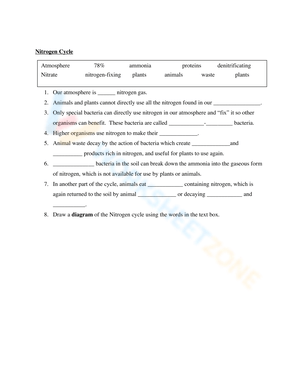
Students who struggle with reading load or retrieval work better when given a printed word bank and a diagram with the atmosphere, soil layer, and decomposer positions already marked. That structure shifts the task from "recall and place everything" to "recognize and complete," which keeps lower-confidence students moving through the worksheet rather than stalling at the first blank. The 8th grade on nitrogen cycle pdf worksheets in this set include enough open space that teachers can attach a printed word bank before copying without crowding the diagram.
Students ready for extension need a different kind of adjustment: remove the word bank, then ask them to explain what would happen to plant growth if denitrifying bacteria populations increased significantly, or have them compare the nitrogen cycle's dependence on bacteria with another matter cycle they have studied. Those additions require no new materials — questions written on the board or added as a handwritten note before the worksheet is distributed are enough.
Frequently Asked Questions
What do eighth graders actually need to know about the nitrogen cycle?
Students should be able to name and explain all five processes, identify the organisms that carry out each step — especially distinguishing nitrogen-fixing bacteria from decomposers — and trace nitrogen movement across soil, plants, animals, and the atmosphere. Understanding why plants cannot use atmospheric nitrogen directly is usually the conceptual turning point for this age group.
Do these worksheets address fertilizer runoff and human impact?
Yes. Several items ask students to explain how excess nitrogen from agricultural sources enters waterways and disrupts ecosystem balance. That connection works for teachers who want human-impact context woven into the unit without adding a separate research assignment.
Can I assign one worksheet as a standalone review rather than using the full set?
Each worksheet functions independently — none requires completion of another first. Teachers commonly assign a single worksheet for targeted homework review, use one as a bell-ringer after returning from a long weekend, or pull one for intervention practice with a small group during a flex block.
How do these resources pair with carbon cycle instruction?
The pairing is productive because both cycles involve decomposers, bacteria, and atmosphere-to-organism movement. Students who complete 8th grade on nitrogen cycle pdf worksheets alongside carbon cycle practice regularly make cross-cycle comparisons that sharpen their understanding of how matter flows through ecosystems more broadly — a connection that tends to stick when it comes from the students rather than from teacher explanation.