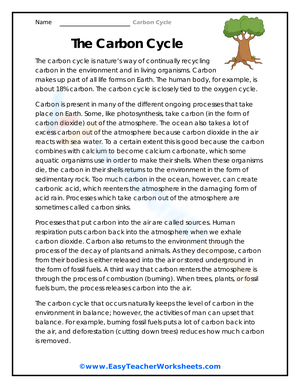
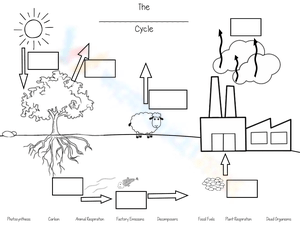
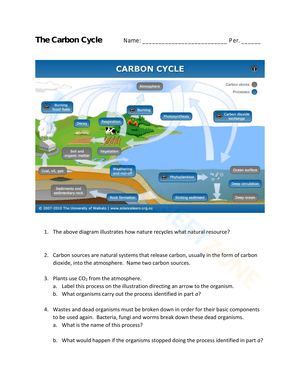
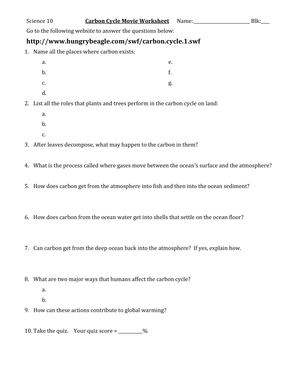
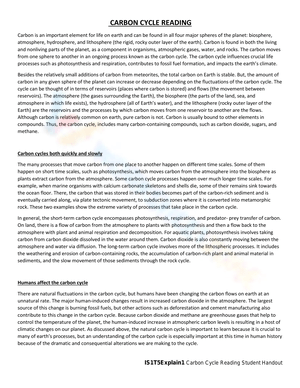
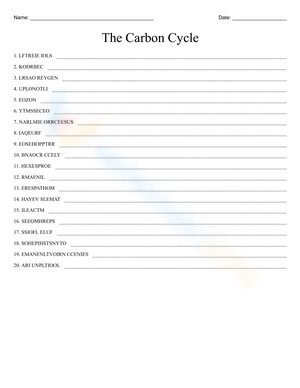
These 8th grade the carbon cycle printable worksheets give science teachers a direct path into one of middle school's most persistent conceptual challenges: helping students see carbon not as something locked in a single location, but as matter in constant exchange among five major reservoirs—the atmosphere, oceans, rocks, soil, and living organisms. Most state science frameworks at this level ask students to trace those transfers and explain what drives them, not simply match vocabulary to definitions. At this developmental stage, students are ready to reason about systems and explain cause and effect, but they still need concrete models to organize that reasoning—which is where printed practice earns its place in a carbon cycle unit.
What Students Practice Across the Set
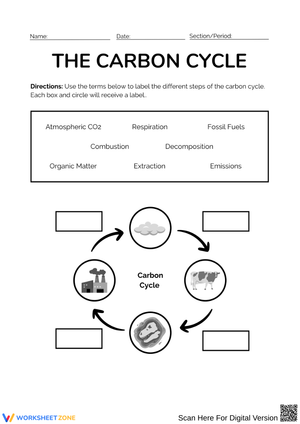
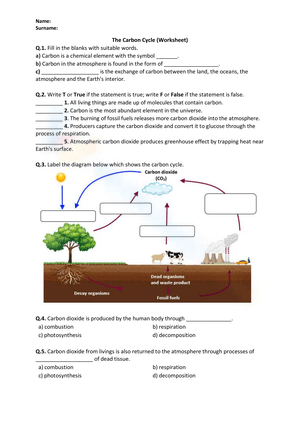
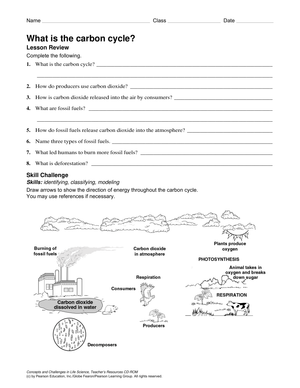
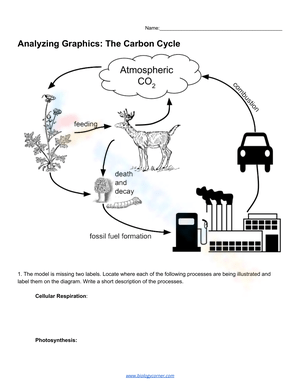
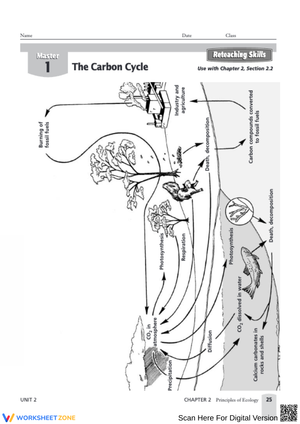
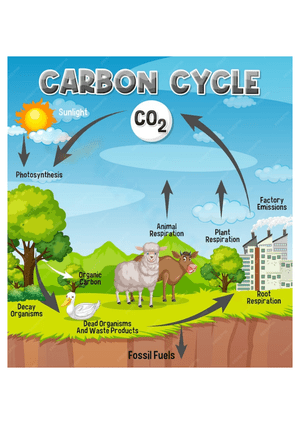
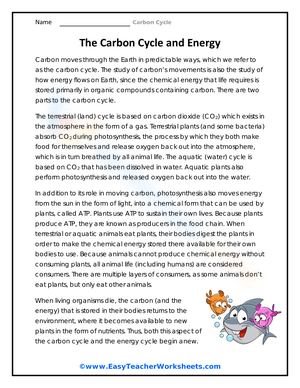
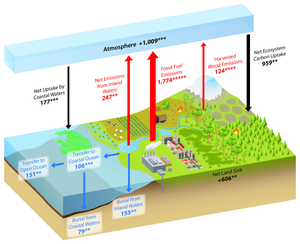
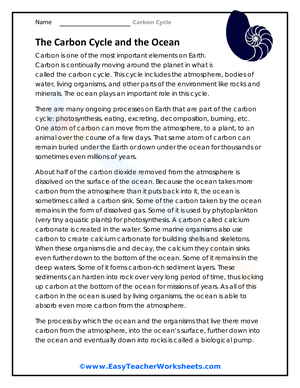
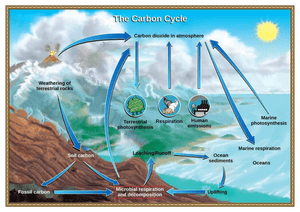
Each worksheet asks students to do something active with the model rather than copy terms from a word bank. Labeling tasks build reservoir identification and ask students to describe the form carbon takes in each location—gaseous CO₂ in the atmosphere, dissolved forms in ocean water, organic compounds in living tissue, ancient carbon locked in sedimentary rock. Tracing tasks push further: follow a carbon atom from atmospheric CO₂ absorbed by a plant, into the tissues of a producer, into a primary consumer, into a decomposer after that animal dies, and back to the atmosphere. That specific pathway work reveals far more about student understanding than a matching exercise does.
The most demanding tasks ask students to write out why an arrow in the diagram points one direction and not another—not just draw arrows but explain the mechanism behind each transfer. Across the set, students work on:
- Identifying all five reservoirs and distinguishing living carbon stores from nonliving ones
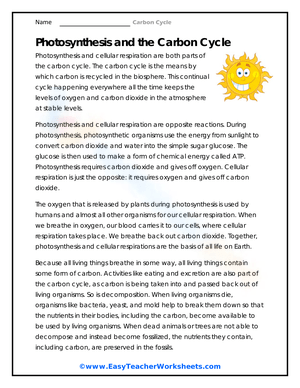
- Connecting photosynthesis and respiration as complementary processes rather than isolated definitions
- Explaining how decomposers break down organic matter and where that carbon moves next
- Describing combustion as a carbon-release pathway and connecting it specifically to fossil fuel burning
- Applying the full cycle to a short scenario—a wildfire, a factory, a clear-cut forest—and predicting the effect on atmospheric CO₂
The Predictable Errors That Show Up in Every Class
The most reliable predictor of a weak quiz response on this topic is not vocabulary confusion—it is a conceptual one. Students who can define photosynthesis accurately will still draw the cycle with the atmosphere at the top as a one-directional source, as if CO₂ only flows down into plants and never returns. They treat the atmosphere as an input zone rather than a reservoir that both sends and receives carbon continuously through multiple pathways. A worksheet that requires students to annotate every arrow—including the return arrows from respiration, decomposition, and combustion back into the atmosphere—does more to reveal that misconception than any labeling task.
Decomposition causes its own persistent trouble. After lessons that group respiration and decomposition together as "carbon release" processes, students conflate the two. Ask a student to explain in writing what a decomposer does to the carbon in a dead leaf, and a common response is something close to "it breathes it out." That answer sits adjacent to accurate but skips the actual mechanism: microbial breakdown of organic matter that releases CO₂ through metabolic activity. A worksheet that gives decomposition its own dedicated question—rather than bundling it with respiration—forces students to articulate the distinction rather than blend the two processes into one vague idea about things releasing carbon.
Combustion is the third gap. Students understand in a general sense that burning releases carbon, but many cannot explain why fossil fuel combustion matters differently from a forest fire or natural decomposition. An extension question comparing the rate of natural cycling to the pace of fossil fuel burning makes that distinction concrete and connects the cycle to climate content without requiring a separate lesson to get there.
Standard Alignment
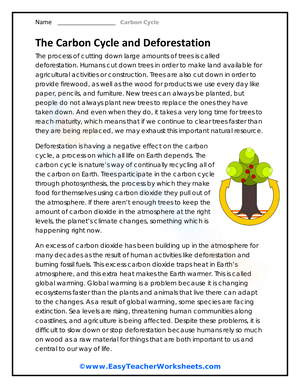
Carbon cycle instruction connects to three NGSS middle school performance expectations. MS-LS2-3 asks students to explain how matter and energy move through food webs and through the work of decomposers—the carbon cycle is the clearest classroom example of matter cycling in action at this grade. MS-LS1-6 links photosynthesis directly to matter cycling in plants, making it a natural anchor for explaining how carbon enters living systems from the atmosphere. MS-ESS3-5 brings human impact into the picture, supporting lessons where students connect fossil fuel combustion to measurable increases in atmospheric CO₂ concentration.
In practice, these three standards do not require three separate units. A set addressing reservoir identification, process explanation, and human-activity comparison can carry through both a life science unit on ecosystems and an Earth science unit on climate, six or more weeks apart. That cross-unit return is where spaced retrieval does its most useful work for 8th graders, and printable resources hold a distinct advantage: the same worksheet goes back into a folder and comes back out when students need the review before a summative assessment.
Putting the Worksheets to Work Across a Carbon Cycle Unit
The most efficient sequencing is task by complexity, not all tasks in one sitting. A unit opener works well as a reservoir-labeling exercise done from memory before formal instruction begins—students attempt it cold, then compare results when the lesson starts. That baseline is more useful than a blank pretest because it shows exactly which reservoirs students confuse or omit. Mid-unit, tracing tasks produce stronger written responses when students work in pairs. When two students have to talk through each arrow before writing, one of them will say something like "the plant takes it in," and the partner asks: takes in what, exactly, and from where? That back-and-forth produces more precise language than silent independent work, and precision is what the written explanation tasks are actually measuring.
Teachers who keep 8th grade the carbon cycle printable worksheets in their sub folders report that the format holds up better than slide-based activities when an absence disrupts the planned lesson. A substitute can hand out a tracing task or a short-answer explanation worksheet without needing technology, and students still do genuine science work. End-of-unit review works best when teachers assign one tracing task and one written explanation—not the full set at once. Rushing through all tasks in a single session leads students to skip the written explanations, which carry the most diagnostic value of any item in the set.
Meeting Different Readiness Levels With the Same Set
Students who need more support work with a partially completed diagram—reservoirs already labeled, some arrows already drawn—combined with sentence frames such as Carbon moves from ___ to ___ when ___ occurs. That guided structure keeps the task accessible without removing the core scientific thinking: students still identify the process and explain the direction of matter movement; they just do it with fewer blank spaces in front of them at once.
Students who move through baseline tasks quickly can work with extension scenarios. A question describing a region where widespread deforestation has occurred, asking students to predict how both atmospheric CO₂ and soil carbon stores would change over time and explain the reasoning, requires applying the full cycle model to an unfamiliar situation—which is closer to what NGSS-aligned assessments actually ask for than a diagram-label task ever is.
For targeted reteaching after an assessment, pulling the reservoir-labeling worksheet and the decomposition explanation task together gives a focused session of about fifteen minutes. Students who missed those items work through both with teacher support, then write one corrected explanation before moving on. That approach is more efficient than reassigning everything, and it is one reason 8th grade the carbon cycle printable worksheets end up in intervention folders—they carry enough specificity to target exactly what a student missed without requiring the teacher to rebuild the lesson from scratch.
Frequently Asked Questions
What should 8th graders already know before using these worksheets?
At minimum, students should recognize that matter moves through ecosystems and that carbon takes different forms in different places. Prior exposure to photosynthesis and cellular respiration—even at the introductory level from 7th grade life science—makes the first labeling task far more productive. Students who arrive without that background can still work through the set, but teachers should plan for a brief direct-instruction opener before the first tracing exercise.
How do these worksheets support NGSS-aligned middle school instruction?
The core tasks—reservoir identification, process explanation, and human-impact analysis—map directly onto MS-LS2-3, MS-LS1-6, and MS-ESS3-5. The written explanation tasks also address the NGSS science and engineering practice of developing and using models, which means students are not just filling in diagrams but building explanatory language that appears on NGSS-aligned assessments.
Can the same worksheets serve both a life science unit and an Earth science unit?
Yes, and that cross-unit flexibility is one of the practical reasons teachers return to 8th grade the carbon cycle printable worksheets more than once in a school year. The reservoir identification and photosynthesis-respiration tasks fit naturally inside a life science unit on ecosystems. The combustion and human-impact questions belong in Earth science and climate discussions. Teachers do not need separate resources for each context—the same worksheets serve different instructional purposes depending on which tasks they assign and which they hold for extension.
What is the most effective way to use these for test review?
Assign one tracing task and one written explanation the day before a quiz, not the full set. Students who work through everything at once tend to rush the explanations, which are the highest-value practice items. A targeted review—trace one complete carbon pathway, then explain one return process in your own words—takes around fifteen minutes and shows clearly whether students can reason through the cycle without a word bank in front of them.