8th grade protons neutrons and electrons practice pdf worksheets give science teachers a fast, readable window into exactly which part of atomic structure a student has actually grasped — and which part they are still carrying as a memorized phrase rather than a usable rule. In grade 8, this is one of those topics where the vocabulary arrives early and the confusion arrives quietly, usually surfacing around the second or third problem in a set.
The Specific Skills Each Worksheet Targets
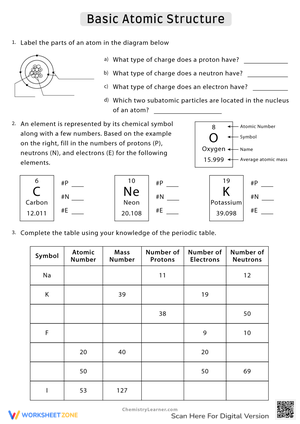
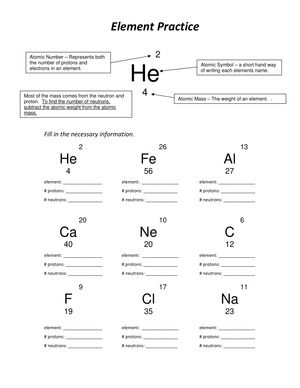
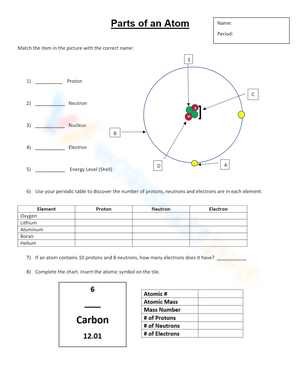
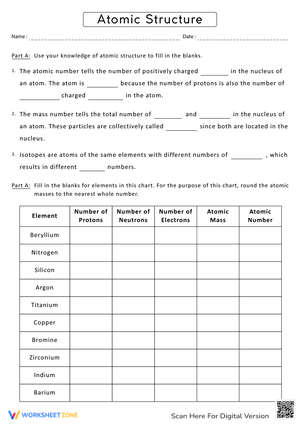
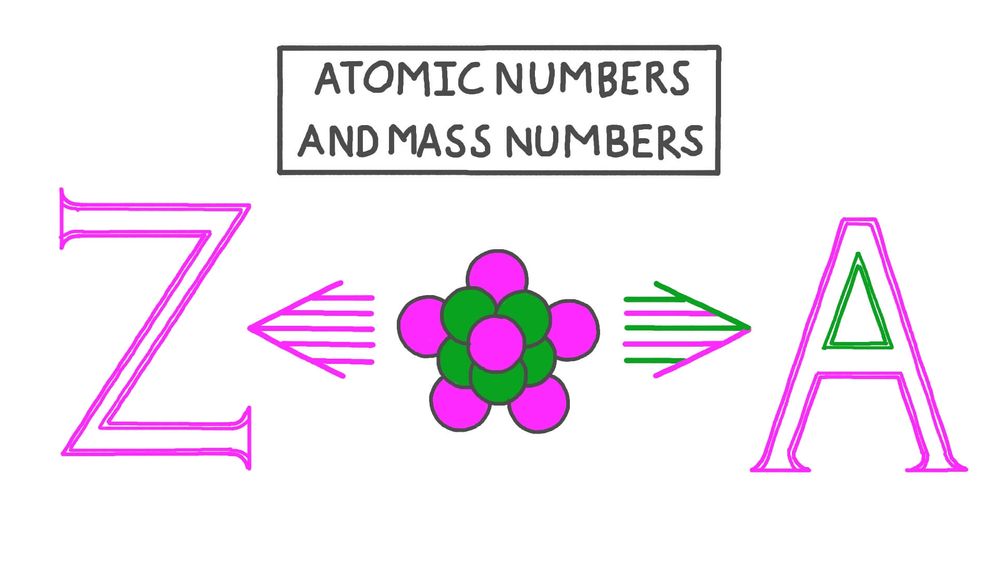
The core task sequence in this set moves students from identifying particle locations to calculating particle counts using information from an element square. That progression matters because students need to read atomic number and mass number correctly before they can do anything useful with either value.
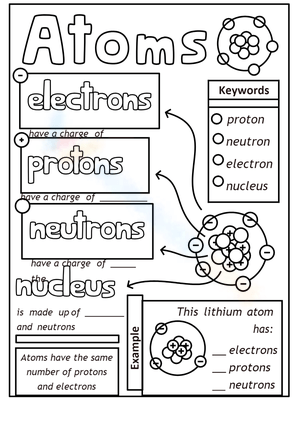
- Label a nucleus diagram with the correct particle names and locations.
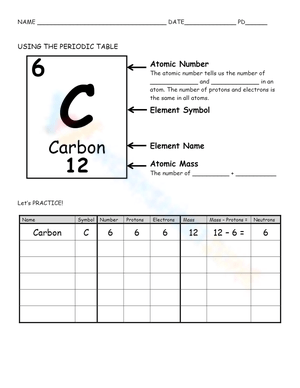
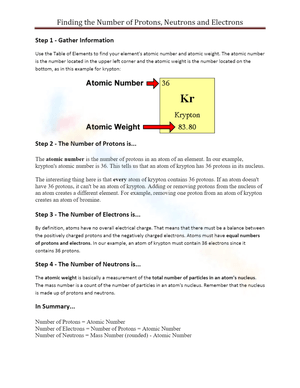
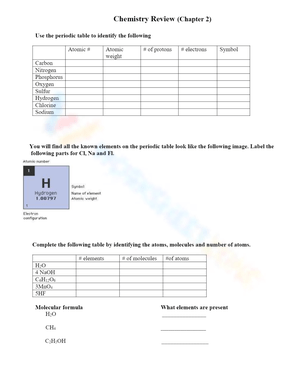
- Read an element square and extract the atomic number and mass number without conflating the two.
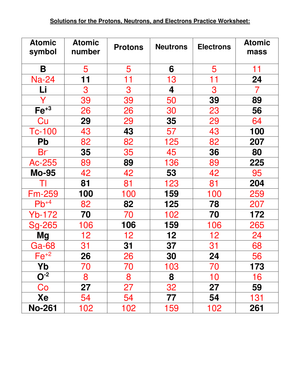
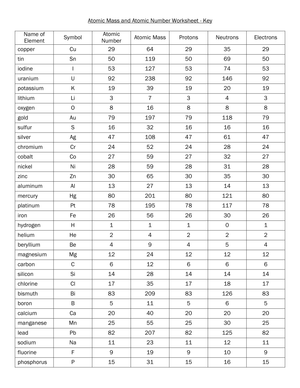
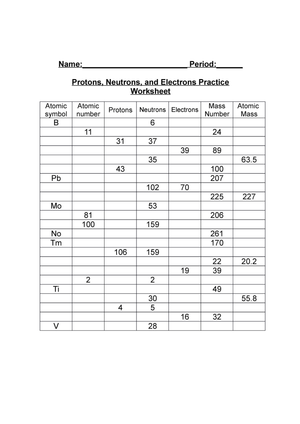
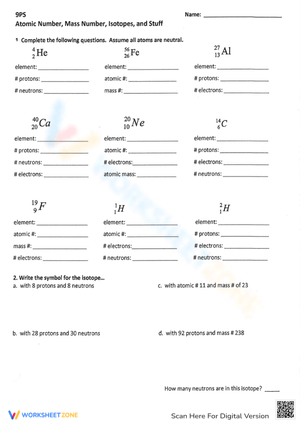
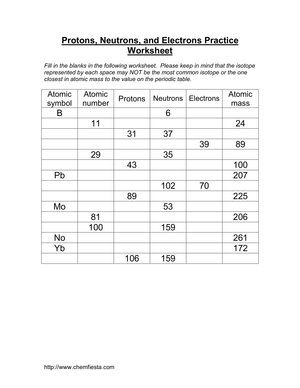
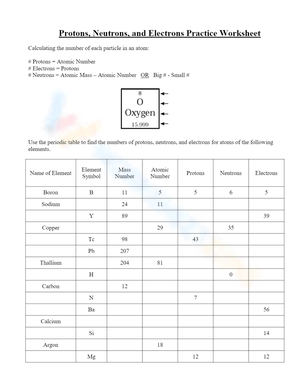
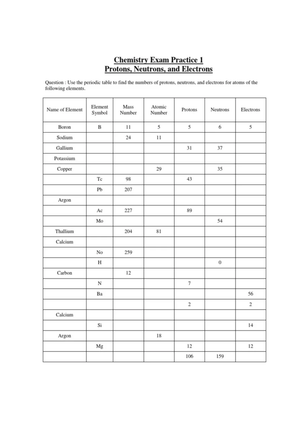
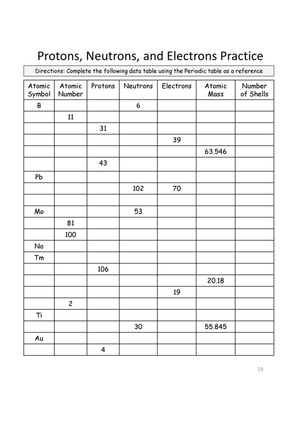
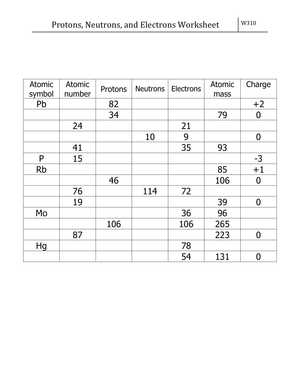
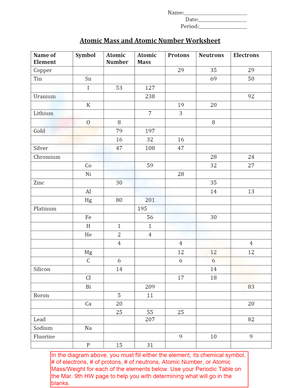
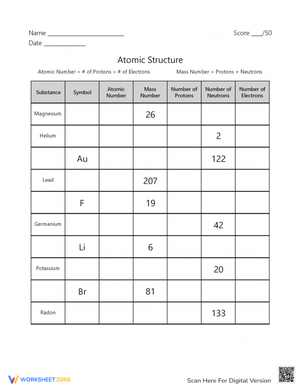
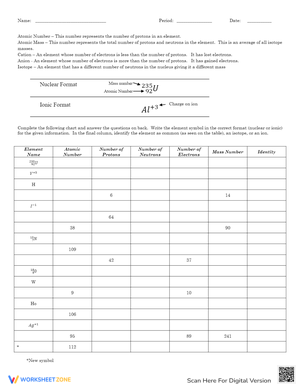
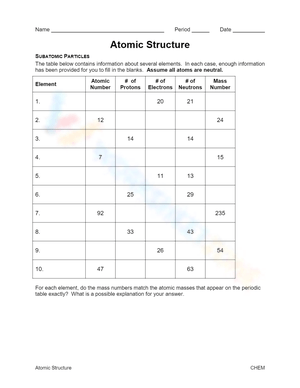
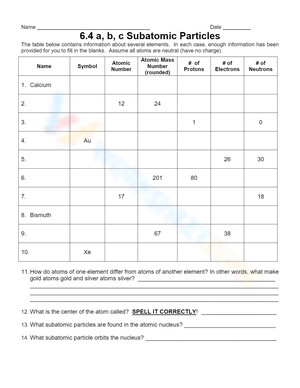
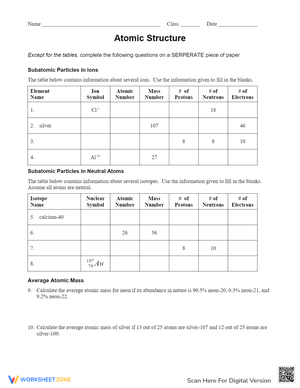
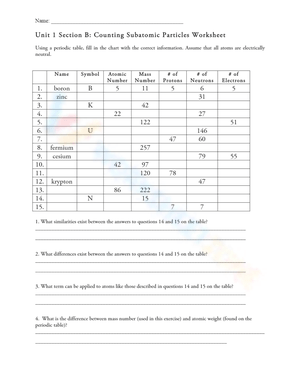
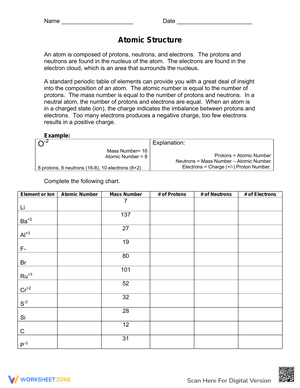
- Complete particle count tables for neutral atoms, filling in protons, electrons, and neutrons.
- Calculate neutron count by subtracting atomic number from mass number.
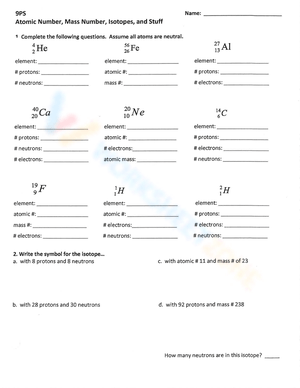
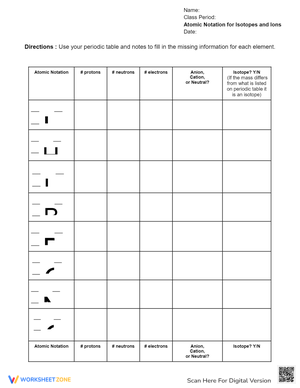
- Identify why two atoms of the same element with different neutron counts are isotopes rather than different elements.
- Explain in writing why a neutral atom carries equal proton and electron counts.
The written explanation items matter more than they look on the surface. Students who fill a table correctly sometimes cannot explain the rule behind their own answer. That gap shows up on unit tests, and these worksheets surface it first.
Student Mistakes That Show Up in Every Stack of Graded Worksheets
The most consistent error in 8th grade atomic structure work is a number-selection problem: students read the wrong value from the element square. A student working on carbon will write 12 as the atomic number instead of 6 and then build every particle count from that wrong starting point. The final answer looks plausible on the surface — the work is organized, the math is correct — but the foundation is off. Asking students to underline the atomic number and circle the mass number in a different color before doing any calculation reduces this error noticeably.
A second error pattern is more structural. Students often know that protons and electrons are equal in a neutral atom, but they apply that rule to the mass number rather than the atomic number. For an element with atomic number 11 and mass number 23, they write 23 electrons instead of 11. That tells the teacher the student has the rule partially but has not connected it to the right number. A completely different wrong answer — writing electrons equal to the neutron count — suggests the student is guessing rather than applying any rule at all. Those two mistakes require different responses, and a well-built worksheet makes them easy to distinguish at a glance.
Fitting These Worksheets Into the Lesson Cycle
8th grade protons neutrons and electrons practice pdf worksheets fit into chemistry instruction at several natural points, and the format holds up across all of them. The first useful slot is the bell ringer: project a single element square and ask students to fill in three particle values before morning meeting wraps up. That reactivates prior knowledge without eating into direct instruction time. The second slot is guided practice, where the teacher models how to read atomic number versus mass number, then releases students to complete a particle table while circulating. The third slot is independent work mid-unit, where a full worksheet gives teachers a clear read on who is ready to move toward ions and who still needs neutral-atom work to settle first.
Small-group reteach is where these resources prove their usefulness most clearly. Pulling four or five students to work through a focused set of neutral-atom problems — skipping neutron calculation entirely until the proton-electron relationship is solid — takes about twelve minutes and produces visible progress. That kind of targeted use is harder to execute with a digital activity that runs all problem types simultaneously.
- Bell ringer: one element square, three particle values, two minutes before instruction begins.
- Guided practice: teacher-led particle table with three or four elements, checking each row together before releasing.
- Independent work: mixed problem types covering diagram labeling, particle tables, and short written explanations.
- Exit ticket: two neutron calculation problems to close the lesson and gauge readiness for the next day's content.
Standard Alignment
These worksheets align with NGSS PS1-1, which asks 8th grade students to develop models that describe the atomic composition of simple molecules and extended structures. The specific skill of identifying proton, neutron, and electron counts is foundational to understanding why different elements behave differently — an idea that runs through chemistry and physical science at the middle school level. In classroom terms, this standard appears most directly in the first two weeks of an atomic structure unit, before students move to electron configuration or chemical bonding. The 8th grade protons neutrons and electrons practice pdf worksheets in this set address the standard directly by requiring students to both model atomic structure visually and calculate particle counts numerically, which reflects the dual emphasis on models and data built into NGSS performance expectations.
Adjusting the Set for a Range of Student Readiness Levels
For students who need additional support, the most effective adjustment is reducing the number of elements in the particle table to three or four and providing a labeled periodic table excerpt rather than a full-page periodic table. Students who freeze when scanning 118 elements often do fine when they can focus on a short reference list. Pairing that reduction with a sentence frame — The atomic number of [element] is ___, so it has ___ protons — gives students a structured entry point without removing the reasoning step entirely.
For students who move through the basic problems quickly, the isotope explanation item provides natural extension. Ask those students to work two or three isotope examples in writing rather than table form, explaining in their own words why element identity stays the same when neutron count changes. That pushes into conceptual territory without requiring separate materials. A small group of students will also be ready to connect these particle counts to the idea of charge, making the transition to ions a natural next step within the same class period. The 8th grade protons neutrons and electrons practice pdf worksheets in this set carry enough range in problem type that extension and support can both happen without pulling out a different resource.
Frequently Asked Questions
How do students calculate neutron count when it is not given directly?
Students subtract the atomic number from the mass number. The mass number represents the combined total of protons and neutrons, so removing the proton count leaves the neutron count. Students who struggle with this often try to read neutrons directly from the element square, which does not list them — the periodic table shows atomic number and average atomic mass, not a fixed neutron count for each element.
Why does changing the number of neutrons not produce a different element?
An element is defined by its proton count alone. Sodium is sodium because it has 11 protons, and that does not change if the neutron count shifts from 12 to 13. Atoms of the same element with different neutron counts are called isotopes. This concept is worth addressing directly because students often assume any change to the nucleus creates a new element — a reasonable but incorrect inference.
Can these worksheets be used in grades other than 8th?
The content fits anywhere atomic structure appears in the curriculum. Some 7th grade science courses introduce subatomic particles, and many high school chemistry teachers use similar particle tables as a unit review. The readability of the problems and the presence of diagram labeling items make each worksheet accessible across a range of grades without modification.
What if students have not yet learned to use the periodic table?
Several problems in the set supply the atomic number and mass number directly rather than asking students to locate them on the periodic table. Teachers working with students who are new to the element square can start with those items and gradually introduce periodic table navigation as students build comfort. That sequence — given values first, then located values — keeps the focus on particle relationships rather than reference-tool use.