These 8th grade prokaryote and eukaryote cells pdf worksheets give science teachers a set of structured comparison tasks built around the distinctions students at this level are actually expected to master. The set covers the membrane-bound nucleus as the central organizing concept, then moves outward to organelles, DNA arrangement, size differences, and organism classification. Teachers get printable resources that work across direct instruction follow-up, small-group reteach, and independent review within the same unit.
The Core Comparisons Each Worksheet Targets
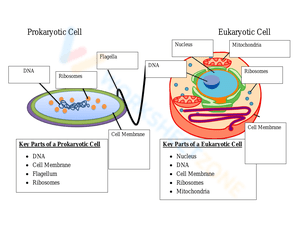
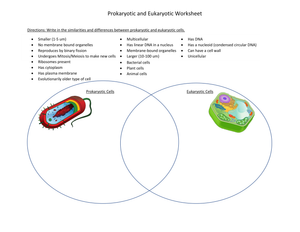
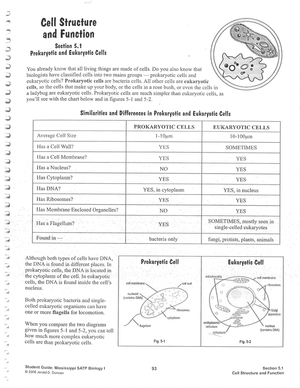
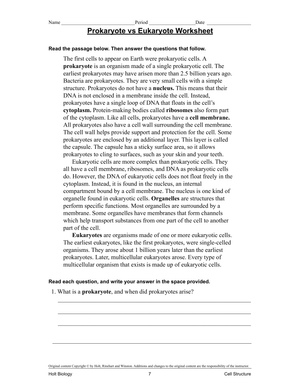
The anchor comparison — prokaryotic cells lack a membrane-bound nucleus, eukaryotic cells have one — is where every worksheet in the set starts, but it is not where they stop. Students also work with shared features. Both cell types carry a cell membrane, cytoplasm, ribosomes, and DNA. If that similarity never appears on the worksheet, students leave the lesson thinking the two categories have nothing in common, and that gap shows up on assessments when they cannot explain why all cells need a membrane.
Across the set, students sort organism examples into the correct category, identify cell features as exclusive to eukaryotes or present in both, and write brief explanations using the vocabulary of cell structure. Bacteria and archaea as prokaryotes, plants and animals and fungi and protists as eukaryotes — those are the organism groupings students need to have solid before the unit moves forward. The 8th grade prokaryote and eukaryote cells pdf worksheets in this collection treat organism classification as a separate checkpoint from feature comparison, which makes it easier to see exactly where a student's understanding breaks down.
The specific features each worksheet addresses include:
- Presence or absence of a membrane-bound nucleus
- Membrane-bound organelles in eukaryotic cells
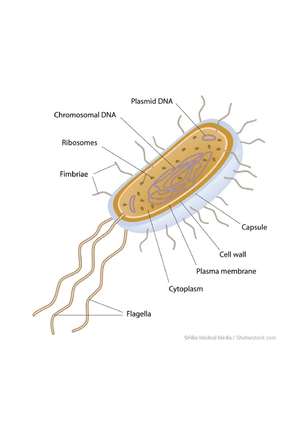
- DNA arrangement — nucleoid region in prokaryotes versus nucleus-enclosed in eukaryotes
- General size difference: prokaryotic cells are substantially smaller
- Organism classification: bacteria and archaea as prokaryotes; plants, animals, fungi, and protists as eukaryotes
- Shared structures: cell membrane, cytoplasm, ribosomes, and DNA
Mistakes Students Make That These Worksheets Surface
The most common error at this grade level is not forgetting the nucleus — students usually remember that part. The slip happens when they overextend the rule. Students who know bacteria are prokaryotes will sometimes place fungi in the same group because "they seem simple." Fungi are eukaryotes, and that misconception is worth addressing directly before it hardens. The sorting tasks in these worksheets catch that error in writing, where it is straightforward to correct before a quiz.
A second error pattern involves the shared structures. Students learn that prokaryotes have no membrane-bound organelles, and they then write that prokaryotes have no DNA or no ribosomes — which is wrong. Both mistakes follow the same flawed logic: if prokaryotes lack the key structures, they must lack all structures. That line of reasoning signals a conceptual gap rather than a vocabulary gap. The student who writes "prokaryotes have no DNA" needs a different correction than the student who writes "prokaryotes have DNA but no nucleus," and the written responses these worksheets produce make that distinction visible before the unit assessment.
Fitting These Worksheets Into Your Cell Unit Sequence
These resources work at multiple points in a cell unit, not just at the end. One worksheet functions well as a Monday opener after students have had their first exposure to cell structure — even five minutes of sorting bacteria versus plant cells by cell type reactivates the nucleus comparison before the week's instruction begins. The full set holds up as independent practice after direct instruction, when students have enough working knowledge to complete a two-column comparison without the teacher modeling each step.
For the 12 to 15 minutes before a period ends — the window where attention drifts — pulling three targeted prompts from one worksheet works as a quick formative check. Ask students to name one feature found only in eukaryotes, one feature shared by both cell types, and one example organism from each category. That narrow slice still produces actionable data on where the class stands. Sub plans also benefit from this format because the directions stay on the worksheet itself, and the task does not require prior knowledge of the teacher's exact phrasing or unit vocabulary.
Standard Alignment
These worksheets address NGSS MS-LS1-1, which asks students to conduct an investigation to provide evidence that living things are made of cells. At the 8th grade level, most state science frameworks translate that standard into direct comparison of prokaryotic and eukaryotic cell structures. The cell type comparison — nucleus present versus absent, organelle complexity, organism classification — is the content that anchors this standard in middle school biology instruction. Teachers assigning these worksheets as formative tasks are collecting observable evidence of that standard before moving into the broader cell function and growth sequence.
Adjusting the Work for Mixed-Readiness Classes
The 8th grade prokaryote and eukaryote cells pdf worksheets in this set work across readiness levels without requiring the teacher to rewrite the science. For students who struggle with open response, the sorting and classification tasks alone — placing organism names into a two-column chart — give them access to the same comparison the whole class is working on. Sentence frames written directly on the worksheet, or added by the teacher in a pre-printed annotation, give those students the language structure they need to write even one sentence about the nucleus difference.
Students who move through the basic tasks quickly benefit from a pushed extension: why does the presence of a nucleus make a cell structurally more complex? That question asks them to connect structure to function in a way that the sorting tasks do not, and it keeps the work substantive rather than mechanical. The content does not change — the depth of response expected does. For a mixed class, that is a cleaner adjustment than running two completely different worksheets at the same time.
Frequently Asked Questions
What is the key structural distinction between the two cell types?
The membrane-bound nucleus is the critical difference. Prokaryotic cells store their DNA in a nucleoid region — an area in the cytoplasm without a surrounding membrane. Eukaryotic cells enclose their DNA inside a membrane-bound nucleus. That one distinction is the checkpoint students at this grade need to own before the rest of the comparison makes sense.
Are bacteria prokaryotic or eukaryotic?
Bacteria are prokaryotic. So are archaea. Both groups lack a membrane-bound nucleus. In 8th grade science, bacteria are almost always the first example students use when sorting organisms by cell type, so these worksheets place bacteria classification early in the task sequence.
Which organelles are exclusive to eukaryotic cells?
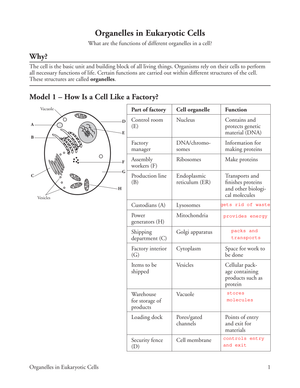
Membrane-bound organelles — including the nucleus, mitochondria, endoplasmic reticulum, and Golgi apparatus — appear only in eukaryotic cells. Prokaryotic cells do have ribosomes, but ribosomes are not membrane-bound, so they appear in both cell types. That distinction trips students up often enough that the 8th grade prokaryote and eukaryote cells pdf worksheets in this collection return to it across more than one task format.
Can these worksheets serve as quiz review materials?
Yes. Each worksheet produces written and classification evidence that a teacher can read quickly before a unit assessment. The combination of organism sorting, feature identification, and short written response gives students one more pass through the content in a format that mirrors what many 8th grade science assessments ask — identify, classify, and explain.