These photosynthesis worksheets for 8th grade give life science teachers print-ready practice that runs from chloroplast structure inside a plant cell through how glucose production positions plants as producers in a food web. The set mixes diagram labeling, equation analysis, vocabulary review, and short written responses — enough variation that one session of practice actually surfaces misconceptions rather than confirming what students can already copy off a slide.
Skills and Concepts Across the Set
Eighth graders arrive at this unit with uneven background knowledge. Some encountered photosynthesis in fifth or sixth grade; others are meeting the equation for the first time. Each worksheet moves from concrete inputs and outputs toward the harder work of explaining why those exchanges matter inside living systems.
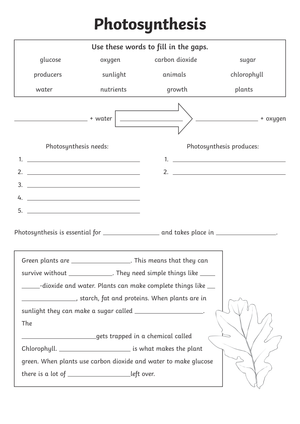
- Diagram labeling: Students mark sunlight, carbon dioxide, water, chloroplasts, glucose, and oxygen on a plant cross-section or leaf cell illustration.
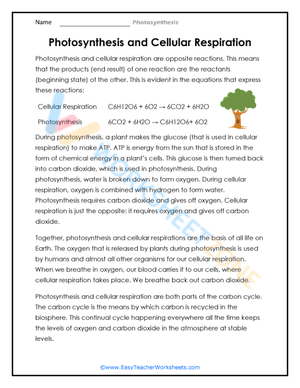
- Equation work: Students read 6CO2 + 6H2O + light → C6H12O6 + 6O2, identify each molecule as a reactant or product, and explain what the process is converting.
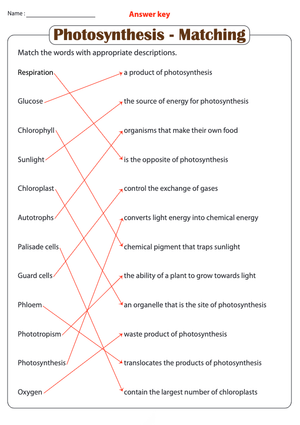
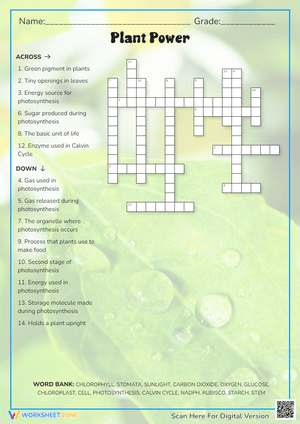
- Vocabulary tasks: Terms like chlorophyll, chloroplast, glucose, reactant, and product appear in matching and fill-in formats that reward precision over guessing.
- Short written responses: Students explain how photosynthesis supports plant growth, where released oxygen goes, and how the process connects a single leaf cell to energy flow across an ecosystem.
- Compare and sort tasks: Students distinguish matter inputs from energy inputs, or match organelles to their specific functions in the photosynthetic process.
The written response items in these photosynthesis worksheets for 8th grade are where the real diagnostic work happens. A student who correctly labels every part of the diagram but writes "plants make food from the sun" on the short answer has not grasped what the equation is actually saying about matter rearranging. That gap shows up in student writing before it ever appears on a multiple-choice test.
How to Sequence These Worksheets Through a Life Science Unit
Where a worksheet lands in a lesson sequence changes what it can do. A diagram labeling task used before direct instruction surfaces prior knowledge — teachers see immediately whether students understand that photosynthesis happens inside chloroplasts or whether they are guessing "in the leaves" without linking the process to a specific organelle. Equation practice fits after modeling, when students have seen the symbols explained and can handle them with some independence. A mixed review worksheet works best at the end of a cells-and-ecosystems sequence, right before a quiz or summative assessment.
A few practical slots where these consistently deliver: the first eight minutes of class as bell work with three to five equation or vocabulary items; homework with a focused diagram and two short-answer questions students can complete without support; and sub plans where the task needs no digital tools and no teacher explanation at the start. For exit tickets, pull two questions from a longer worksheet to check end-of-class understanding without adding grading burden. If you use the answer key, have students revise wrong answers in a second color — that single move turns a completion task into a formative check.
Common Student Errors That These Worksheets Help You Catch
The most persistent error in 8th grade photosynthesis work is not vocabulary confusion — it is that students treat the equation as a sequence to memorize rather than a statement about matter rearranging. They can write 6CO2 + 6H2O + light → C6H12O6 + 6O2 from memory and still be unable to say where the carbon atoms in glucose came from. Ask them, and most write "from the plant" rather than "from carbon dioxide absorbed from the air." That is a conservation-of-matter gap, and it is exactly what shows up on state assessment constructed-response items.
Two other errors appear reliably. Students confuse chlorophyll and chloroplast — they know both words but swap their roles, writing that chlorophyll is where photosynthesis occurs rather than naming it as the pigment that captures light energy inside the chloroplast. And when asked to connect photosynthesis to a food web, students answer at the wrong scale: they describe a plant growing taller rather than explaining that glucose is the energy source animals and decomposers depend on indirectly. Short written responses make both errors visible in a way that matching items never will.
Standard Alignment
These worksheets align to NGSS MS-LS1-6, which asks students to construct a scientific explanation based on evidence for the role of photosynthesis in the cycling of matter and flow of energy into and out of organisms. The standard sits in the MS-LS1 "From Molecules to Organisms" unit but connects directly to MS-LS2 (Ecosystems), because photosynthesis is the entry point for energy into most food webs. In classroom terms, that means students need to do more than recall the equation — they need to trace carbon dioxide uptake and oxygen release into system-level processes. The short written response items in the set address that connection explicitly, pushing students to move between the scale of a leaf cell and the scale of a food web in the same task.
Adjusting the Set for a Range of Learners
The most direct adjustment is matching the response expectation to the learner without changing the core content. Students who are still building confidence with the vocabulary benefit from sentence frames paired with a diagram task: "Photosynthesis takes place in the ______, which contains the pigment ______ that absorbs light energy." Students who already control the vocabulary work from the same diagram but write a free-response explanation connecting chloroplast function to why plants are classified as producers. The content stays aligned; the cognitive demand shifts.
For students who struggle specifically with the equation, separating inputs and outputs into two distinct steps before combining them into the full expression works better than starting with the complete notation. For advanced learners, a follow-up question asking why the coefficients in front of each molecule matter for conservation of mass gives them something genuinely harder to think through. The photosynthesis worksheets for 8th grade in this collection handle that range without requiring teachers to print entirely separate materials for each group.
Frequently Asked Questions
What 8th grade concepts does this set actually cover?
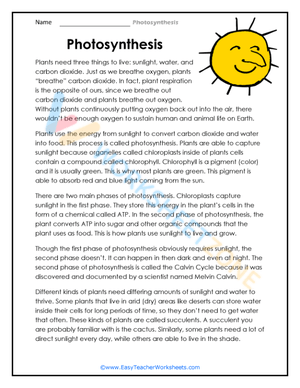
Each worksheet targets one or more of the core ideas in 8th grade life science: the reactants and products of photosynthesis, the role of chloroplasts and chlorophyll, the equation with its coefficients, and the connection between plant glucose production and ecosystem energy flow. Some tasks stay at the cell level; others push students to explain why photosynthesis matters at the scale of a food web or the atmosphere.
Can these be used for reteach or review rather than initial instruction?
Yes. Teachers who pull photosynthesis worksheets for 8th grade for review rather than first exposure often start with the short written response items to see where understanding has held and where it has not, then assign the diagram or vocabulary tasks to address specific gaps. The mixed-format worksheets work particularly well in small reteach groups where the goal is catching errors, not introducing new content.
How long does each worksheet take to complete?
A focused diagram-plus-equation worksheet typically runs 15 to 20 minutes. A mixed worksheet with vocabulary, a diagram, and two to three short-answer items takes closer to 25 to 30 minutes depending on how much students write. Bell-work or exit-ticket use — pulling two or three items from a longer worksheet — takes about five to eight minutes.
Do these worksheets address ecosystems, or only plant cell structures?
Both. The set moves between scales. Some tasks concentrate on the chloroplast and the equation itself; others ask students to trace how glucose production supports food webs or explain why oxygen release matters to other organisms. That movement between cell-level and system-level thinking reflects what NGSS MS-LS1-6 and MS-LS2 actually require at this grade.