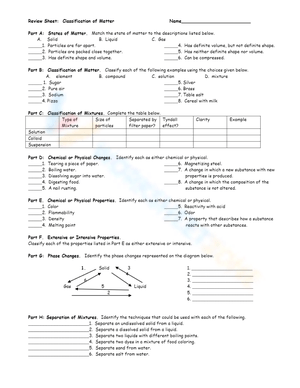
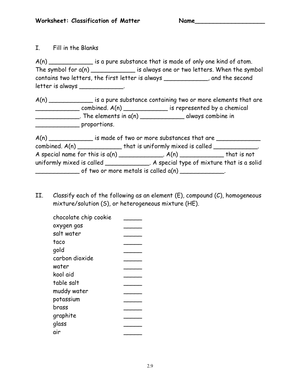
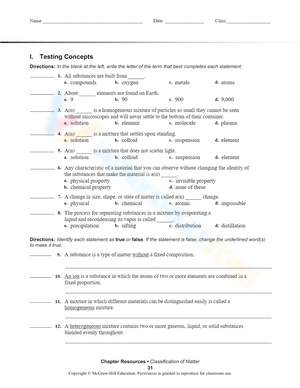
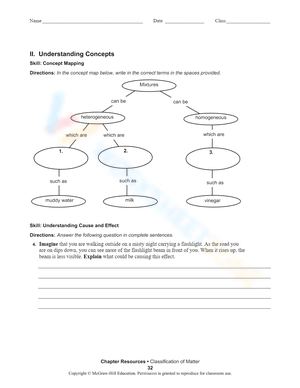
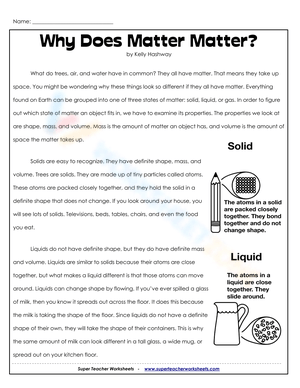
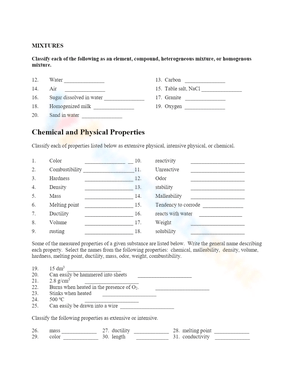
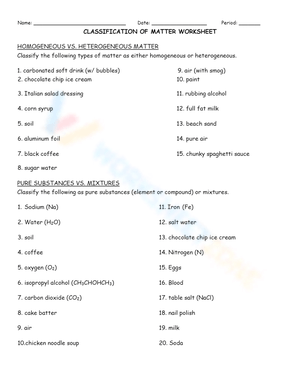
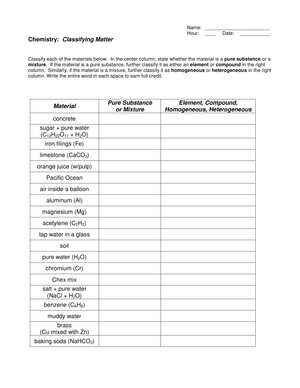
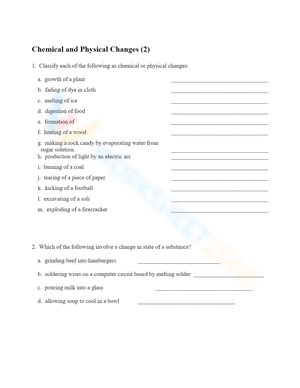
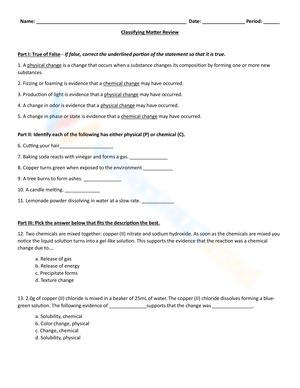
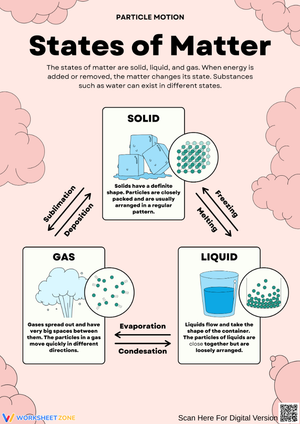
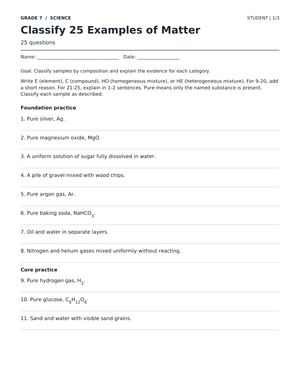
These 8th grade classifying matter worksheets resources give science teachers printable practice that builds precise category reasoning — not recognition alone, but the kind of composition-based thinking that holds up during labs and assessments. The set targets the core distinctions in introductory chemistry: pure substances versus mixtures, and elements versus compounds within the pure-substance branch.
The Core Distinctions These Worksheets Target
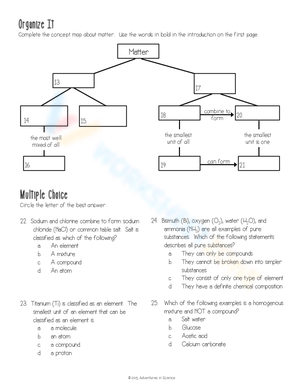
The classification hierarchy in 8th grade chemistry has a specific shape. Students start by identifying whether a sample qualifies as matter, then decide whether it belongs to the pure-substance or mixture branch. Within pure substances, they sort further into elements and compounds. Some worksheets in the set extend to homogeneous and heterogeneous mixture language when the lesson sequence calls for it.
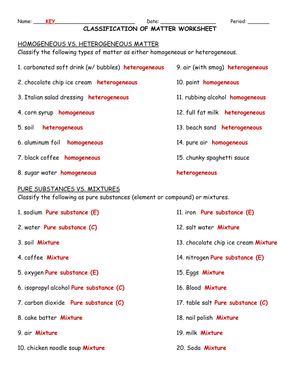
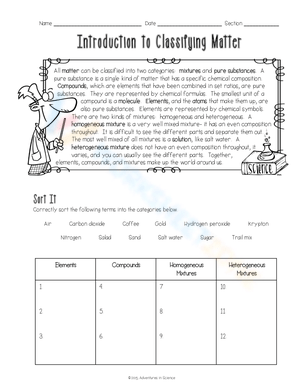
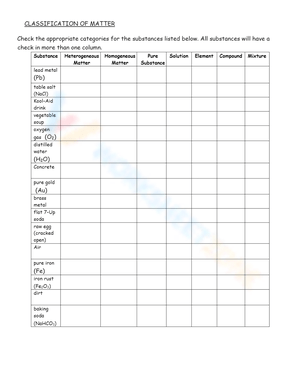
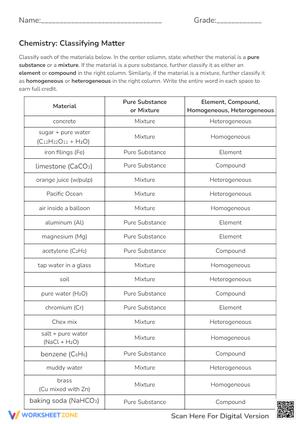
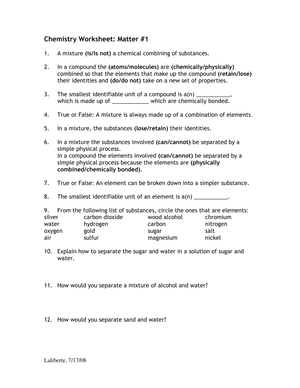
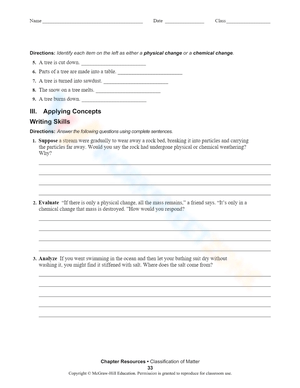
The tasks move from labeling to justifying. Students sort common materials — salt water, oxygen gas, trail mix, carbon dioxide, iron filings — into the correct categories, then write short statements explaining their reasoning. That combination matters because a multiple-choice answer tells a teacher what a student chose; a sentence reveals whether they are reasoning from composition or guessing from appearance.
- Identify pure substances and mixtures from written descriptions and real-world examples
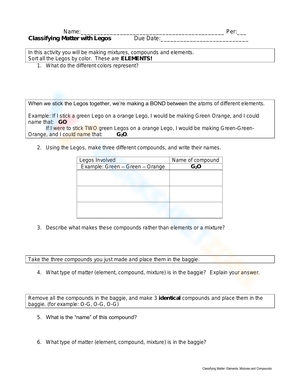
- Distinguish elements from compounds using atomic composition language
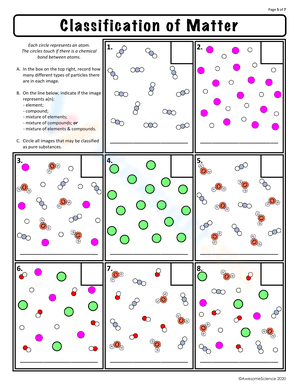
- Interpret particle diagrams to determine whether a sample contains one particle type, bonded unlike atoms, or a physical mix of multiple particle types
- Write brief evidence-based justifications tied to composition rather than visual appearance
Student Errors Worth Anticipating Before the Lab
Three misconception patterns show up reliably in this unit. The first: students assume any sample containing more than one atom type is a mixture. Carbon dioxide — two oxygen atoms bonded to a single carbon atom in every molecule — frequently gets labeled a mixture rather than a compound. The bonding is invisible to students who are reasoning from atom count rather than structural relationship.
The second pattern is nearly the opposite: students treat uniform-looking samples as elements. Salt water earns the label element in early assessments because it is clear, consistent, and familiar. These students are categorizing by visual texture rather than composition. The third error is confusing "pure" with "single-element." Water gets labeled an element by students who associate simple and natural with elemental. They are importing everyday meaning into a technical term, and the mismatch stays hidden until they meet a particle diagram or a direct comparison task.
These worksheets surface all three errors because the tasks require students to commit to reasoning, not just an answer. An item showing a diagram of identical bonded pairs alongside a one-sentence justification prompt catches the atom-count misconception more efficiently than a traditional test question.
Particle Diagrams as Classification Evidence
Particle-model items shift the task from vocabulary recall to visual reasoning. A student who cannot recall the definition of "compound" may correctly read a diagram showing repeated pairs of two unlike bonded atoms and identify it as distinct from a mixture — and reading structure from a model is closer to actual chemical thinking than memorizing terms.
The most effective format places two nearly identical diagrams side by side: one showing repeating bonded pairs of unlike atoms, the other showing those same atom types floating freely in the same space without bonding. Students who see only one diagram often guess correctly. Students who must compare both and explain the structural difference are forced to articulate what bonding actually means. That comparison task reveals depth of understanding more clearly than any matching exercise, because it removes the option of answer-matching by elimination.
This work connects directly to NGSS performance expectation MS-PS1-4, which asks middle school students to develop models describing the atomic composition of simple molecules and extended structures. Particle-diagram classification is that reasoning — not abstract prep for a standard, but the practice the standard itself describes.
Building These Worksheets Into Your Chemistry Sequence
The 8th grade classifying matter worksheets format keeps classroom setup to a minimum, which matters during a packed unit. Teachers use these resources in at least four positions: as a vocabulary warm-up the day after initial instruction, as a station activity during lab-prep days, as targeted homework before a quiz, and as a fast reteaching tool when assessment data reveals category confusion.
The station structure is worth planning deliberately. One group works through written-description sorting items using real-world examples. A second group handles particle-diagram tasks independently. A third works with the teacher on explanation sentences — the point where reasoning becomes visible and correctable. That rotation means the set carries a full station block without additional materials.
Before a mixture-separation lab, a short classification worksheet reactivates the language students will need during the activity. Students who cannot reliably separate element, compound, and mixture going into a lab tend to produce muddled observation notes — the categories they use to describe what they see are still blurry. That confusion compounds when they try to interpret separation results or connect observations to chemical properties later in the unit.
Standard Alignment
MS-PS1-4 is the primary NGSS expectation addressed here. It requires middle school students to develop models to describe the atomic composition of simple molecules and extended structures. In classroom terms, that means students need repeated practice interpreting particle-level representations, not just reading written definitions. The particle-diagram items in these worksheets directly support that expectation.
MS-PS1-1 is also relevant. It asks students to use the periodic table to predict properties of elements and simple compounds. Classification work lays the conceptual ground for that standard by establishing what an element and compound are before students begin working with the table itself. Sequencing these worksheets early in a matter unit positions classification as a foundation for later chemical reasoning rather than a vocabulary exercise to move past quickly.
Adjusting the Set for a Range of Learners
For students still building confidence with chemistry vocabulary, starting with written-description sorting items gives them access before they reach particle-model tasks. A simple reference card — one diagram per category showing element, compound, homogeneous mixture, and heterogeneous mixture — reduces memory load while keeping the reasoning task intact. That support can be removed once a student demonstrates consistent category accuracy across several items.
For students working beyond grade level, the most productive adjustment is not more items but more demanding justifications. Ask them to write explanations that include a counter-argument: "This is a compound, not a mixture, because the particles are bonded in fixed ratios — a mixture would show particles that could be physically separated without breaking chemical bonds." That framing pushes category knowledge into formal scientific argument, which is a meaningfully different cognitive task than labeling alone.
Mixed-ability classrooms can use the same 8th grade classifying matter worksheets set across groups by varying the follow-up task rather than the classification items. Students working toward grade level confirm answers using a reference card; students at grade level write single-sentence justifications; students working above grade level add the counter-argument framing. Shared classification items make whole-class discussion possible across all three groups without requiring separate materials.
Frequently Asked Questions
What is the difference between a compound and a mixture at the 8th grade level?
A compound is a pure substance in which different elements are chemically bonded in a fixed ratio — water is always two hydrogen atoms bonded to one oxygen atom. A mixture contains two or more substances together without that fixed bonding, so the components can vary in proportion and can often be physically separated. That distinction is where 8th grade classification instruction spends the most time, because it is also where the deepest misconceptions sit.
Should these worksheets come before or after introducing particle diagrams in class?
Introduce particle diagrams in direct instruction first, then use worksheet practice to consolidate the interpretation skill. Assigning a particle-model task before students have encountered that representation in class tends to produce confusion rather than productive struggle — the format is unfamiliar enough to become an obstacle rather than a reasoning tool.
Do these sets include answer keys?
Most 8th grade classifying matter worksheets sets include answer keys, and those that do are significantly more versatile — usable for stations, sub plans, homework, and self-checking without requiring teacher grading for every item. When reviewing a set, look for answer keys that include brief explanations alongside correct labels so students can check their reasoning rather than just the final answer.
How many worksheets does a teacher typically need to cover this topic?
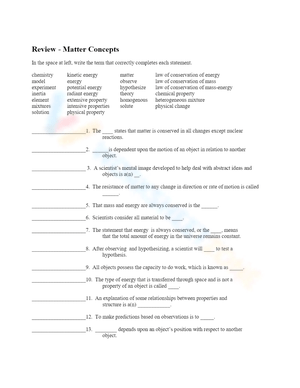
Three to five worksheets cover the full task range well: vocabulary and definition practice, written-description sorting, particle-diagram classification, mixed practice with short justifications, and a quick review item set for assessment preparation. That count provides enough variety to address classification from multiple angles without repeating the same format across every lesson.