These periodic table printable worksheets for 8th grade give teachers a set of standalone resources that move students from basic element identification toward reading the table as an organized model of matter. Each worksheet targets the vocabulary and concepts that anchor a middle school chemistry unit — names, symbols, atomic numbers, groups, and periods — and the set spans enough scope to cover everything from the first class on elements through final review before a unit assessment.
Mistakes Students Make That These Worksheets Help You Catch
The most persistent confusion at this level is the orientation of groups and periods. Students who can correctly tell you that sodium has an atomic number of 11 will still write "period 1" instead of "period 3" when asked to locate it on the table. They've memorized facts in isolation without connecting those facts to the table's geometry. A worksheet that asks students to shade a vertical column or a horizontal row — rather than simply write a number — exposes this gap immediately, faster than a quiz does.
Symbol capitalization produces a second wave of errors. The rule is simple: one uppercase letter, or an uppercase followed by exactly one lowercase. But students copying from memory write "CL" for chlorine instead of "Cl," or "FE" for iron instead of "Fe," which signals they're reproducing a letter string without registering that case carries meaning. Prompts that ask students to write a symbol and then verify it against a reference table build that habit more reliably than correction alone. A third sticking point: students see two numbers inside an element cell and pick atomic mass when the prompt asks for atomic number. In early practice, that happens roughly a third of the time — especially when the two numbers are close in value and the cell is printed small.
What's Inside the Set
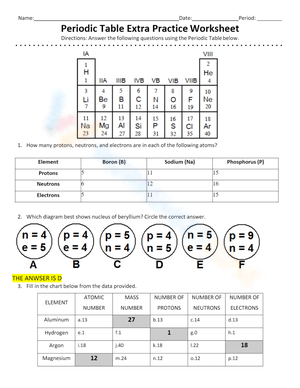
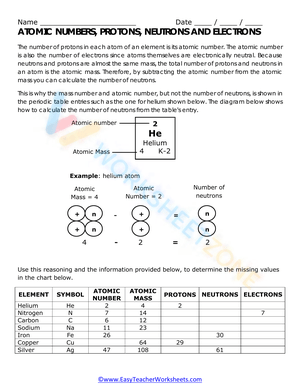
The worksheets concentrate on a clearly sequenced range of skills. Students begin by locating elements, matching symbols to names, and reading atomic numbers directly from the table. From there, tasks shift toward structure: identifying whether an element belongs to a group or a period, tracing which direction each one runs, and eventually recognizing that atomic number increases left to right across every row. That last step — reading the table as a system rather than scanning it for a single answer — is where 8th graders make the move from memorization to actual scientific reasoning.
- Match element names to their chemical symbols
- Use atomic numbers to locate specific elements
- Identify groups as vertical columns and periods as horizontal rows
- Work through the first 20 elements as a manageable reference set
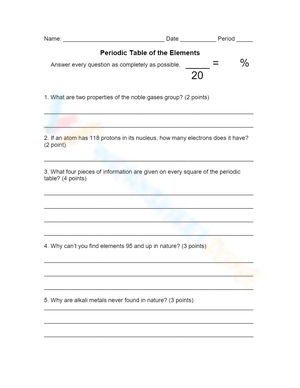
- Answer short interpretation prompts about what an element's position tells you
- Extend practice to the full table once foundational skills are in place
The first 20 elements — hydrogen through calcium — receive particular attention across the set. That range includes the most commonly referenced symbols, sits within a span students can realistically practice and recall, and gives teachers a concrete checkpoint before pushing into the wider table. Once students move through those 20 elements with confidence, the same worksheet format extends naturally into broader table questions without requiring a completely different resource.
Working These Worksheets Into Your Weekly Lesson Plans
In a standard 8th grade block, these worksheets fit well into the five to eight minutes at the start of class before direct instruction begins. Students pick up a worksheet, work independently, and class opens with a quick check rather than a slow organizational stretch. That routine works especially well in the first two weeks of a chemistry unit, when students need repeated low-stakes contact with element vocabulary before they can use it fluently in discussion or lab work.
Station rotations are another strong fit. One group labels a reference table, a second works through a matching task on groups and periods, and a third answers two short interpretation questions while the teacher pulls a small group for reteaching. The periodic table printable worksheets for 8th grade are structured to stand alone at a station without teacher narration — students read the prompt, reference the table, and check against a posted answer key. During the days before a unit test, spreading two or three short worksheets across Monday through Thursday gives students spaced retrieval practice, which produces more durable retention than a single review session the night before.
Standard Alignment
The primary reference for this content is MS-PS1-1 from the Next Generation Science Standards — Matter and Its Interactions. That standard places middle school students in the role of analyzing and interpreting data about substances. The periodic table is the scientific model they're expected to use as a source of evidence, not memorize as a wall poster. A worksheet that asks students to explain what group 18 tells them about noble gas reactivity pushes directly toward that standard's expectation. A worksheet that only asks students to copy element names does not. The set includes both foundational recall tasks and short interpretive prompts, so teachers can work through the full progression — from initial exposure through standards-level analysis — using the same resources.
Adjusting the Worksheets for a Range of Learners
The content itself has a natural difficulty gradient built in: names and symbols are more accessible than group and period identification, which is more accessible than reading cross-table patterns. What makes periodic table printable worksheets for 8th grade easy to differentiate is that teachers can assign tasks at different points along that gradient from the same set — the prompt changes, but the resource looks the same to students.
Students who freeze when they encounter an unfamiliar element cell benefit from partially completed formats — a table where names are already filled in and students supply only the symbols and atomic numbers. That removes one layer of demand while keeping the core task intact. Students ready for more work through multi-step prompts: "Element X has an atomic number of 17 and sits in period 3 — what group does it belong to, and how do you know?" That kind of question is well within reach for on-level 8th graders who've had enough table practice, and it previews the pattern-based reasoning that appears in high school chemistry.
Frequently Asked Questions
What prior knowledge do students need before starting these worksheets?
Students should understand what an element is and have seen the periodic table at least once, even briefly. They don't need any symbols memorized — several worksheets in the set build that familiarity from scratch. What helps most is that students arrive knowing the table is organized rather than random, so they approach tasks by looking for structure instead of scanning for familiar words.
How do these fit into sub plans or independent work days?
These worksheets are well-suited for days when a substitute is covering the class. Students label, match, sort, and answer short questions from the table — none of which require lab equipment, teacher modeling, or a lengthy explanation. The directions on each worksheet are written clearly enough that a sub can distribute the work and keep students on task. For the same reasons, they function as take-home review without generating parent confusion about expectations.
Can these worksheets serve as formative assessment?
These periodic table printable worksheets for 8th grade are among the most practical resources for quick formative checks. A five-to-eight item worksheet that isolates a single target — period identification, symbol writing, or atomic number location — gives teachers a fast read on class understanding without scoring a full test. The written student work sorts easily into "ready to move on" and "needs another pass," which is enough information to plan the next day's instruction.
Do these work for 7th graders or as review for students entering high school?
The skill sequence in the set — first 20 elements, then table structure, then pattern reading — maps to a 7th grade introduction as naturally as it does to 8th grade mastery. A 9th grade teacher reviewing the periodic table before a chemistry unit can pull from the same resources; the prompts don't reference a specific grade level. The tasks stand on their own as element-identification and table-reading practice regardless of where they fall in a student's science sequence.