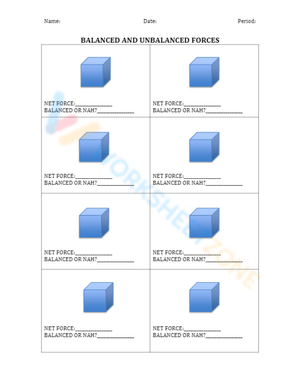
These 8th grade balanced and unbalanced forces printable worksheets give teachers a ready format for the part of physical science where reasoning has to do work that memorization can't. Students are not just learning vocabulary — they are building a mental model that connects what forces do to what happens next in a system. The set covers net force, direction, and motion outcomes, which puts it squarely in the middle of most physical science pacing guides.
What Students Actually Practice Across the Set
Each worksheet moves students through a consistent reasoning chain: identify the forces acting on an object, note their directions, determine net force, and state what happens to the object's motion. That sequence matters because it teaches students to treat force as directional, not just numerical. The worksheets include:
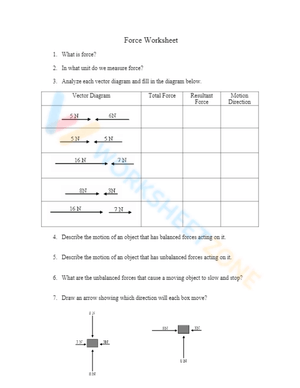
- Reading force arrows in diagrams and deciding whether forces cancel or combine
- Calculating net force in opposite-direction and same-direction scenarios
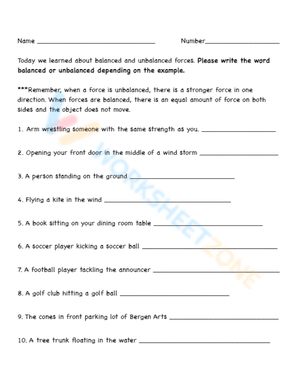
- Identifying why two equal forces pointing in opposite directions produce a net force of 0 N
- Predicting motion outcomes — whether an object stays at rest, keeps moving, speeds up, slows down, or turns
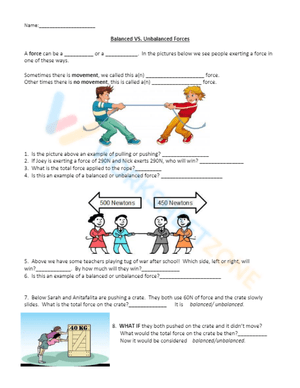
- Connecting force diagrams to real-world situations like pushing a box across a floor or an uneven tug-of-war
The task structure on each worksheet separates the prediction step from the calculation step. Students first determine whether forces are balanced or unbalanced, then calculate net force, then state the motion outcome in a third response area. That separation makes it much easier to see exactly where a student's reasoning breaks down — and reteaching becomes far more targeted as a result.
Frequent Student Errors Worth Catching Before Assessment
The most persistent error in this unit is confusing "balanced" with "not moving." A student who sees a force diagram of a hockey puck sliding at constant speed will often insist the forces must be unbalanced because the puck is in motion. The concept that an object moving at constant velocity has zero net force takes real repetition to settle, and these worksheets build in enough examples for that pattern to surface and get corrected before test day.
A second common problem is arithmetic that ignores direction. A student who sees a 10 N rightward force and a 6 N leftward force may write 16 N as the net force, adding the values because both read as positive numbers on the diagram. When each worksheet requires students to commit to a direction before doing any arithmetic, that error gets exposed at the right moment rather than compounding into the next unit. The third pattern to watch: students can label a diagram "unbalanced" correctly but still cannot say whether the object speeds up, slows down, or changes direction. When the worksheet isolates that final step as its own written response, students are forced to take it explicitly rather than leaving it implied.
Building These Worksheets Into Your Weekly Lesson Plans
These resources fit several points in the lesson cycle without any modification. At the start of class, two or three force diagrams make an effective bell ringer that revisits the previous day's reasoning. During whole-group instruction, teachers can project one problem, model the decision process aloud, and then release the remainder of each worksheet for partner or independent practice. That gradual-release structure works especially well on the first and second day of the unit, when students need to see the reasoning modeled before they replicate it on their own.
The printable format also suits small-group reteaching. If a group consistently misapplies direction when finding net force, the teacher can pull one worksheet, work through the first two problems together, and hand off the rest as guided practice within the small group. These resources also work well as:
- exit tickets — two or three problems at the end of class check whether students can apply net force reasoning independently
- homework after a modeled lesson, so students practice the same process at home rather than a new format
- sub plans that stand on their own without verbal setup
- intervention material for students who need repetition before moving to Newton's laws
- pre-assessment review before a unit test on motion and forces
One practical note: printing each worksheet back-to-back with an answer key makes return-and-correct sessions faster during the last ten minutes of class, when time is short and self-correction still carries instructional value.
Standard Alignment
These worksheets address NGSS MS-PS2-2, which asks students to plan an investigation showing that changes in an object's motion depend on the sum of the forces on it and its mass. In practice, that standard requires students to work from evidence — diagrams, measurements, observations — toward a conclusion about motion. Each worksheet creates that reasoning arc in a structured practice context, which is exactly the kind of repeated exposure students need before applying the standard in a lab or performance task. Teachers in states using NGSS can point to these worksheets as formative support for the same reasoning skill the standard assesses at summative.
Adjusting the Worksheets for a Spread of Learners
Middle school science classes rarely have uniform readiness, and the visual format of these worksheets helps teachers respond to that range without writing entirely different tasks. Students who need more support can focus on the identification step alone — balanced or unbalanced — using the arrows as a direct visual cue. Students working at grade level move through all three steps: classification, net force calculation, and motion prediction. Students who are ready for extension can write brief explanations connecting net force to acceleration, or restate the scenario in Newton's second law terms.
For students who still need a concrete anchor before reasoning through diagrams, pairing each worksheet with a brief physical demonstration — two students pulling a rope, or a book resting on a desk while someone pushes horizontally — helps make the abstract arrow language meaningful. That extra step costs about two minutes of class time and significantly reduces the number of students who reach the worksheet with no working mental model. The 8th grade balanced and unbalanced forces printable worksheets set supports this kind of tiered approach because the core task stays stable while the expected depth of response can shift from student to student.
Frequently Asked Questions
What is the difference between balanced and unbalanced forces?
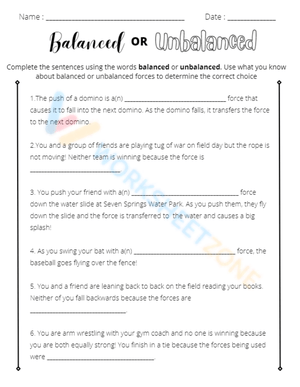
Balanced forces have a net force of 0 N, so the object's motion does not change — it stays at rest or keeps moving at the same speed in the same direction. Unbalanced forces produce a nonzero net force, which causes the object to accelerate: start moving, stop, speed up, slow down, or change direction. Students in grade 8 practice this distinction by comparing the magnitude and direction of forces shown in diagrams, which is also what NGSS MS-PS2-2 expects them to do in an investigation context.
How should students calculate net force on a worksheet?
Students identify each force acting on the object, note the direction of each force, then combine or subtract the values. Forces pointing in the same direction add together. Forces pointing in opposite directions subtract — the net force equals the difference, and its direction matches whichever force is larger. When opposite forces are exactly equal, net force is 0 N and the forces are balanced. Students who skip the direction step and simply add all values will consistently get wrong answers on unbalanced problems, which is one of the more diagnostic errors to watch for in returned work.
Can these worksheets be used for homework or review, not just classwork?
Yes. Because each worksheet presents a self-contained set of force diagrams with clear tasks, students can work through them independently at home after a modeled lesson. Teachers also use them in review sessions before unit tests, especially when the goal is to check whether students can move fluently between reading a force diagram and predicting the resulting motion. The 8th grade balanced and unbalanced forces printable worksheets format requires no setup beyond printing, which makes it easy to repurpose across multiple instructional situations without rewriting anything.
What should correct student responses look like?
Strong answers show process, not just a final label. Students should state net force with a number and direction when forces are unbalanced, recognize that equal opposite forces mean no change in motion, and explain the motion outcome causally — because there is a nonzero net force, the object accelerates. Students who only label a diagram without connecting the result to motion are showing partial understanding, which is useful diagnostic information. These 8th grade balanced and unbalanced forces printable worksheets help teachers surface that gap early enough in the unit to address it before summative assessment.